

Buy This Book Buy This Series



“Daughters, I would rather be a poor man with honest friends than a rich man with none,” Paps. –Seeds of Hope
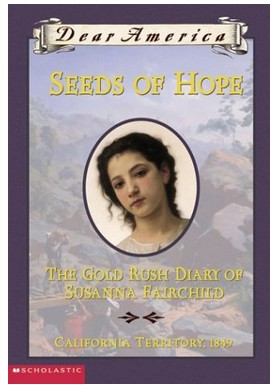
Seeds of Hope: The Gold Rush Diary of Susanna Fairchild
by Kristiana Gregory
AR Test
8+
Score
5.5
182
Seeds of Hope presents a diary account of fourteen-year-old Susanna Fairchild’s life in 1849. After losing his wife and money during their steamship journey from New York, Susanna’s father succumbs to gold fever and abandons his plan to establish a medical practice in Oregon. Instead, he takes his two daughters to a mining camp, where they face danger from untrustworthy men and wild animals.
Susanna and her sister Clara are devastated by their father’s decision, but after losing their mother, they want to stay close to him. The sisters are often left alone as their father searches for a more productive claim. Though afraid, they spend their time transforming their cabin into a home. Susanna’s diary chronicles both her fears and her grief over her mother’s death.
Despite difficult circumstances, the Fairchilds find friendship within the camp. The girls occasionally visit Rosita and her family, who are from Peru. This friendship allows the book to illuminate the era’s discrimination. When people from other countries began arriving in California, Americans complained “that the foreigners are taking up space and if allowed to step on Californian soil, they will be trespassing. Since the gold belongs to the United States, they will be thieves, plundering what is not theirs.” Greed drove some miners to steal from, beat, and sometimes kill minorities. These harsh realities may be upsetting to some readers.
Few women lived in California during the Gold Rush, which gives Seeds of Hope a unique perspective and highlights the daily dangers they faced. Death from accidents, gunfights, and murder occurred frequently. Despite this violence, Susanna and Clara show kindness to others. When a family friend steals from the Fairchilds, this saddens them, but it also demonstrates that “true character often isn’t revealed until a person is faced with temptation.”
Seeds of Hope reveals the bleak reality for many individuals who hoped to improve their circumstances through sudden wealth. This creates a depressing tone, especially as Susanna’s father becomes increasingly obsessed with gold and neglects his daughters. Despite the dangers, he leaves the girls alone for long stretches while he searches for gold. Eventually, he realizes that wealth cannot bring happiness. He abandons mining, returns to practicing medicine, and decides to move to Oregon as originally planned.
Although Seeds of Hope features fictional characters, it depicts significant events in American history and helps readers imagine the daily lives of young girls during the Gold Rush. While Susanna is a likable protagonist, she frequently writes about mundane tasks such as food preparation, laundry, and household chores. Even though Seeds of Hope is not full of action and adventure, Susanna’s diary allows readers to peek into the past and see how gold fever affected one family. True to history, the story highlights the difficulty and sometimes deadly nature of searching for gold. The story’s slow pacing and depressing atmosphere make Seeds of Hope best suited for readers already interested in the Gold Rush. Despite these limitations, the book conveys a meaningful message: when given a choice, always prioritize family and friendship over money. Readers seeking more information about this era should consult the non-fiction book Sutter’s Mill and the California Gold Rush.
Sexual Content
- One of the minor characters is a lady who works at a dance hall. “Her dress was satin, her cheeks and lips were painted red. Papa wouldn’t look at her, and he told us to never go near that place.”
- Clara stops wearing a corset because “she didn’t like so many men staring at her womanly figure.”
- While on a ship, Susanna tripped and “fell against Sam. But before I could gather myself, he enfolded me in his arms and bent down to kiss me. . . I burst out laughing. I don’t know why.” Later, Sam and Susanna get married.
Violence
- While sailing to California, Susanna’s mother died when “a wave broke over the bow, sending such a flood of water on deck that we were all swept off our feet. . . She threw up her arms in surprise, and passed us swiftly in green water. . . she was swept away.”
- Clara mentions several gunfights but doesn’t describe them all.
- Boys were kicking a baby donkey. When Susanna and Clara see them, Susanna picks up “some stones and threw them at the boys’ feet, not to hurt, but to let them know we meant business. Clara peeled a thin branch from a tree and began whipping their legs.” The boys ran away.
- Susanna mentions that “three men were killed last week when the mine they were digging caved in on top of them.”
- In a mine, there was an explosion. “Three boys were killed right away, but Sam was rescued from underneath some rocks.” Sam’s leg and ribs are broken. “Because the broken bone is exposed to the air, Sam is in so much pain he keeps slipping in and out of consciousness.”
- Sam’s leg has to be amputated. “Clara and I prayed with the boy and gave him a good swig of laudanum.” Susanna, Clara, and another man hold Sam down. Later, “Papa’s clean shirt was spattered with blood. So were the bed and floor. . . The friend dug a hole beyond the cabin to bury the damaged leg.” Sam recovers.
- Foreigners were often beaten and robbed. “Chinese especially.” Rosita, one of Susanna’s friends who is from Peru, had all of her cooking things stolen. Rosita describes how two Chinese men were robbed and a “Yankee cut their hair off. To shame those poor boys.”
- Susanna’s father is a doctor. In the past, he “cut off a man’s broken foot that had turned black with gangrene.”
- There are several murders in the gold camps. A storekeeper says, “A young blacksmith had been murdered last night behind one of the saloons.” Later, a dance-hall lady finds the body of a man who “was shot. He bled all over the stairs.”
- There is a shoot-out at a Saloon that “landed four men in the hoosegow and four full of bullet holes. Their bodies were displayed on Main Street. . . Their faces were purple and bloated. Flies swarmed over the wounds.”
- Susanna and her sister are in the river when a man floats by them. “He was on his back with dead staring eyes.” He has a knife in his chest.
- Men ran off “foreigners” who were panning for gold. “When some of them put up a fight, vigilantes found a tree and hanged five of them! Then they jumped their claims and stole their gold.”
- A bear attacks two sleeping men. One dies. “The other lost his right ear and right eye and most of his scalp. Papa was able to stitch up his cheek where the bear had clawed him.” The dead man’s “face was completely gone and one shoulder had been eaten.”
- Two kids are playing with a gun when they “accidentally shot off three fingers of [a miner’s] left hand.”
- After a palm reader’s prediction, a young man is hanged for murder, even though there was no proof. Afterwards, the dance hall lady is so upset that she confesses, saying, “I am guilty of one death, not three. He was a thief, a man without integrity.” She apologizes for not admitting the deed earlier. “Suddenly, the thick rope was put around her neck, like a brown collar that came up to her chin. . . [Papa said] the woman died instantly.”
- After the dance hall lady dies, Papa explains how he had to treat cuts on her hands. “Someone had stolen her money, then tried to stab her. When she held up her hands to stop the blows, the knife made deep wounds.”
Drugs and Alcohol
- Susanna’s father smokes a pipe.
- When Sam is injured, his friends give him whiskey for the pain. He is also given laudanum, which is “opium mixed with alcohol.”
- The town is setting up a fight between a bear and a bull. Susanna and Clara cannot watch because Papa “did not want us to be around men guzzling whiskey or eating the spoils of a bear fight.”
Language
- “My god” is used as an exclamation twice.
- The Peruvians working on a ship are often referred to as “Tar Heads.”
- Someone says a murderer is a “no-good Mexican.”
Supernatural
- When three murders take place, “the palm reader studied tea leaves to help the vigilantes catch the killer of those men. She said he would be a foreigner who lives alone.”
Spiritual Content
- Susanna and her sister pray before they go to sleep.
- When someone needs medical help, Susanna and her sister go to find their father. “We are praying that God will guide us to him.”
- When Susanna and Clara find gold, they do not file a claim, and others take it. “Papa said that some injustices we must leave up to God to make right.”
- After a friend named Jesse Blue steals Papa’s money, Susanna thinks, “I know anything is possible with God, but I don’t know if Jesse Blue cares.” Later, Susanna writes to Jesse Blue’s wife, telling her about his thieving ways. “I pray that his heart will change. . .”
- Susanna wonders why “thieves and vigilantes run free,” but her mother died. “When I get to heaven, I’m going to ask God about all this.”
- Susanna and her sister boil a fish for dinner. Afterwards, they find gold in their cooking pot. Papa “thanked God for providing the fish with gold in its belly.” He prays, “Lord, please grant us enough money so we won’t have to steal to eat, but not so much that we’ll forget you. Thank you, amen.”
- While the house is empty, a man steals the family’s money. Afterward, Papa keeps his gun by the cabin’s door. “He said he will trust God to deal with the thief, but he must still be ready to protect us from him.”



“Daughters, I would rather be a poor man with honest friends than a rich man with none,” Paps. –Seeds of Hope
Latest Reviews
I Wish I Didn’t Have to Tell You This

On Pins and Needles

American Dog: Poppy
Time Cat

Under the Surface
Star Wars: The Rise and Fall of Darth Vader

Lucky Enough
The Disappearing Otters
When Objects Talk: Solving a Crime with Science