
Buy This Book




“As he knelt beside the mummy, he realized just how much ancient Egyptians had feared the dangers of the underworld. He also recognized the love, care, and respect that had gone into Tutankhamun’s burial.” –The Curse of the Mummy
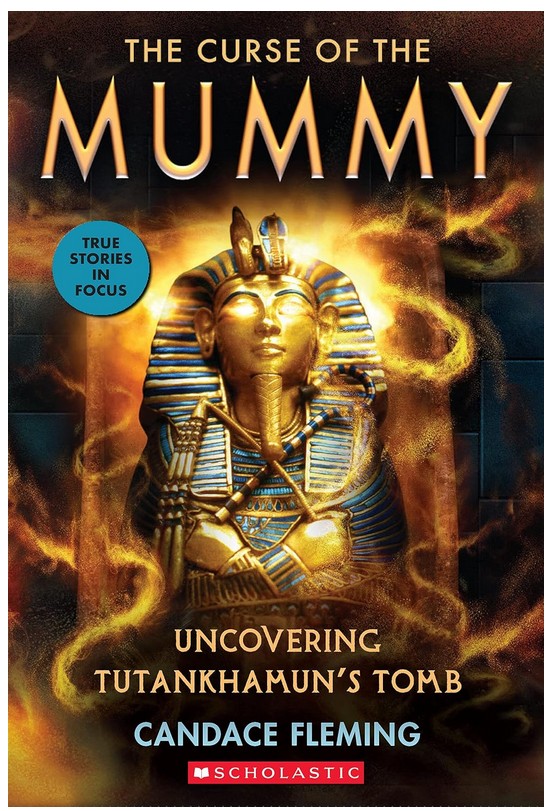
The Curse of the Mummy: Uncovering Tutankhamun’s Tomb
True Stories in Focus
by Candace Fleming
AR Test
8+
Score
6.8
304
During the reign of the New Kingdom of Egypt, the boy pharaoh Tutankhamun ruled and died tragically young. In order to send him on his way into the afterlife, his tomb was filled with every treasure he would need after death. And then it was lost to time, buried in the sands of the Valley of Kings. His tomb was said to be cursed.
Centuries later, as Egyptomania gripped Europe, two Brits—a rich earl with a habit for gambling and a disreputable, determined archaeologist—worked for years to rediscover and open Tutankhamun’s tomb. But once it was uncovered, would ancient powers take their revenge for disturbing and even looting the pharaoh’s resting place? What else could explain the mysterious illnesses, accidents, and deaths that began once it was found?
When most people think about Egypt, they think about the pyramids, and the mummies hidden within them. However, very few consider how the political and social context of the 1900s enabled wealthy British aristocrats to plunder Egypt’s treasures. Among the wealthy who were allowed to excavate in the Valley of Kings was Lord Carnarvon, who had no experience in archaeology and lacked the knowledge to dig scientifically. To help him find treasure, Lord Carnarvon hired archaeologist Howard Carter, who meticulously recorded every aspect of his excavations. Many of the photographs taken of King Tutankhamun’s burial chamber are included in the book, allowing readers to experience the excitement of discovering the boy king’s treasures.
The Curse of the Mummy conveys the British lack of respect for Egyptian people and culture. For example, Howard Carter understood the importance of each precious item that was placed on King Tutankhamun’s body. However, Howard Carter and Dr. Douglas Derry “pawed through the mummy’s thirteen layers of wrapping,” plundering every item of value. To make matters worse, “the team could not remove all the jewelry. So they cut off its arms in order to slide off the bracelets. They cut the torso in half, too, and sawed off the head, before using a chisel and hammer to gouge out each body piece.” After reading about King Tutankhamun’s treatment, readers can understand why some believed in the mummy’s curse.
Even though The Curse of the Mummy is packed with information, the text is broken into manageable pieces. To help readers visualize the events, the book includes large pictures from Tutankhamun’s burial chamber, as well as photographs and artwork that appear every two to nine pages. In addition, at the end of each chapter is a short segment about some of the deaths and misfortunes that were attributed to the mummy’s curse. For example, Lord Carnarvon’s personal secretary, Richard Bethell, was at the opening of Tutankhamun’s burial and was found dead seven years later. The cause of death was unknown. “Police were baffled, but those who believed in the curse weren’t. They knew the cause of death.” However, at the end of the book, Fleming debunks the curse by explaining the lack of scientific evidence to support the notion that the curse is real. Fleming explains, “Science and logic have shown there is no such thing as the mummy’s curse. It is nothing but a knot of rumors and superstitions.”
As part of the True Stories in Focus Series, The Curse of the Mummy is specifically written for a middle school and high school audience, utilizing rigorous research to provide accurate and compelling content for young readers. The True Stories in Focus Series emphasizes sharing true stories and focusing on real individuals and their authentic experiences. These books aim to help young people understand the world, develop critical thinking skills, and connect historical events to the present.
Anyone interested in ancient Egypt should read The Curse of the Mummy. Fleming includes fascinating facts and photographs that allow readers to step into King Tutankhamun’s tomb and see its grandeur. While Fleming doesn’t demonize the British, readers will be exposed to the harsh realities of the time period, a time when Britain looked down upon anyone who wasn’t an aristocrat, including the Egyptians and archaeologist Howard Carter. While The Curse of the Mummy takes a deep dive into the archaeological excavation of King Tutankhamun’s tomb, there is very little information about the boy king himself.
However, readers can learn more about King Tutankhamun by watching National Geographic’s documentary “King Tut’s Treasures: Hidden Secrets Rediscovered.” Readers interested in learning more about Egyptian culture should also read The Curse of King Tut’s Mummy by Kathleen Weidner Zoehfeld and See-Through Mummies by John Malam. Readers who want to explore ancient Egypt through fiction should grab a copy of The Boy Who Could Draw by Scott Peters or the TombQuest Series by Michael Northrop.
Sexual Content
- None
Violence
- Sections explain the myths behind the curse of King Tutankhamun. During excavation, Lord Carnarvon, a wealthy British aristocrat, found a mummified cat. Afterwards, “One of his servants had been stung by a scorpion. . . Delirious from the insect’s poison, he claimed a large gray cat was chasing him.”
- Some thought London’s British Museum was under a mummy’s curse. The cursed item was “the coffin lid of a priestess of Amen-Ra. According to newspaper accounts, anyone who gazed upon the object felt its unseen force.”
- Five treasure hunters bought the coffin lid, and Arthur F. Wheeler took ownership of it. Three days after getting the coffin lid, one of the treasure hunters, Thomas Douglas Murray, had an accident. “His gun exploded for no reason, blowing off his left hand.”
- Arthur F. Wheeler received a “telegram telling him that two of his servants had unexpectedly died.” Wheeler gave the coffin lid to his fiancée. “She soon came down with a mysterious ailment. Then her mother suddenly died, and her pets went insane.” More suspicious events followed the coffin, which are explained over three pages.
- Lord Carnarvon’s guests believed that “The cat was angry for being disturbed.” This idea was reinforced when the cat’s coffin had fallen open, and the cat’s bandages, “had been ripped open around the neck as if the spirit of the dead feline had burst out of them.”
- Howard Carter was put in charge of caring for the monuments of Upper Egypt. One evening, “a group of drunken French tourists forced their way into a site after attacking the Egyptian guards. Carter told the guards to fight back. The result was a rowdy brawl that left men on both sides with black eyes and bloody noses.”
- To maintain control over the Egyptians, the British did not permit protests. “In one instance, after a handful of Egyptian villagers pelted a group of British soldiers with rocks, authorities rushed in. They arrested fifty-two of the villagers. . . Four rock throwing villagers got the death penalty, two went to jail for life, and the remaining received forty lashes with the whip.”
- After World War I, the Egyptians sought to expel the British. The Egyptians organized protests and strikes. “At first, the British had responded with their usual harshness—suppressing demonstrations and killing hundreds of protestors.”
- A terrorist shot the British commander of the Egyptian Army. The British used this as an excuse to “seize control of the country.
Drugs and Alcohol
- Some believe priests would put poison in the tombs. “Maybe they’d drench the mummy’s bandages in cyanide made from peach pits, or laced tomb objects with scorpion venom.” Despite the speculation, “archaeologists have found little or no evidence of poison placed in tombs.”
Language
- None
Supernatural
- According to some, Tutankhamun’s mummy was cursed when the “high priest carried out mysterious rituals. As specified by The Book of the Dead, they had summoned protective demons and placed charms in the tomb’s walls. They had recited spells and prayers.”
- Some people said that “the curse was carved above the tomb’s entrance and read: Death will Slay with its wings / Whoever disrupts the peace of the pharaoh.”
- Others said the curse was written on the sarcophagus: “O anyone who enters this tomb, / who will make evil against this tomb: May the crocodile be against him on water, / and the snake against him on land.”
- Others said the curse was written on a magic brick. The curse read: “It is I who drives back robbers from the tomb with flames of the desert. / I am the protector of Tutankhamun’s grave, / and I will kill all those who cross this threshold.”
- Many deaths were blamed on the mummy’s curse. The book has a large number of events that could be attributed to the curse. Therefore, not all of the deaths are listed below. The first person to die of the curse was Lord Carnarvon. A mosquito bite led to an infection that killed Lord Carnarvon. Towards the end, “delirious, he muttered over and over, ‘A bird is scratching my face. A bird is scratching my face.’” Some believe Lord Carnarvon’s death was caused by the curse of the mummy.
- The curse of the mummy struck George Jay Gould, a wealthy American, who toured King Tutankhamun’s tomb. Almost immediately afterward, he fell sick with a fever and a cough. “As the dying man struggled for breath, he claimed to be surrounded by the ‘spirits of the pharaohs,’ and that Anubis, the Egyptian god of mummification and the afterlife, ‘drew the last breath out of him.’”
- A wealthy man named Ali Kamel Fahmy Bey visited the tomb and joked about the curse. “Just months after his visit, on July 11, 1923, his wife of six months shot him in their London hotel room. . . Hours later he died.”
- Howard Carter brought a pet bird to Egypt. Some believed the bird brought Carter luck. However, when Carter opened King Tutankhamun’s tomb for the first time, a servant “brought news of a tragedy. A cobra had slipped into Carter’s house” and ate the bird.
- Lord Carnarvon was receiving advice from a psychic. “Carnarvon was getting advice from beyond the grave. Or so he believed.” Lord Carnarvon believed the psychic was passing on “ghostly communications.”
- Cheiro, a psychic, told reporters that the night King Tutankhamun’s tomb was opened, “a shadowy form was taking shape. Slowly, it materialized into the ghost of a beautiful woman.” Cheiro believed it was the ghost of an Egyptian princess, who wanted Cheiro to warn Lord Carnarvon “not to remove any relics from the cursed tomb. If he did, he would suffer from a swift and terrible sickness that would kill him.” The scene is described over two pages.
Spiritual Content
- The Egyptians believed in many Gods, which are mentioned in the book. For example, a collector had a statue of “Sekhmet, the lion-headed goddess who tore men to pieces at the request of the sun.”
- The Egyptians believed the resting place of mummies was “crucial. Egyptians believed a tomb was an important symbol of continuity, of eternity, of a ruler passing from the living world to that of the gods. For this reason, it was important that a king’s body not be disturbed after it had been laid to rest.”
- Before Tutankhamun became king, the Egyptians believed “the gods had turned their backs on the land. . . But Tutankhamun had stepped forward to rebuild the temples and sanctuaries. He’d offered nourishing foods to the deities.” The Egyptians praised Tutankhamun for “restoring the traditional religion of the land. . .”
- During mummification, the heart was left in the body because “it was believed the heart was the ‘seat of the mind,’ and that the god Osiris would judge it against a ma’at feather, the symbol of truth and rightness.”
- One of the death rituals performed was the Opening of the Mouth. “Using what the Egyptians believed was a magical adze, [a high-ranking official] touched the mummy’s face mask. This, it was believed, allowed the dead king to breathe, walk, and talk in the afterlife.”
- During the early 1990s, Spiritualism was practiced all over Europe and the United States. Lord Carnarvon had “been hiring clairvoyants and holding séances at his estate. He also employed palmists to read his palm, and fortune-tellers to glean his future from the depths of their crystal balls.”
- During one of Lord Carnarvon’s séances, the psychic medium’s “face convulsed. Her eyes rolled back and she turned white as a corpse. Her lips worked spastically. . . then, in a guttural voice not her own, she spoke.” The psychic spoke in Coptic, “a type of language descended from the ancient Egyptians.”
- Howard Carter unwrapped King Tutankhamun’s mummy. “A pair of golden hands, sewn to the wrappings, held a crook and flail. And across its chest lay a large golden bird, its wings spread wide as if in flight. The ancient Egyptians believed that at death the spirit flew free, but that it returned to the body when it was ready to enjoy eternal life. . . [The body] needed to be perfectly preserved so the spirit would recognize it when it returned to the tomb.”
- A wishing cup found in King Tutankhamun’s tomb was inscribed with a prayer: “May your spirit live, may you spend millions of years, you who love Thebes, sitting with your face to the north wind, your eyes beholding happiness.”


“As he knelt beside the mummy, he realized just how much ancient Egyptians had feared the dangers of the underworld. He also recognized the love, care, and respect that had gone into Tutankhamun’s burial.” –The Curse of the Mummy
Latest Reviews

Elephant Secret
Archie Celebrates Diwali
Small Wonder
Haunted Mansion
Wabi Sabi

Impact: The Story of the September 11 Terrorist Attacks

Star Wars: The Wrath of Darth Maul

Olive Oakes and the Haunted Carousel

Star Wars: A New Hope: The Life of Luke Skywalker