
Buy This Book






“God and the army are on the side of the revolution now,” Grand Duke Paul. –The Family Romanov
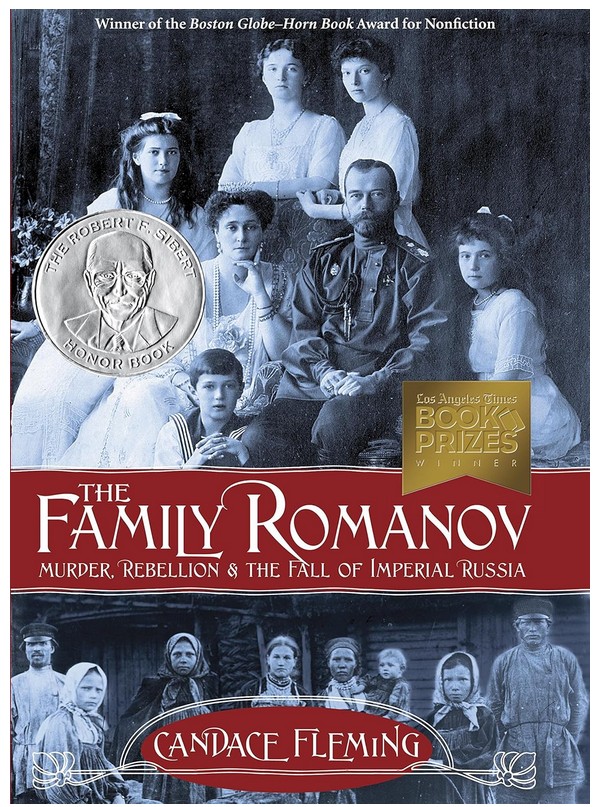
The Family Romanov: Murder, Rebellion & the Fall of Imperial Russia
by Candace Fleming
AR Test, Must Read, Teaches About Culture
12+
Score
7.2
304
He was Tsar Nicholas II of Russia: the wealthiest monarch in the world, who ruled over 130 million people and one-sixth of the earth’s land surface, yet turned a blind eye to the abject poverty of his subjects.
She was Empress Alexandra: stern, reclusive, and painfully shy, a deeply religious woman obsessed with the corrupt mystic Rasputin.
Their daughters were the Grand Duchesses Olga, Tatiana, Marie, and Anastasia: completely isolated and immature girls who wore identical white dresses and often signed joint letters as OTMA, the initials of their first names.
Their only son was Tsarevich Alexei: youngest of the Romanovs, heir to the throne, a hemophiliac whose debilitating illness was kept secret from the rest of the world.
Candace Fleming deftly maneuvers between the plight of Russia’s poor masses and the extravagant lives of the Romanovs, from their opulent upbringings to the crumbling of their massive empire, and finally to their tragic murders. Using captivating photos and compelling first-person accounts throughout, The Family Romanov is history at its most absorbing.
The book begins by focusing on Nicholas II’s childhood and the influence of his father, Tsar Alexander III. Unfortunately, Alexander was embarrassed by Nicholas’s small stature and gentle demeanor. The tsar refused to allow Nicholas to participate in government business because he considered him “a bit of a girlie” and “a dunce.”
Not only was Nicholas unprepared to be tsar, but he also alienated many who were unhappy with Nicholas’s choice of wife—a shy woman whom the Russian people viewed with distrust and who initially failed to produce a male heir. To make matters worse, on the day Nicholas was crowned as the new tsar in May 1896, an accident occurred that killed an estimated fourteen hundred people. This tragedy was interpreted as a bad omen, and many peasants predicted that Nicholas’s reign “would be beset with troubles from God.” Initially, readers will sympathize with Nicholas, who appears overwhelmed by circumstances beyond his control. However, this sympathy quickly fades as Nicholas makes increasingly unwise and cruel decisions.
Interspersed throughout the book are first-person accounts from Russia’s poor that paint a vivid picture of human suffering. Peasants faced starvation and were forced to send their children to work in factories for long hours and inadequate pay. The poor lived in constant fear of becoming attached to their children because of the high mortality rate. These descriptions give readers a stark understanding of the vast divide between Russia’s wealthy nobility and its impoverished peasants. When comparing these two worlds, it becomes clear why the Russian Revolution was inevitable.
When the poor began protesting for better working conditions, Tsar Nicholas showed no compassion. Instead, he blamed the workers for the problems and told his troops they were “obligated to fire” on protesters. Nicholas’s only concern was silencing dissent rather than addressing legitimate grievances.
Instead of helping people, Nicholas took away people’s rights. “If Russians so much as grumbled about the government, they could be arrested and exiled to far-off frozen Siberia without recourse. To keep the peace and protect order, the tsar censored the press, banned books, limited public speech, and refused people the right to assemble for political reasons.”
Nicholas’s attempts to quell unrest proved ineffective because he refused to acknowledge the underlying problems, which only fueled further discontent. The working class refused to remain silent. Despite book bans in Russia, workers continued reading authors like Jules Verne and James Fenimore Cooper. These books allowed them to “envision a better life” and taught them critical thinking skills. “These literate workers were now able to picture a government more responsive to their needs.”
By the end of World War I, Tsar Nicholas and his government had completely lost the people’s trust and were overthrown. Even under house arrest, the Romanov family continued to live in luxury. They still had “footmen in elaborate ornate livery [who] still bowed and served meals; expensive wines from the imperial cellar still appeared on the table; maids still came to help [Empress Alexandra] change into lace gowns and lengths of pearls.” While readers may be horrified by the Romanovs’s eventual murders, the book clearly illustrates the causes that led to the family’s downfall.
The Family Romanov transforms complicated history into an engaging account divided into four parts. The text is broken into manageable sections with headlines announcing each topic, making it less overwhelming for readers. Short, firsthand accounts from the working class and peasants reveal the horrendous suffering they endured. The book also includes 28 pages of photographs featuring the Romanov family and key figures in their lives, as well as images of wounded soldiers, injured protesters, and Rasputin’s “battered corpse.”
While many may believe their government—whether democratic or monarchical—will never fail, no government is invincible, making The Family Romanov essential reading. The book not only helps readers understand Russian history but also highlights the failures of Tsar Nicholas that ultimately led to his downfall. The Family Romanov is well-researched and provides a comprehensive examination of the past that helps readers fully understand why Imperial Russia collapsed. Discover more about Russia by reading these exciting books: Swimming with Spies by Chrystyna Lucyk-Berger, Stalin by Sean McCollum, and Spy Runner by Eugene Yelchin.
Sexual Content
- The holy man, Gregory Rasputin, was accused of molesting “numerous women—maids, noble women, even nuns. And according to one member of Rasputin’s family, the report contained obscene photographs.” Tsar Nicholas did not believe the rumors.
Violence
- Since the book covers both World War I, the Russian Revolution, the civil war, and the tsars’ violence, not every instance of violence is documented below.
- In 1881, a man “hurled a bomb at the imperial carriage. Miraculously, [Tsar Alexander] went uninjured, but many in his retinue were not as lucky.”
- When Tsar Alexander stepped out of the carriage to help people, a second bomb was thrown. “This one landed between his feet. An explosion of fire and shrapnel tore away Alexander’s left leg, ripped open his abdomen, and mangled his face.” He was taken to the palace, where he died.
- A peasant boy was afraid of his father, who often got drunk. “He would drink to the point where he was seriously ill, and there were even occasions when he was close to death. . .” While drunk, the boy’s father “fell upon my unfortunate mother. . . [I] prevented him from beating her. This. . . usually ended up with Father beating me up as well.”
- When the new tsar, Nicholas, was to be sworn in, hundreds of thousands of peasants attended. “Panic broke out. . . The crowd pushed forward, eager to grab their share [of food and gifts]. Some wooden planks that had been placed over several deep ditches gave way. Men, women, and children tripped and fell. Unable to rise in the mass of pushing, shoving bodies, they were trampled, crushed, suffocated.” Approximately 1,400 people died. Later, the tsar wrote a letter to his mother detailing his plans to “crush the rebellion by sheer force. . . and that would mean rivers of blood.
- The working class and the peasants suffered from terrible working conditions and a lack of food. They protested, hoping that Nicholas would intervene. Instead, soldiers fired on the crowd. “Bullets shredded the flags, and icons, and portraits of Nicholas. Bodies fell to the snow-covered ground. . . When the shooting stopped, between 150 and 200 men, women, and children lay dead. Between 450 and 800 were wounded.” This event is known as Bloody Sunday.
- On the day the October Manifesto was proclaimed, the Russian government promised reforms, including the right to peacefully demonstrate. Additionally, many political prisoners were released from prison. Moscow workers marched in the streets. A mob of supporters of the tsar, called the Black Hundred, attacked the Moscow workers and newly freed prisoners. “The mob pulled out knives and brass knuckles. Within minutes, the workers’ triumph turned to terror as they were slashed and beaten. . . When the attack was over, one of the prisoners lay dead, and dozens more were injured.”
- The Black Hundred continued to attack people, and the most vicious attacks were perpetrated against the Jews. “Russian subjects, provoked by the Black Hundred, rose up against their Jewish neighbors, burning homes, looting shops and synagogues, and murdering innocent men, women, and children. . . government officials looked the other way.”
- On Easter Sunday, a leaflet “printed under the supervision of Nicholas’s minister of the interior and paid for with the tsar’s money” was given to people. The leaflet said, “Let us massacre these. . . monsters.” Monsters referred to Jews in this letter. The Christian attack lasted three days. “When peace was finally restored, fifty-seven Jews (including two babies and a twelve-year-old) lay dead, and five hundred more were wounded.” Jewish homes and businesses were destroyed. When told of the deaths, Tsar Nicholas said, “Good. The Jews need to be taught a lesson.”
- One Jewish person wrote about the Easter Sunday riots. One group of people, including “the glazier Grienschpoun” hid in an outhouse. “The rioters rushed for the shed. . . A neighbor . . . was the first to stab the glazier in the neck. . . they finished him off with sticks and clubs.”
- To get away from the mob, three Jews named Chiaia, Macklin and Berlatsky climbed onto a roof. “Finally all three were tripped over the edge of the roof. Chiaia fell on a pole of feathers . . . escaped with her life. The wounded Macklin and Berlatsky lay writhing with broken limbs on the pavement, where the cowardly crowd finished them off with crowbars.” The event is described over three pages.
- The tsar’s police arrested the leader of the Soviets, who was against the autocracy. Russian peasants and workers protested by barricading their section of town. Nicholas deployed a fighting unit. “The tsar’s troops were ruthless. Bringing up artillery, they bombarded the workers’ section until the whole district was nothing but smoldering rubble. . . Their orders were to shoot anyone who had not already fled. Men, women, and children were systematically mowed down. . . More than a thousand people had been killed, and thousands more were injured.”
- World War I started when a terrorist “calmly stepped out in front of Archduke Ferdinand’s car during the prince’s ceremonial visit to the city of Sarajevo. . . fired twice. The archduke’s wife, Sophie, instantly crumbled, and blood gushed from the archduke’s neck.” Both died.
- During World War I, Alexandra and her two oldest daughters became nurses so they could help wounded soldiers. One person wrote, “I have seen the empress of Russia assisting in the most difficult operations, taking from the hands of busy surgeons amputated legs and arms, removing bloody and vermin-ridden field dressings, enduring all the sights and smells and agonies of the most dreadful of all places, a military hospital in the midst of a war.”
- Rasputin had become so powerful that some believed he was the puppet master, making decisions for Nicholas and Alexandra. Three nobles—Yusupov, Purishkevich, and Pavolvich—decided to assassinate him. Yusupov shot Rasputin in the back. They thought Rasputin was dead, but he wasn’t.
- Rasputin staggered “to his feet, his mouth foaming, [he] lunged at his would-be murderer. His long, bony fingers dug like steel claws into the prince’s shoulders. Terror-stricken, Yusupov struggled to break free from the death grip.” Yusupov fled.
- Rasputin attempted to flee. Purishkevich said, “I fired [at Rasputin]. . . I missed. I fired again. Again I missed. . . I fired a third time. The bullet hit him in the shoulder. . . I fired a fourth time and hit him in the head.” The three nobles cut a hole in the ice and put Rasputin’s body in a river. The book contains a picture of Rasputin’s dead body.
- A group of men took the Romanov family and their servants into a basement. The family thought they were going into the basement for their safety. They were lined up in two rows. Chief executioner of Emperor Nicholas II, Yakov Yurovsky, “jerked the Colt pistol from his pocket. . . He shot the tsar. Nicholas crumpled to the floor just as the other men raised their guns and fired. Alexandra died as she tried to cross herself.”
- The Romanov children had hidden so many jewels in their clothing that they were essentially bulletproof. “Incredibly, bullets aimed directly at both the girls’ and Alexei’s chest merely bounced off and jumped about the room like hail.”
- Alexei couldn’t run. His chair tipped over. “He moaned and clutched his father’s arm. Minutes later, Yurovsky shot him in the head.”
- The girls tried to escape. “Crawling through the thick cloud of gun smoke that now filled the room, [the girls] searched frantically for a way out. Only their outlines could be seen, and the men began firing randomly at anything that moved. . . Olga and Tatiana, arms around each other, huddled in a corner. Bullets soon took their lives.”
- Marie and Anastasia “pressed themselves together. Both girls screamed for their mother. The murderers moved forward. They slashed at the ‘Little Par’ with bayonets before silencing them both with gunshots.” The bodies were hidden in the Koptyaki Forest.
Drugs and Alcohol
- During many of the royal parties, alcohol such as champagne, cognac, and wine was served.
- Occasionally, the book describes men as being drunk. For example, many of the poor became drunkards. Many of the poor would go to “the neighborhood tavern, they tried to drown their misery by squandering precious kopecks on cheap vodka and watered-down beer.”
- While in the military, Nicholas “focused on what he enjoyed most — laughing and partying with his fellow officers.” Once, he got so “stewed” that “the Officers carried [him] out.”
- While pregnant, Empress Alexandra drank “bitter herbal concoctions,” “prayed,” and “even bathed in the moonlight” in the hopes that this would allow her to have a son. However, she delivered another daughter.
- According to Rasputin’s security detail, the holy man did not always act holy. “Rasputin took part in a drinking party with some [college] students. . . A musician struck up, and there was singing, and Rasputin danced with a maid-servant.” Rasputin was often seen “dead drunk.”
- To kill Rasputin, his assassins “plied [him] with wine that they thought was laced with cyanide.” Later, the assassins learned that the wine was not poisoned.
- When the Romanov family was exiled, they packed “vials of holy water; boxes of smelling salts; laxatives, morphine, and even a year’s supply of bath oil and cologne.”
Language
- The tsar Nicholas derisively called Jews “the Yids” and encouraged people to attack them. Nicholas said, “[They] must be put in their place.”
- When Nicholas realizes that he will be executed, he says, “Lord, oh, my God! Oh, my God!”
Supernatural
- None
Spiritual Content
- For the Romanov family, religion was a daily part of their lives and appeared often. Because of this, not every reference is below.
- The poor did not feel guilty about stealing food from the wealthy people’s forest. They believed, “God grew the forest for everyone.”
- The Romanovs believed that “God had given them this power, had chosen them to rule the Russian people. As God’s representative on earth, they maintained, the tsar should be left to run the country according to his own ideas of duty and right.”
- The tsar had two restrictions. “He had to abide by the teachings of the Russian Orthodox Church. . . and he had to follow the laws of succession.”
- After her mother died, Empress Alexandra became “obsessed with God and the afterlife.”
- After a peasant boy’s mother died, he was distressed because he fell asleep before he could read the Psalter forty times. “According to popular belief . . . you have to read the entire Psalter forty times over to [send a soul to Heaven.]”
- To marry Nicholas, Empress Alexandra had to convert from Lutheranism to Russian Orthodoxy, a branch of Christianity. “To toss [being Lutheran] aside would, she believed, be an insult to God.” Finally, after much prayer, Empress Alexandra decided, “She wouldn’t really be changing faiths, she reasoned. She would merely be changing the way she expressed that faith.”
- Alexei, Nicholas’s son, had Hemophilia. “Nicholas believed Alexei’s illness was God’s will, and so he accepted it passively. ‘My own fate, and that of my family are in the hands of Almighty God,’ he said.”
- Empress Alexandra collected icons. “Believing, as the Church taught, that God and the saints helped and healed people through these icons, she surrounded herself with them, then spent hours each day on her knees in prayer. She also began putting her faith in so-called holy men—hermits, soothsayers, wandering monks, and faith healers. They were, she believed, a direct link to God.”
- Empress Alexandra thought that the Russian Orthodox Church “believed in seers, holy men, martyrs, and living saints as well as visions, miracles, and speaking in tongues. . . It had [been] taught that God often blessed ordinary men with the divine ability to heal bodies and souls, in addition to the ability to act as spiritual guides to the rich and powerful.”
- Even though Empress Alexandra believed a daughter was a “miracle of God,” she prayed “before icons, begging God for the miracle of a son.”
- Empress Alexandra was introduced to “Dr.” Philippe by relatives who “dabbled in the occult, the two were notorious for the midnight seances. . . both women believed in a host of psychic phenomena—ghosts, astrology, even magic.” It was believed that “Dr.” Philippe could “heal the sick by chanting, predict the future by praying and make himself invisible just by donning a magic hat.”
- “Dr.” Philippe told Empress Alexandra that she would have a son if she “Prayed to Seraphim of Sarov.” Three months later, Alexandra was pregnant. “She was convinced it was because of ‘Dr.’ Philippe. He had interceded with the Almighty on her behalf, and God blessed her. This event cemented her belief in mysticism.”
- Nicholas believed “God’s will must always be accepted without complaint. After all, everything that happened in life was God’s will, so it was pointless to question the meaning of events.”
- However, Alexei’s illness made Alexandra question God. “But after she’d waited so long and prayed so hard, why had God allowed this terrible thing to happen?” She believed that Alexei’s illness was because of her “unworthiness.” To become holier, “She began to pray longer and harder, spending hours on her knees in the palace chapel. . . She covered the walls of the nursery, and even baby Alexei’s crib, with hundreds of icons and religious images.”
- When the working class and the poor began to rebel, the tsar believed that he was not the problem. Instead, “It was the fact that people had turned against the autocracy and their holy tsar. ‘We have sinned. . . and God is punishing us,’ he said. Therefore, strikes were not a sign that the country needed democratic reform. Rather, they were God’s way of telling the country it needed an even stricter autocracy.”
- Because a peasant’s life was so hard, when an infant died, a common saying was, “Thank goodness the Lord thought better of it!”
- Gregory Rasputin was a peasant farmer who “claimed to see a vision from God.” He left his family and went to a monastery in Greece. When he returned, “he declared himself to be what Russians called a starets—a holy man.” Some believed he was a healer and a prophet. Empress Alexandra put her faith in Rasputin and often followed his advice.
- After the prime minister was assassinated. Alexandra believed this proved that “Those who offend [Rasputin] may no longer count on divine protection.”
- During the three hundredth anniversary of Romanov rule, the royal family threw a jubilee. During the ceremony, they saw two doves circling overhead. Nicholas and Alexandra believed this was a religious sign. Nicholas said it was “a symbol that the blessings of God, after three centuries, continue to rest on the Romanov[s].”
- Orthodox Church outside of Russia “largely ignored [Tsar Nicholas’s] anti-Semitism, poor leadership, and brutal suppression of his subjects.” The church wanted to declare the family “martyred saints.” The Orthodox Church outside of Russia did not agree. Three pages discuss the conflict.




“God and the army are on the side of the revolution now,” Grand Duke Paul. –The Family Romanov
Latest Reviews

Elephant Secret

Archie Celebrates Diwali

Small Wonder

Haunted Mansion
Wabi Sabi

Impact: The Story of the September 11 Terrorist Attacks

Star Wars: The Wrath of Darth Maul

Olive Oakes and the Haunted Carousel

Star Wars: A New Hope: The Life of Luke Skywalker