
Buy This Book

“But you are free,” Miss Yu says. / “In your mind. No one can / take away your thoughts.” –Eureka
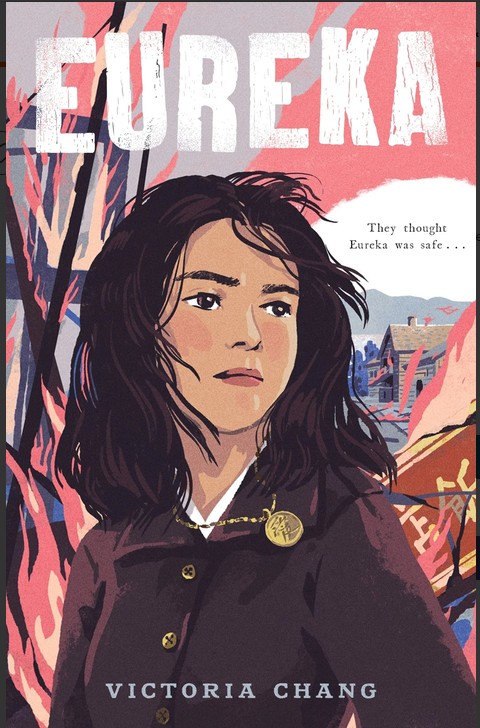
Eureka
by Victoria Chang
Teaches About Culture
10+
Score
3.7
60
The year is 1885. San Francisco is dangerous for Chinese immigrants like twelve-year-old Mei Mei. She must venture on her own, without her family or friends, to Eureka, California, where it is supposedly safe.
But 300 miles from home, Mei Mei misses her Ma Ma’s kindness, helping out in her Ba Ba’s store, and playing hide-and-seek with her best friend, Hua Hua. Despite her fear and the increasing violence against her community, she finds hope in an unexpected friend, the giant redwood trees, and a new dream: learning how to read in English. As the world around her grows scarier, Mei Mei discovers her own power, as well as the joy of found family, the importance of courage, and the nature of freedom.
Eureka is told from a unique point of view — Mei Mei, a young Chinese girl who moves from San Francisco to Eureka to live with her aunt and uncle. Mei Mei doesn’t understand why her parents want to send her to Eureka. She thinks it’s because “Maybe my badness / has gotten too big / and now I must be sent away.” As she grapples with her parents’ decisions, she also deals with understanding her culture and the dangers of being a Chinese girl in a predominantly white society. For example, Mei Mei often compares Ma Ma’s feet to hers. At first, Mei Mei wants to have pretty feet like her Ma Ma. That changes when she realizes her “big, unbound feet, / wide, long, thick, / flat” give her a freedom that her mother doesn’t have. While many of Mei Mei’s conflicts are rooted in the time period, every reader will understand her desire to go to school, have friends, and have the freedom to make decisions.
Both in San Francisco and Eureka, Mei Mei witnesses discrimination and fighting between Chinese gangs. Because the story is told from Mei Mei’s point of view, the violence is not depicted in graphic detail. Nevertheless, the book carries a content warning for violence and racism. Despite this, Eureka is an important book to read in order to understand the racism that permeated many early American towns. Because Mei Mei is Chinese, she cannot attend regular school; she is in danger of being kidnapped, and she is put to work as a servant for a white family. This leaves her wondering “why all women can’t be free, why all women can’t be rich and run.”
Mei Mei faces many obstacles that may upset readers. She often compares her feet to Ma Ma’s feet, and the description of foot binding may be distressing to some. Additionally, the story hints that Mei Mei’s aunt and uncle were dishonest and tricked Mei Mei’s parents into sending her to them. They were not necessarily cruel to her, but they arranged her job and took her pay. In the end, Mei Mei finds her way back to San Francisco with the help of a trusted friend.
Eureka is a fast-paced, suspenseful, verse-written story that powerfully portrays the hardships faced by Chinese people in early America. It focuses on the expulsion of Chinese people and the burning of Chinatown in Eureka, California, in 1885. The author’s note and back matter provide additional context about this horrific event and Chinese culture.
Ultimately, Eureka is a moving and necessary read. Through Mei Mei’s eyes, readers experience the injustice, resilience, and quiet courage it took to survive in a world that was often openly hostile to people who looked like her. The story’s verse format gives it an emotional immediacy that will resonate with young readers, while its historical grounding makes it a valuable tool for understanding a too-often overlooked chapter of American history. Mei Mei’s journey — marked by fear, longing, and eventual triumph — reminds us that the search for freedom, belonging, and education is timeless.
Sexual Content
- None
Violence
- Mei Mei’s Ma Ma cannot walk without help, because her feet were deliberately malformed as a sign of wealth. “‘It showed we were richer,’ she / said, ‘and that we didn’t need / to work the fields. She said men liked it, / thought it was beautiful, / especially when / we walked, dainty, nearly / falling over like dolls.’”
- “Ma Ma once told / me that her ma ma / trimmed my ma ma’s / toenails, soaked her feet in a metal / tub filled with herbs and / pig blood to / soften her feet.” Her ma ma’s feet were wrapped tightly. “Then she pushed the toes / on each foot down and / curled them under as / hard as she could / downward / downward / then squeezed them / until the toes broke, until the arch of each / foot broke.” The bandages were sewn so she couldn’t take them off. At the time Ma Ma was four years old.
- Mei Mei’s Ba Ba warns her to be careful because “The Chinese people have been kidnapping / young girls like me” and making them slaves.
- The Chinese people fight with the white people about money. The Chinese people stay in Chinatown unless “they want to / get shot in the head.”
- Tom, a young Chinese orphan, is a servant in a rich man’s house. While serving dinner, he drops something, and Mei Mei hears “a slap and then / the sound of something hitting a wall.”
- The Chinese gangs fight. Afterward, Mei Mei’s uncle comes home. He “falls over like a large wounded animal.” His face is “bloody and red, / purple bumps by his eye. / He’s groaning.”
- While working for a white man, Mei Mei goes upstairs to his daughter’s room. The girl’s father, Mr. Bobbit, finds out and gets angry. “He grabs my arm and lifts / me up so that my feet / are dangling an inch / from the floor. . . He drops me onto / the ground, and I’m surprised I don’t / fall on the floor / but am still standing / tall, upright. . . Before I know it, / he’s dragging me and / shoving me into the closet. / Then darkness.” The punishment scene is described over three pages.
- Two Chinese gangs fight and some of them have guns. Mei Mei watches through the door. “The dirt rising up in / clouds of messy dust, / hands flying, / fist clenched, / more gunshots.” During the fight, two men are killed, three are injured, and the police arrest some of them, including Mei Mei’s uncle.
- In another fight, Mei Mei sees “Uncle and another man / pushing, yelling, and I see / a red flash, hear a bullet / break the air, then another / and another.” During the fight, a white man and a boy are injured. The scene is described over several pages.
- All of the Chinese are told to leave Eureka. If they don’t, “They said they’ll hang us on the gallows they’re building right now.”
- Miss Yu, Tom, and Mei Mei flee from Eureka. They are in the woods when a mountain lion attacks Tom. “Tom falls back / onto the ground. Everything’s blurry, / there’s brown fur, / Tom’s face, / white fangs / that start to get bigger. . .” Mei Mei scares the mountain lion away.
Drugs and Alcohol
- None
Language
- Mei Mei is called a Chinaman in a derogatory way.
- Some of the white people yell mean things at the Chinese, such as “Go back to China!” and “Chinese must go!”
Supernatural
- None
Spiritual Content
- In Eureka, the redwood trees “go so high up, / they must be able / to see heaven, which / the church teachers / told me all about.”


“But you are free,” Miss Yu says. / “In your mind. No one can / take away your thoughts.” –Eureka
Latest Reviews
Elephant Secret
Archie Celebrates Diwali
Small Wonder
Haunted Mansion
Wabi Sabi

Impact: The Story of the September 11 Terrorist Attacks

Star Wars: The Wrath of Darth Maul

Olive Oakes and the Haunted Carousel

Star Wars: A New Hope: The Life of Luke Skywalker