
Buy This Book
Other books by Steve Brezenoff
“This ghost,” the protester finally went on, “was a Lakota spirit. You have to listen to the spirit’s warning and leave this Lakota land at once.” –The Mount Rushmore Face That Couldn’t See
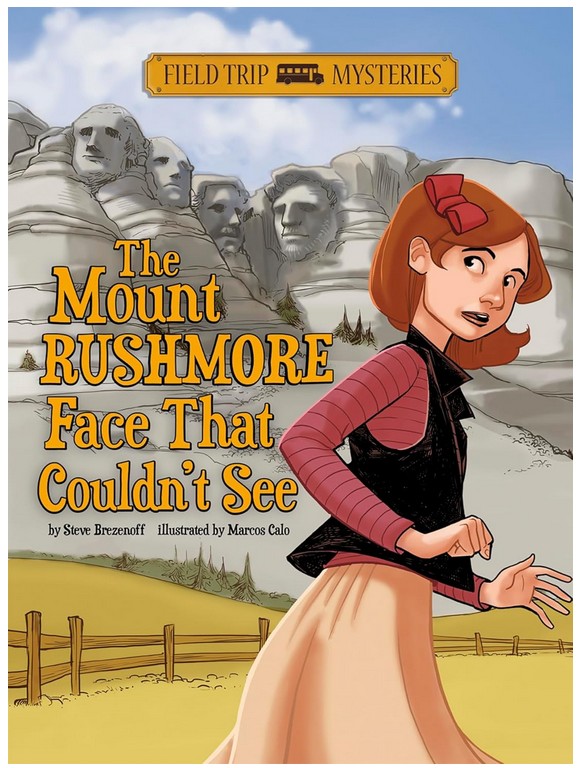
The Mount Rushmore Face That Couldn’t See
Field Trip Mysteries
by Steve Brezenoff
AR Test, Diverse Characters
8+
Score
3.4
88
The History Club, which includes Sam, Cat, Egg, and Gum, takes a field trip to Mount Rushmore. When they arrive, a group of Lakota kids who are protesters are in the parking lot. Instead of being curious about the issue, Gum says, “People will protest anything.” The trip gets more complicated when their tour guide doesn’t arrive. Cat and her friends find him tied up in his bed, and the mystery deepens.
The kids visit the Sculpture Center. While there, a voice booms, “Get out!” Some believe it’s the voice of a Lakota spirit, while others believe it’s the voice of one of the dead presidents. Cat and her friends investigate to find out who wants to scare visitors away from Mount Rushmore.
The mystery is told from Cat’s point of view. However, all four kids work together to solve the mystery. Since the story is short, there is very little character development, and the characters have no distinct personalities and are portrayed stereotypically. For example, Anton is portrayed as a typical bully, and there is no logical reason for him to be on the field trip. When Anton is being rude, Ms. Juniper says, “You are on this trip because your grade in history was beyond terrible. One more mean word out of you, my friend, and you’ll spend the rest of your life in the sixth grade.” The lack of character development makes it difficult for readers to connect with the characters or relate to their conflicts.
At first, Sam accuses the caretaker of trying to scare people away from Mount Rushmore. However, there is little evidence to support this. Sam explains her reasoning, “He’s a grump. You saw how he looked at us, and how he talked to us. He doesn’t like kids. He wants us out of here.” Later, they discover that the park ranger’s daughter, Ruthie, is the culprit. Ruthie explains that she tied up her father because she was hoping he would get fired and they could move back home. Some readers may question the evidence, wondering how Ruthie could tie up her father without waking him up. Additionally, readers will question how Ruthie could have hidden speakers throughout the woods and in the Sculpture Center. In the end, the mystery is solved, but the lack of evidence and the unrealistic culprit led to an unsatisfying reveal.
While the story includes Native Americans, they are not developed as people. Instead, they are protestors whose only purpose is to be suspects in the mysteries. The park ranger says, “This heritage village is the newest exhibit at Mount Rushmore. It was set up to show how the Lakota, Dakota, and Nakota nations lived before the United States began its growth to the west.” Despite this information, the exhibit is never shown, nor is there any historical information about the indigenous people. While one of the illustrations shows teepees, they are used only as hiding places for a suspect. Additionally, the park ranger says, “My family is from Mexico. That means we have a lot of Native American blood in our veins.” Overall, the book misses an opportunity to showcase Native Americans’ vibrant culture or explain how Western Expansion affected them.
The Mount Rushmore Face That Couldn’t See begins by using a graphic to introduce the narrator, Cat, and ends with a glossary, a report on Mount Rushmore, and questions to consider. The story contains very little information about Mount Rushmore or the Lakota people. However, the report gives a short explanation of the conflict. Unfortunately, the book uses stereotypical characters and clues that don’t quite fit the puzzle. Overall, The Mount Rushmore Face That Couldn’t See’s simple plot, recurring characters, and full-color illustrations make the story accessible to younger readers who aren’t ready for more advanced plots.
Sexual Content
- None
Violence
- When Cat and her friends find Anton hiding in the woods, Cat “slapped him on the arm. It didn’t hurt him. I just couldn’t help myself.”
Drugs and Alcohol
- None
Language
- Two boys who are considered bullies are referred to as thugs and goons.
- One of the kids calls the bully a “dummy.”
- Anton calls Cat and her friends “dorks.”
- One of the kids calls the caretaker a “grump.”
- Anton refers to his teacher, Ms. Juniper, as “Ms. Jupiter.”
Supernatural
- None
Spiritual Content
- When the kids hear a voice warning them to leave, a protester says, “This ghost was a Lakota spirit. You have to listen to the spirit’s warning and leave this Lakota land at once.”
Other books by Steve Brezenoff
“This ghost,” the protester finally went on, “was a Lakota spirit. You have to listen to the spirit’s warning and leave this Lakota land at once.” –The Mount Rushmore Face That Couldn’t See
Latest Reviews
Elephant Secret
Archie Celebrates Diwali
Small Wonder
Haunted Mansion
Wabi Sabi

Impact: The Story of the September 11 Terrorist Attacks

Star Wars: The Wrath of Darth Maul

Olive Oakes and the Haunted Carousel

Star Wars: A New Hope: The Life of Luke Skywalker