

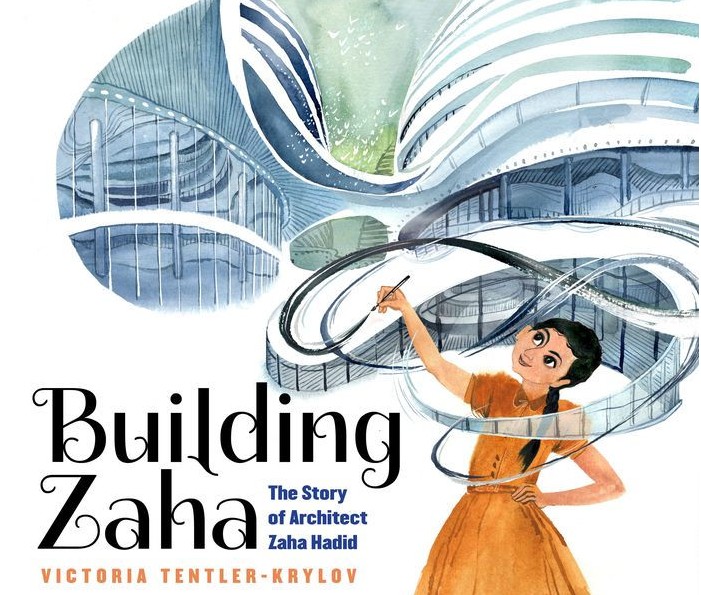



Building Zaha: The Story of Architect Zaha Hadid
by Victoria Tentler-Krylov
AR Test
5+
Score
5.3
48
Imagine growing up surrounded by stunning mosques and palaces in the Middle East during the 1950s, a time when Baghdad, Iraq was experiencing a vibrant period of cultural growth. Building Zaha traces the life of Zaha Hadid, revealing how she rose to global prominence as an architect and broke through barriers in a male-dominated field to become one of the world’s most celebrated designers.
Zaha Hadid’s story is both rare and powerful, tracing the rise of a woman who defied expectations, not only in her place in the world but also in redefining what architecture could be. Her gravity-defying structures and bold, curvilinear forms are truly remarkable. At its heart, the narrative highlights simple, relatable lessons for young girls who dream of becoming designers: trust your instincts, remain resilient in the face of criticism, and pursue excellence by setting goals and striving toward them.
This picture book invites readers to explore both urban and rural landscapes as sources of artistic inspiration. One of Zaha’s most memorable childhood trips was to Sumer, in the Middle East, where she observed floating homes in the Sumerian wetlands. She “wondered whether it was better to live in a modern city like Baghdad or to live as one with nature.” She was drawn to ever-shifting elements like rays of sunlight and rippling water, a fitting reflection of the fluidity that would later define her work.
Building Zaha traces her journey through the years, highlighting key milestones while capturing young Zaha’s delight in the world around her and the warm support of her family. Her ability to trust her instincts is evident from the start. As a child, she confidently declares, “I want to be an architect,” after observing a fascinating scale model of a building. The model, much like a dollhouse, represented her relatives’ future home, but for Zaha, it marked the first time she truly began to think about buildings and how they are made.
Readers follow Zaha through her college years, first studying math in Beirut and then moving to London to study architecture. During this time, resilience becomes essential as she faces criticism and challenges. “She stayed in the studio for hours on end, sketching, reading, and thinking.” Like many architects, Zaha entered competitions, but she also faced early rejection when her designs were considered too complex to build. Although her ideas were bold and original, she struggled to bring them to life at the start of her career, leading critics to label her a “paper architect – someone whose designs never get built.” Rather than discouraging her, this only strengthened her resolve. “She had to be tougher than most and confident in her vision.”
A recurring theme in the story is Zaha’s drive for excellence and her commitment to achieving her goals. Early on, a simple scale model of a building inspires her to “set a goal for herself” and learn more about how buildings are made. She begins by observing the structures around her and strengthening her math skills. After college, her ambition becomes clear when she opens her own architecture studio just three years after graduating. Her career begins to take off with her first major project in Germany, leading to work across Europe, the United States, and Asia. What follows is a long and influential career marked by daring, original designs that reflect her unique vision. “All over the world people stopped to stare at the shapes and structures she had created.”
Building Zaha unfolds like a journey, guiding readers through the key moments that shaped her life, while highlighting the determination and imagination behind her success. Fluid watercolor washes fill each full-page spread, with sweeping, organic forms that align with Zaha’s design sensibility. The layered, painterly mixed media style captures the energy and originality of her ideas. The book’s length and vocabulary are best suited for older readers. Some pages feature complex sentences that use advanced vocabulary, including terms such as mosque, architect, conjured, and unconventional. This picture book offers young readers a meaningful introduction to a fearless woman who became one of the world’s most celebrated figures.
The story concludes with supplementary material, including an “Author’s Note” and a “Selected Timeline.” This marks the author’s first work as both writer and illustrator. In the “Author’s Note,” Tentler-Krylov shares meaningful lessons from studying Zaha Hadid’s work that readers can connect to, including “How to set yourself apart from the competition.” This book is especially inspiring for young girls who dream of becoming designers.
Sexual Content
- None
Violence
- None
Drugs and Alcohol
- None
Language
- None
Supernatural
- None
Spiritual Content
- None
by Maureen Lowe



Zaha was not afraid to question what was possible." —Building Zaha
Latest Reviews

Elephant Secret
Archie Celebrates Diwali

Small Wonder
Haunted Mansion

Wabi Sabi

Impact: The Story of the September 11 Terrorist Attacks

Star Wars: The Wrath of Darth Maul

Olive Oakes and the Haunted Carousel

Star Wars: A New Hope: The Life of Luke Skywalker