
Buy This Book


“I lay in my blood, looking at the sky, thinking. What would I tell my sister when she asked, ‘What happened in the Bathhouse?,’” unnamed protagonist. –The Bathhouse
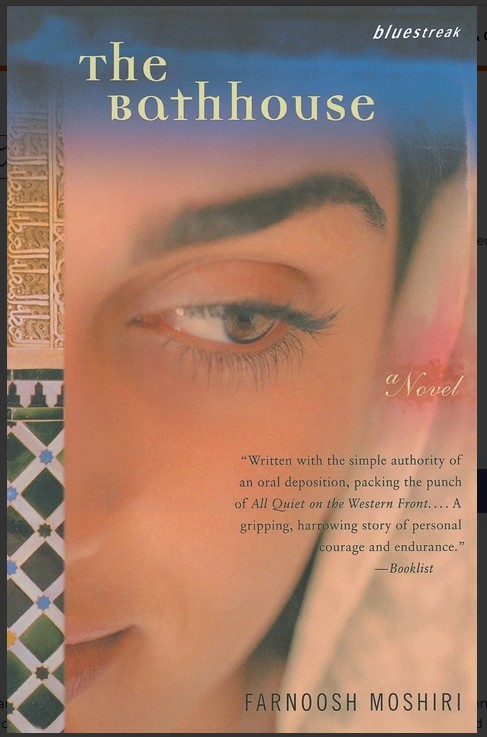
The Bathhouse
by Farnoosh Moshiri
Teaches About Culture
16+
Score
5.4
150
During the aftermath of the Iranian Revolution, the new religious regime of Ayatollah Khomeini cracks down on religious opposition, promising to purge and convert all of the so-called “devil worshipers.” A normal teenage girl, the unnamed protagonist, is arrested because of her brother’s connection to leftist politics and activism. Held captive in a public-bathhouse-turned-prison, she is subjected to torture and death threats. She meets many other prisoners, and together they attempt to survive the oppressive conditions while maintaining their spirit and sanity.
The novel is based on interviews with real Iranian women detailing their experiences during and after the Iranian Revolution. As such, it tackles difficult topics such as religious persecution, torture, and human cruelty. The prisoners are subjected to many different forms of violence, including beatings, stonings, and executions. Moshiri does not shy away from the reality of the violence, providing at times bloody descriptions through the eyes of the protagonist’s innocence. The protagonist remains unnamed throughout the work to represent each woman who endured the same torturous experience.
As the novel progresses, the protagonist is powerless against her captors and loses her ability to fight back. The book focuses more on depicting the brutality of the prison rather than the resistance against it. This approach is highly effective at showing the cruelty that the prisoners endure and the consequences of tyrannical power dynamics. The protagonist, despite being physically powerless against her captors, has a strong character. She is resilient throughout the devastating abuse, but she tries to comfort others and protect them. While she doesn’t physically resist, her survival and unwillingness to convert act as forms of rebellion.
The supporting cast of characters further conveys the sadness of the situation, as many of them are there for the wrong reason. Despite the hardships, the women stick together, protect each other, and care for one another. However, as each one meets their fate, sometimes death, sometimes escape, the protagonist is left on her own. The characters in the novel provide heart despite the oppression they face and serve as the work’s emotional core. They enhance the themes of both human kindness and cruelty, making the novel’s message effective.
The Bathhouse has strong themes of religion, hierarchies of power, and disillusionment of ideals. Jamali, the head of the prison, declares that he intends to convert all of the “devil worshippers” to the religion of Islam under the new Iranian regime. Despite this claim, the prison guards commit many atrocious acts that go against what their religion teaches. Some prisoners who convert only pretend to do so to survive, such as Zohre and Ferial, who do it to protect their babies. The divide between Jamali’s supposed ideals and the brutal reality of the prison demonstrates the consequences when religious power is abused as a form of oppression. Since Jamali is backed by the new government, the actions in the bathhouse, such as the execution of political and ideological opponents, are not condoned nor stopped. Moshiri shows through the protagonist’s experience that disillusionment between the Iranian Revolution’s ideals and reality has devastating consequences that lead to horrid acts done for oppression and control over opposition.
While the protagonist is released from prison at the end of the novel, the ending remains somber as she now has to live out the rest of her life having experienced great atrocities for simply being related to a political activist. The perpetrators of the great abuse do not face any consequences. It is an ending meant to convey the weight of the horrible conditions many people experienced during the Iranian Revolution and does not offer any comfort, forcing the reader to come to terms with what they just experienced.
The Bathhouse is a powerful account of the religious persecution of the Khomeini regime. It has a lot of foul language and violence, including sexual violence. The Bathhouse is not a novel one reads for entertainment. Similar to Night by Elie Wiesel, it has heavy themes of survival amidst cruelty that are only for mature audiences. If read in the right mindset, it is an extremely powerful work that opens one’s mind to humanity’s potential for good, evil, and survival despite oppression. Readers interested in Middle Eastern history may also want to read A Thousand Splendid Suns by Khaled Hosseini.
Sexual Content
- When a group of armed men storm the protagonist’s house, they make her change clothes. “Then I felt cramps in my belly. I reached under my skirt to see if I was bleeding, but the boy kicked the door open, jumping into my room. . . I realized that he had been watching me getting dressed.”
- The protagonist is on her period for a portion of the book and describes her bleeding. “Thinking about her opened a hot flood inside my belly. I bled again. My underwear and my skirt were wet with blood. Blood dripped down my thighs. . . Another gush of blood flooded out. I let it pump out of me, flowing under my body.”
- The protagonist mops up her blood and passes out. “I knelt on the floor, wiping the blood, but more gushed out. I panicked. All my insides were pumping out. As I was wiping the floor, my eyes blurred and I thought that I was Ferial and I was losing my baby. . .Then I thought I’d rather lie down here and get some sleep close to my bloody child.” The protagonist is making a comparison and is not pregnant.
- The protagonist, at 17 years old, wants to comfort a baby so she “unbuttoned my uniform and took my breast out. I didn’t need to put my nipple in her mouth, her mouth found it. She began to suck. She sucked and I closed my eyes, feeling a sharp pain in my hard breast. She was not crying now, just sucking on my empty breast.”
- Before female prisoners are executed, they are raped so that they are not virgins and go to hell.
- Before she is to be executed, the protagonist is brought into a room, blindfolded, and raped. “Now one of them held my arms from above and someone else removed my uniform. They pressed my arms down and I heard a scream–not my scream, one of the girls’ in the room, because I’m sure that I remained mute and didn’t utter a syllable when something pierced me and tore my insides. All I could imagine in that deep darkness I’d fallen into was Sister Sultani drilling a hole in me with her long forefinger.”
Violence
- The protagonist’s parents died in a car crash. “When he and Mother died in a car accident, a policeman handed us a plastic bag containing their belongings.”
- A group of armed men storm the protagonist’s house and threaten her with machine guns. “He prodded me with the butt of his machine gun, cursing.”
- The armed men tie people up and put them in blindfolds, slapping them to keep them quiet.
- At the bathhouse prison, the guards often beat and abuse the prisoners to force them to convert to their religion. “And then I heard the distinct sound of whoop. . . whoop. . . whoop. . . From somewhere a woman screamed, ‘No. Stop! Don’t. . . I’ve seen it; yes, with my own eyes–’”
- The blindfolded prisoners are dragged around by ropes and handcuffed. “Now I felt something around my neck and in a second I was pulled by a leash. I felt like a blind goat on the way to the altar.”
- The guards severely beat. “Whoop. . . I felt a sudden blow on my head. The shock was more disturbing than the pain itself. . . Whoop. . . Another blow. My scalp was on fire.” These descriptions occur often.
- Many prisoners are executed by firing squad, including the protagonist’s brother. It is described as “a mountain of iron collapsing.”
- The protagonist describes the prisoners in very bad condition. “I remembered that there were eighty people less. I looked around to find Ferial or Hamid, I looked for Zohre and her baby, too. The inmates’ faces were tired, sleep-deprived. Some had black and blue bruises, some had bandages around their head.”
- The protagonist describes her pain when she gets beaten. “One million wasps stung my palms and pierced their sharp needles into my flesh. . . My palms looked like balloons, or two red rubber gloves with air blown in them.”
- After being in prison for a while, the protagonist develops suicidal thoughts. “Let them whip me in the empty pool. Let them shoot me. For the first time since my arrest, I wished for death.”
- To make a prisoner give information about her son’s friends, the staff hangs her son from the ceiling in front of her. “Mrs. Moradi, who was behind me in line, told me in a whisper that all day yesterday they had hanged her son upside down from the ceiling and had forced her to watch. Finally she couldn’t tolerate it and rushed toward her son to bring him down. That’s when they whipped her face.”
- Many of the prisoners are severely beaten on many occasions. The novel describes the beatings and screams of pain. For example, one prisoner hangs herself before she is to be raped and executed. “She was on the next death list. She had told her friends that she was not afraid of death, she feared the rape.”
- The prisoners are forced to stone other inmates. “Many girls didn’t cooperate. The guards pushed them in the pool and others hit them. Now there were several women in the pool and I could see the blood. I tried not to look inside the pool, at the bloody heads and the bruised bodies. . . [a prisoner] ripped her scarf off, baring her bald head; she tore her black uniform open, she undressed, shrieked again, and then jumped in the pool of dust and blood to be stoned with everyone else.”
- A group of prisoners is tortured by being forced to stand outside blindfolded overnight and being forced into small boxes for a week without being let out.
Drugs and Alcohol
- The smell of alcohol is briefly mentioned.
Language
- Bitch is used often.
- Damn, Goddamn, crap, and fuck are used.
- The prison guards call the prisoners “dirty little leftists” and “godless leftists.”
- The guards often call the girls “unclean” and “devils.”
- Whore is used twice.
Supernatural
- None
Spiritual Content
- The novel takes place during the aftermath of the Iranian Revolution. The new Islamic regime persecutes anyone who does not follow their religion. God is often mentioned as the “Great Leader” and “His Holy Face.”
- The protagonist mentions neighborhood parties in which people “discussed the existence or non-existence of the Sacred Face of the Great Leader on the moon.”
- The protagonist mentions her old playmate had been sent to fight in the Holy War. “Since the army had recruited their only son, sending him to the Holy War, the couple hadn’t had a full night’s sleep.”
- The prisoners call the execution site the “Wall of the Almighty.”
- Jamali, head of the prison, interrogates the protagonist of her religion. They discuss Christianity, Judaism, atheism, God, and Satan.
- Jamali describes atheism as “devil-worshipping.”
- A doctor is arrested for being political and talking about her beliefs. “I just said something about the picture on the moon. Because it’s ridiculous. It’s medieval. The shadow on the moon is the Sea of Tranquility. It’s a real sea. Astronauts have seen it. . . it’s lunacy.”
- The protagonist and other prisoners call out to God on many occasions.
- The staff of the prison kneel and do prayer. “The Party is one, the Party of Allah. . .”
- The religious leaders call on the prisoners to repent. “This is your last chance to repent and join the ranks of the believers. This way the gates of heaven will open to you. Now you’re hanging over a pit of fire, any minute we can cut the rope and drop you into the burning flame. The rope of Allah is in our hands now. Our Leader is chosen by Allah and our government is the government of Allah.” Some of the prisoners claim to repent.
- The prison manager, Jamali calls the protagonist “Mother Teresa” for trying to save a baby.


“I lay in my blood, looking at the sky, thinking. What would I tell my sister when she asked, ‘What happened in the Bathhouse?,’” unnamed protagonist. –The Bathhouse
Latest Reviews

Elephant Secret
Archie Celebrates Diwali

Small Wonder
Haunted Mansion
Wabi Sabi

Impact: The Story of the September 11 Terrorist Attacks

Star Wars: The Wrath of Darth Maul

Olive Oakes and the Haunted Carousel

Star Wars: A New Hope: The Life of Luke Skywalker