

Buy This Book
“I remember that my brain can be noisy. And that my thoughts are sometimes jumpy. And then I remember that all that noise and all those thoughts are just in my head.” –Good Night Thoughts
Good Night Thoughts
by Max Greenfield
AR Test, Picture Book
3-7
Score
3.4
32
With their mind racing with visions of tarantula-filled toilet bowls, giant robot sharks and the dentist, a child struggles to find the quiet mindset they need to fall asleep. They remember the time they envisioned the world popping into a piece of popcorn or pictured themself falling off a cloud and flying towards the sun. With these scary thoughts bouncing around in their mind, the narrator wonders how they will ever fall asleep. Though they attempt to think of happier things, such as a baby panda and singing donuts, they cannot convince their minds to settle down.
However, they begin to feel less anxious when they remember that their thoughts are just in their head, and that all those scary ideas are not reality. After reminding themselves that they are okay, the child finds the peace they need to say goodnight to their thoughts and go to sleep.
Told from the first-person perspective, the main character experiences a common struggle as they attempt to navigate their racing thoughts. Although the young child is the only character in the book, the child’s imagination becomes a character of its own as it surrounds the narrator. The child’s facial expressions are exaggerated to show their emotions, which range from scared to completely at ease by the end of the book. Full-page illustrations appear on almost every page. The child and their surroundings are depicted in dark blue, while the things they imagine are drawn mainly in pink, blue, yellow, and green. The colors take away from the image’s realism. For example, a toilet filled with tarantulas is depicted fully in pink, making the drawing appear less lifelike and, as a result, less scary.
Although Good Night Thoughts is a picture book, the story is intended to be read aloud to a child, rather than for the child to read independently for the first time. Each two-page spread features one to three sentences that occasionally employ complex sentence structures. For example, when the child can’t sleep, they say, “And if I really can’t fall asleep, if it feels like my brain won’t ever calm down, I try to think about all the people who love me holding hands and wearing every piece of clothing that they own.” The book is an excellent bedtime story because it conveys an essential message: anxious thoughts are not always a reflection of reality.
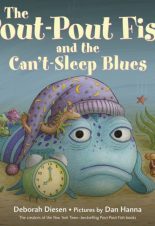
Through the narrator’s struggles, readers will learn that nighttime can often be when the brain is at its noisiest, but the child’s ability to bravely tune out scary thoughts and peacefully fall asleep will encourage children to do the same. Readers will be drawn in by the imaginative illustrations and fall deeper in love with the story as they find themselves relating to the child’s struggles. The humorous images will engage children and reinforce the idea that thoughts are often just the imagination running wild. Good Night Thoughts is an essential and entertaining tool for helping children learn how to identify and manage their anxiety before bedtime. If you know a child who has a difficult time falling asleep, pair Good Night Thoughts with Pippa’s Night Parade by Lisa Robinson, Arlo, The Lion Who Couldn’t Sleep by Catherine Rayner, and The Pout-Pout Fish and the Can’t-Sleep Blues by Deborah Diesen.
Sexual Content
- None
Violence
- None
Drugs and Alcohol
- None
Language
- None
Supernatural
- None
Spiritual Content
- None


“I remember that my brain can be noisy. And that my thoughts are sometimes jumpy. And then I remember that all that noise and all those thoughts are just in my head.” –Good Night Thoughts
Latest Reviews
The Palace of Dreams
Is It Real? The Loch Ness Monster
Cork & Fuzz: Spring Cleaning
The Curse of the Mummy: Uncovering Tutankhamun’s Tomb
Makeda Makes a Birthday Treat
Scout’s Rainy Day
Journey of the Pale Bear
Ready to Wear
Dark Heir