
Buy This Book



“To the Indians of California, the gold rush looked less like an adventure and more like an invasion. Miners drove away the deer and other game that Indians had always relied on for food.”–Which Way to the Wild West?
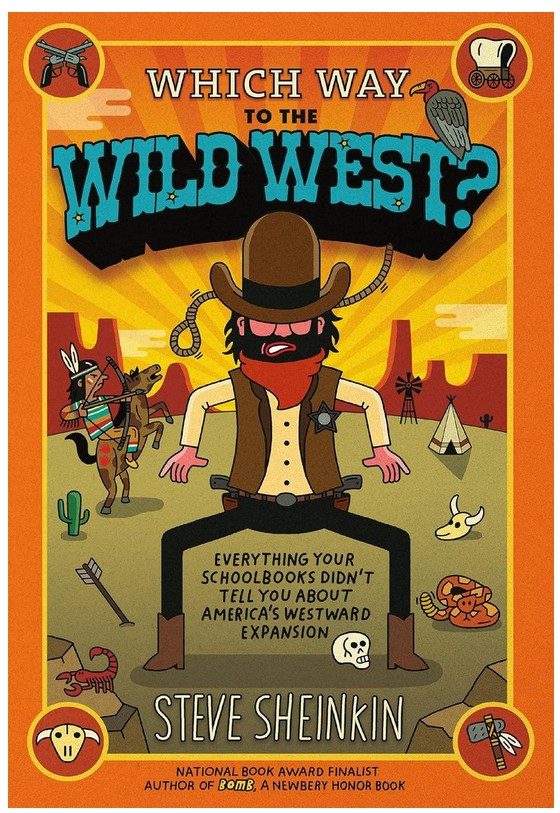
Which Way to the Wild West?: Everything Your Schoolbooks Didn’t Tell You About America’s Westward Expansion
by Steve Sheinkin
AR Test
10+
Score
6.8
288
1805: Explorer William Clark reaches the Pacific Ocean and pens the badly spelled line “Ocian in view! O! the joy!” (Hey, he was an explorer, not a spelling bee champion!)
1836: Mexican general Santa Anna surrounds the Alamo, trapping 180 Texans inside and prompting Texan William Travis to declare, “I shall never surrender or retreat.”
1846: A band of travelers, including the soon-to-be notorious Donner family, becomes trapped in the Sierra Nevada, forcing them to decide whether it is better to eat each other or starve to death in the snow.
1861: Two railroad companies, one starting in the West and one in the East, start a race to lay the most track and create a transcontinental railroad.
Get the feeling the world’s changing quickly? Welcome to the thrilling, tragic, and downright wild adventure of America’s westward expansion.
Which Way to the Wild West? covers Western Expansion in 11 chapters and is jam-packed with information that will leave some readers’ heads spinning, even though each chapter is broken into smaller sections with clear titles like “Santa Anna Does It Again.” The book covers a vast cast of historical figures, including future presidents, religious leaders, and commoners. While all this information will thrill history buffs, other readers won’t have enough stamina to keep track of the rapid change of topics.
Many books that discuss the founding of America gloss over the violence that permeated throughout early America. Which Way to the Wild West? isn’t shy about showing how immigrants’ greed for land and gold shaped the country and negatively affected minorities and Indigenous people. For Indigenous people, the gold rush was “like an invasion.” The miners drove away the deer and game that they relied on for food. “They chopped down forests and polluted salmon streams. When some Native Americans tried to join the search for gold, they were violently driven away from good mining spots.” To make matters worse, “newcomers brought new diseases that devastated the native villages.”
Many readers will be shocked at the Americans’ cruelty when it comes to the Native Americans. To force the Plains Indians off their land, the U.S. government supported buffalo hunters because “once there were no more buffalo to hunt, Plains Indians would no longer be able to roam freely across the plains. Unable to live their traditional way of life, they’d be forced to settle down on reservations.” When this plan did not work, the U.S. military slaughtered Indigenous women and children. In the end, many Native American leaders—Sitting Bull, Crazy Horse, and Chief Joseph—could not win against the U.S. military, and their way of life ended. To learn more about the Native Americans’ struggle to keep their land, read Native American Heroes: Osceola, Tecumseh, & Cochise.
The founding of America was only made possible because of violence, greed, and broken promises. Which Way to the Wild West? discusses the events in a matter-of-fact tone that often uses humor. Despite this, many of the quotes from primary sources show the gravity of the situation. For example, soldiers killed many of the Lakota people who were unarmed. One soldier said, “It was a thing to melt the heart of a man, if it was of stone.”
Western Expansion ended when all of the Indigenous people were forced onto reservations, the cowboys retired, and the land was divided and fenced “into farms, and ranches and towns.” By the end of the book, readers will have a better understanding of how Western Expansion shaped the country in both positive and negative ways. Readers who want to learn more about American history can also read the fiction books Will’s Race for Home, In the Footsteps of Crazy Horse and Alamo All Stars.
Sexual Content
- None
Violence
- The book contains many deaths due to animals, accidental shootings, and murder. The deaths that are not described in detail have been omitted from the list below.
- James Beckworth, a mountain man, was attacked by a grizzly. “The bear smacked Smith around like a doll, smashing several of his ribs. Then it took Smith’s head in its teeth and shook him back and forth. . . The scalp had been ripped from Smith’s skull. One ear was hanging on by a twisted strip of skin.” Someone sewed the ear back on, and “Smith’s ear stayed on.”
- During the Alamo, the Texans surrendered. “Santa Anna’s soldiers killed all 183 Texas soldiers—stabbing many of them with bayonets after they had surrendered. . .” The Mexican soldiers defeated another town. “Mexican soldiers marched the prisoners to an open field, shot and bayonetted all of them, and set the bodies on fire.”
- After the Alamo, the Texans attacked the Mexicans and surprised them. After the attack, “It took Houston’s officers a while to get the Texans to stop killing Mexican soldiers. When it was all over, nearly six hundred Mexicans were dead compared with only nine Texans.”
- While the Donner party was in the desert, two of the men fought. “A man named John Snyder attacked James Reed with a whip. Reed stabbed Snyder, killing him.” Reed was kicked out of the group but survived.
- The Donner Party took a cutoff and was snowed in at Donner Lake. “Fifteen of the strongest members of the party” went for help but got lost. “Someone brought up the question on everyone’s mind: Should they kill and eat one member of the group in order to save the others?” They didn’t kill anyone, but when one of them died, “They cut the flesh from the bodies, roasted it, and ate it.” Only seven of them made it out of the mountain alive.
- Marcus and Narcissa Witmore were missionaries. When the Cayuse Indians began to die of disease, they killed Marcus. Then, the Cayuse men attacked other settlers. “Then a bullet came through the window, piercing Mrs. Witmore’s shoulder. . . Clasping her hands to the wound, she shrieked with pain and then fell to the floor.” The orphans whom the Witmores were caring for had to hide in the attic. Thirteen people died. Later, “The Cayuse men were tried for murder, found guilty, and hanged.”
- A Mexican miner named Joaquin Murrieta was accused of stealing horses and mules. When the Americans confronted him, they “pulled Murrieta off the horse, tied him up, and dragged him to his brother’s cabin. They wrapped a rope around his brother’s neck and hanged him from a tree. Then they tied Murrieta to the same tree and whipped him while his brother’s body swung back and forth from the branch above.”
- Murrieta survived and went on a killing spree, killing the men who had attacked him. “The governor of California offered a five-thousand-dollar reward for his capture.” A group of men “cut off Joaquin’s head, put it in a jar of brandy, brought it back to town, and charged people a dollar to see it.” No one was really sure if it was actually Joaquin’s head in the jar.
- Wilson was carrying mail for the pony express when Indians attacked him. Wilson was shot in the head with an arrow. “His friends tried to pull out the arrow, but the pointed stone stuck fast in his skull.” Wilson’s friend thought he would die, so they left him under a tree. When they returned, “Wilson lay unconscious for the next eighteen days” but he survived.
- As more settlers moved into the Indians’ land, tension mounted. “A group of Indian warriors killed a family of four in Colorado. Furious settlers brought the bodies into Denver and put them on display.” John Chivington, an army officer, led seven hundred soldiers to a Cheyenne camp that was primarily composed of women and children. Chivington told his men: “Kill and scalp all, big and little.”
- Chivington and his men attacked at night. “The Cheyenne fighters were nearly surrounded by American soldiers and were slowly driven out of their camp.” Some U.S. soldiers were “killing women and children, cutting off their scalps, and slicing up their bodies.” The death toll was over one thousand. Despite conducting a “dastardly massacre,” Chivington was not punished.
- Crazy Horse and his warriors wanted to attack a fort, so they waited for soldiers to come out to collect firewood. “Crazy Horse retreated to the top of a hill, trying to tempt Fetterman [a soldier] into attacking him. . . Fetterman led his men on a charge up the hill—and right into Crazy Horse’s trap. . . In less than thirty minutes of brutal combat, Fetterman and all his men were killed. About two hundred Indian fighters were killed or wounded as well.”
- The railroad companies hired Chinese men to do dangerous work that often ended in death. For example, men set off dynamite to dig through the mountain. “Chinese bodies flew from the cave as if shot from a cannon. Blood and flesh were mixed in a horrible mess.” Ten men died in that explosion.
- Two girls killed their stepmother “by pouring melted lead into her ears.”
Drugs and Alcohol
- A man was called “Big Drunk” because he was tall and often drunk.
- During a battle between the Mexicans and Americans, some of the soldiers seized someone’s brandy and “downed it in quick gulps.”
- During the California gold rush, “the price for a glass of whiskey was one pinch of gold dust.”
- When a man became ill, he was given brandy.
- Railroad inspectors were given whiskey. One inspector got really drunk, and when the inspector woke up, “he gave his official approval to the tracks.” When the tracks were completed, “there was a great abundance of champagne.”
Language
- An adult uses “Great God” as an exclamation.
- A miner told his wife, “I am willing to stand [the hard work of mining] to make enough to get us a home, and so I can be independent of some of the darned [censored] that felt themselves above me because I was poor.”
Supernatural
- None
Spiritual Content
- The first women to travel to Oregon were two missionary wives. Their goal was to teach Christianity to the natives.
- Some settlers believed in manifest destiny and that all the land should be theirs. “Some were convinced that God wanted it that way—that it was God’s plan to have the American style of democracy spread across the continent to the Pacific Ocean.”
- When the two railroads were connected, a gold spike was set in place. The spike had an inscription: “May God continue the unity of our country as the railroads unite the two great oceans of the world.”
- The Nez Perce believed that “We came from the earth, and our bodies must go back to the earth, our mother.” They also believed the Great Spirit made the world.
“To the Indians of California, the gold rush looked less like an adventure and more like an invasion. Miners drove away the deer and other game that Indians had always relied on for food.”–Which Way to the Wild West?
Latest Reviews
Elephant Secret
Archie Celebrates Diwali
Small Wonder
Haunted Mansion
Wabi Sabi

Impact: The Story of the September 11 Terrorist Attacks

Star Wars: The Wrath of Darth Maul

Olive Oakes and the Haunted Carousel

Star Wars: A New Hope: The Life of Luke Skywalker