
Buy This Book


“It is hard to believe such an upheaval, such a mutiny, ever took place, for the voyage began like any other. . .” Captain William Bligh. –The Mutiny on Board H.M.S. Bounty
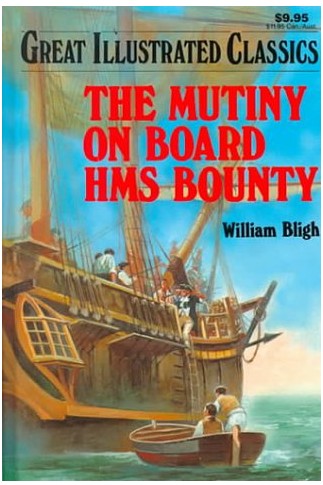
The Mutiny on Board H.M.S. Bounty (Great Illustrated Classics)
by William Bligh
AR Test
8+
Score
6.1
236
What began as a routine voyage would become the most infamous mutiny in maritime history. In April 1789, the H.M.S Bounty left Tahiti after a five-month layover, transporting breadfruit plants to the West Indies when Captain William Bligh was betrayed. Lieutenant Fletcher Christian seized control of the ship, forcing Bligh and eighteen loyal crewmen into an open launch with limited food and water. The mutineers didn’t expect Bligh and his crew to survive long on the open sea.
The Mutiny on Board H.M.S. Bounty is the incredible true story of Captain Bligh’s fateful voyage and mutiny, and his subsequent journey to bring his crewmen home. Written by Bligh, the book was first published in 1790 upon his return to England, utilizing his own logbooks which documented the journey in gripping detail. This version is part of the Great Illustrated Classics series published by Waldman Publishing Corp., an adapted collection of literary classics aimed at younger readers, featuring easy-to-read text and large illustrations on every other page. Author Deborah Kestel adapted Bligh’s original text to suit a younger audience. The language has been simplified to make it easier to understand while preserving the key events of the story.
One of the most fascinating aspects of this book is the ambiguity surrounding the mutiny itself. Fletcher Christian never directly told Captain Bligh why he was taking command of the Bounty. Bligh speculated that it might be his punishment for insubordination; in that time, corporal punishment was the norm in the Royal Navy, and Bligh thought himself “no more stern than any other ship’s captain.” He also believed that the crew missed the relaxed lifestyle they had enjoyed with the natives during their five months in Tahiti. The book also shows that not every mutineer was comfortable with Christian’s actions. Some crewmen objected to leaving Bligh and his loyalists with so few provisions, believing it amounted to “murder.” Of course, since this book is based on Bligh’s personal account, it is only one side of a larger story.
Regardless of the mutiny’s motivations, Bligh’s subsequent adventure is undoubtedly one of the most impressive survival stories in history. With only a small launch (boat) and a limited supply of food and water, Bligh was able to successfully navigate 3,618 miles of the Pacific Ocean including braving torrential downpours, an oppressive sun, and attacks from natives, successfully making it to a Dutch settlement on the island of Timor. Only one man was lost, John Norton, who was killed during an escape from a beach of hostile natives. Bligh’s true accounts, combined with vivid illustrations, capture the spirit of survival, determination, and pure seamanship in its finest form.
In total, The Mutiny on Board H.M.S. Bounty is an engaging, immersive introduction to history’s most infamous mutiny. Deborah Kestel transforms Captain William Bligh’s firsthand account into an approachable format for younger readers while maintaining the intrigue and historical significance of the original text, simplifying the eighteenth-century language and nautical terms. Artist Brendan Lynch’s beautiful, full-page illustrations further help bring this incredible true story to life. This Great Illustrated Classics version is perfect for young readers who are interested in history, exploration, and true stories of survival against all odds.
Sexual Content
- None
Violence
- In 1779, Bligh served as a sailing-master on Captain James Cook’s final voyage. When at Kealakekua Bay, Cook “was killed, beaten to death by natives who thought he was a god and would return in another body.”
- Captain Bligh punished one of the seamen, Matthew Quintal, for “insolence and mutinous behavior,” ordering “twenty-four lashes. . . This may have seemed harsh, for six blows makes the whole back raw, and twelve leave a man’s back in ribbons.” Bligh demands “complete and immediate obedience” from his crew and doesn’t view whippings as “cruel or uncommon.” The following page shows an illustration of Bligh ordering Quintal to be lashed, with the caption, “Twenty-four lashes for Matthew Quintal.”
- After part of a boat’s rudder is stolen in Tahiti, Captain Bligh orders the sailor on watch to receive “a dozen lashes” in front of the island’s chiefs. Despite their pleas for mercy, Bligh believes the punishment is necessary to discourage further thefts and preserve good relations with the Tahitians.
- Three crewmen desert the Bounty but are captured after more than two weeks in hiding. Their ammunition is ruined by seawater, forcing them to surrender “without a fight.” They are returned to the ship and “severely punished.”
- The following day, Captain Bligh orders a seaman to receive nineteen lashes for “striking an Indian.” Bligh states that the sailor’s actions were “so totally against [his] orders” that he “could not let it go unpunished.”
- During the mutiny, Fletcher Christian and three other mutineers burst into Bligh’s cabin. They “dragged me out of my bed, tied my hands. . . behind my back, and threatened me with instant death.” Christian “held a cutlass” while the others carried “muskets or bayonets.” When Bligh demands “the reason for such violence,” Christian warns, “Hold your tongue, sir, or you are dead this instant!”
- The ship’s boatswain is ordered to lower the cutter (a smaller boat) for Bligh and his loyalists but protests that “it would be murder to set men adrift in this cutter.” The mutineers reluctantly allow him to lower the larger launch instead.
- Bligh looks at the “villainous seaman” who “had their guns clocked and their bayonets fixed at [him]. . .They were like vicious animals waiting for the kill.”
- Bligh attempts to plea with Christian who is unwavering. When trying to speak again, Christian roars, “Quiet! Or I will have your brains blown out!”
- Bligh and the other survivors encounter an island whose inhabitants may attack them. When Bligh refuses an invitation to stay the night, an older chief declares, “You will not sleep on shore? Then Mattie!” (“We will kill you!”). As Bligh’s crew slowly retreats, the islanders begin knocking stones together.
- As Bligh prepares to leave the island, a seaman returns to shore to cast off the stern rope despite warnings that, “You’ll be killed!” Moments later, “two hundred natives” attack, and the man is knocked down as “the stones flew like shots from a cannon.” The islanders seize the rope, forcing Bligh to cut it to escape. Looking back, Bligh sees them “standing over the poor seaman they had killed,” with two of them “still beating him about the head with stones.”
- Later, an exhausted seaman gives Bligh a “mutinous look” and claims he could be “captain as well as [Bligh].” Determined to “keep [his] command or die in the attempt,” Bligh grabs a cutlass and orders, “Take a hold of a cutlass, man, and defend yourself!” The sailor immediately backs down, shouting, “You’ll kill me!” and offering “his humble apologies.” No fight occurs, but the following page shows an illustration of Bligh holding the cutlass over the kneeling sailor, with the caption “Defend Yourself!”
- Bligh sends a party to catch birds for food, but they return with only twelve after one man “disturbed the birds, so a great number of birds were lost to [them].” Bligh writes, “Again, the folly of one man had ruined it for us all ” and punishes the sailor by giving him “a good beating.”
Drugs and Alcohol
- During dinner, the Tahitians become interested in Bligh and his crew’s toasts to “His Majesty’s health.” Bligh writes, “By this time the natives have become so fond of wine that they frequently remind me of His Majesty’s health in the middle of dinner by calling out, ‘King George.’” They then “tease me again until I fill each of their glasses to the brim so they may drink to his health again.” The following page includes an illustration of a cheerful Tahitian holding an empty, dripping wine glass with the caption “Drinking to King George’s Health.”
- A few months before their departure from Tahiti, the ship’s surgeon dies. “He had been ill for a long time. This unfortunate man drank a great deal throughout the voyage, he scarcely stirred from his cabin. When he did, it was because he was dangerously drunk.”
- After the mutiny, few things lifted the survivors’ spirits more than rum. “I generally gave a teaspoon or two to each man. It was always good news when I mentioned the rum bottle.”
- As they approach Timor, Bligh describes two sailors, Elphinston and Lebogue, as “the most miserable objects” who looked like “death. . . I occasionally gave them a few teaspoonfuls of wine. Our hope of being able to complete our voyage was now the only real force behind our fight to stay alive.”
Language
- When Bligh accuses Fletcher Christian of stealing coconuts, Christian responds, “I hope you don’t think I am so mean that I stole yours.” Bligh angrily replies, “Yes, you damned hound, I do. Someone has stolen them!”
- During the mutiny, Christian tells Bligh that he has “been in hell for these weeks and will bear it no longer.”
Supernatural Content
- None
Spiritual Content
- After escaping an attack from an island’s natives, Bligh and his crew “thanked God” for “our miraculous escape.”
by Nicholas Paragano


“It is hard to believe such an upheaval, such a mutiny, ever took place, for the voyage began like any other. . .” Captain William Bligh. –The Mutiny on Board H.M.S. Bounty
Latest Reviews
The Mutiny on Board H.M.S. Bounty (Great Illustrated Classics)
Mr. Putter & Tabby Catch the Cold
Jackson Pollock Splashed Paint and Wasn’t Sorry

Once For Yes

How to Save a Tortoise
The First Thanksgiving
A Sweet Diwali
Windows

Elephant Secret