
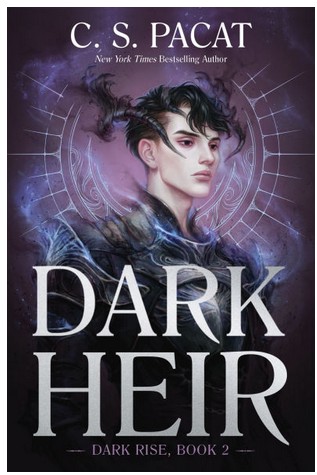
Dark Heir

Centuries ago, the forces of Light and Dark waged a devastating war, resulting in the destruction of magic. That is, until the present day. In 19th-century London, the dead villains are being reborn and reclaiming their destiny. The only hope of stopping them is the Stewards, a secret class of ancient warriors.  

At the heart of the Stewards’ forces is seventeen-year-old Will Kempen, prophesied to one day defeat the Dark King. But as Will and his allies embark on their most dangerous quest yet, Will hides a terrible secret. Will is not their destined hero. He is the Dark King reborna role he does not want nor claim. To stop the gathering Dark Forces, Will must travel into the underbelly of the old world. But as he unravels layers of his forgotten past, Will fears the fine line between confronting history and repeating it.  

Will is a complex, yet sympathetic protagonist. While he lies for most of the book, his deception does not necessarily make him unlikable. For one, the stakes are too high. Every time Will hints at the topic, the surrounding cast always states their intent to kill the Dark King. Secondly, Will’s end goal serves the common good. He wants to prevent anyone from accessing the Dark King’s power, even if it means limiting his own power. For example, the Dark King has an undead army buried below a mountain, and Will attempts to prevent its uprising and the conversion of more innocents. Ironically, the supposed heroes of the book, the Stewards, prevent Will from saving the day. Readers will like Will but will be frustrated by the quick, arguably irrational condemnation of his character.  

The only ally who remains loyal to Will is James St. Clair. James is the reborn version of Anharion, the Dark King’s warrior and lover. James has a complicated relationship with his past life. On one hand, James embraces it, often playing into the villain role as a survival tactic. On the other hand, deep down, James wants to be a protector, which is why he is attracted to the illusion of Will as “the chosen savior.” James believes that Will can break the cycle, when in reality, any association with Will accomplishes the opposite. Further complicating their relationship, Anharion wore the Collar, a magical artifact that reportedly gave the Dark King total control over his actions. Thus, the extent Anharion truly supported the Dark King remains unknown. Presumably, the answer will be revealed in the next book in the series.    

Violet and Cyprian are Will’s friends and allies, but their rigid worldviews create complications. Cyprian, a diligent rule follower, is repulsed by the idea of working with James and blindly adheres to the Stewards’ teachings, placing obedience and group identity above all else. Though aligned with the supposed good guys, his inflexibility borders on prejudice—particularly when he immediately turns against Will. 

Violet represents a softer version of Cyprian’s ideology. Like him, she wants to do the right thing but fails to recognize that reality doesn’t always fit neatly into the Stewards’ framework of Dark versus Light and Good versus Evil. While their hurt over Will’s lies is understandable, both characters abandon him with startling speed, arguably betraying him more severely than he ever betrayed them. This hasty rejection makes Violet and Cyprian feel one-dimensional, as though they make irrational decisions merely to generate conflict rather than acting from genuine character motivation.  

Dark Rise is told in the third person, with each chapter narrated from a different point of view. It primarily focuses on Will, who is the most interesting character to follow. Readers will enjoy the fast-paced plot and the romantic tension building between Will and James as they unravel layers of their forgotten past. While drawn to James, Will is also wary of him, afraid that pursuing a relationship will bring them closer to their past selves. However, both boys bring out the best in each other. Will brings out James’ heroic side, encouraging him to use his powers for good. James teaches Will to be less afraid of the past and question the black-and-white thinking the Stewards instilled in him.   

Dark Heir is a fascinating take on the Chosen One trope, where no character is quite what they seem. It continues building upon the mysterious past hinted at in the first book, while leaving the most significant questions unresolved, presumably until the third and final installment. For example, was the Dark Heir a world-ending villain or a victim of the Stewards’ smear campaign? Did the Collar control Anharion’s actions or did it serve some unknown secondary purpose?  

Overall, Dark Heir explores themes of indoctrination, generational burden, and systemic corruption against a fantasy backdrop. It also provides compelling characters to keep readers emotionally invested. Readers who enjoy dark fantasy will enjoy this book because it does not shy away from the complex moral consequences of a magical war, featuring deeply conflicted yet compelling characters.  

Sexual Content     

  • James is attracted to Will. In one scene, James remembers “how it had felt to have all that attention focused on him, dark eyes looking down into his own, a warm hand brushing hair from his face. God, he hated when he was weak.”  
  • Will is attracted to James. He frequently likens James to poetic figures, such as “a consumptive heroine from a painting, the kind that dies beautifully.”  
  • While the past remains a mystery, the Dark King and Anharion are implied to have had a sexual relationship. For example, James asks Will to “take what was [the Dark King’s]. Prove you’re not afraid. . . Kiss me.” Will turns down the offer but promises to reconsider after they are out of danger.  
  • In one scene, James helps Will unlock his powers. At times, the author’s word choice feels more sexual than academic. As Will describes, “James’ magic was flowing over his body in warm, slow, rippling oscillations, the gentlest pulsing. . . The hot, sweet feel of James blazed through him. . . His veins lit up with power.”  
  • After Will’s identity is revealed, his friends attack him. James saves Will. Overcome with relief, Will kisses James. Will’s “hands pushed inside [James’] jacket, up and over his warm shirt. . . Will touched [James’] shivery hot skin, then pulled his cravat from his throat.” Will stops the kiss when he sees James wearing the Collar. Scared he lacked consent, Will vomits. However, some textual clues indicate that, contrary to the historian’s claims, the Collar does not strip James of autonomy. For example, after James first wears the Collar, he describes feeling “no compulsion. He felt nothing at all.”  

Violence     

  • Sinclair is the main villain and wants to exploit the Dark King’s powers. To raise the Dark King’s undead army, Sinclair begins a digging expedition in the mountain where it is located. The locals dislike Sinclair’s men and kill one named Howell. As Will describes, the local “shot Howell. Howell fell to the ground.” 
  • While exploring the mountain holding the Dark King’s army, Will and his friends are unexpectedly attacked by bandits. James dares the bandits to “shoot everyone,” then uses his magic to catch the bullets and send them flying “backward into the throats of the men who had fired them. The closest bandits fell, their bodies riddled with lead, their lives cut short.” James allows the remaining bandits to flee. 
  • While using his powers to occupy another body, Will is recognized and stabbed. Will describes, “a rush of wet and blood as [the sword] drove him to the ground. . . the sword that was in his gut. . . he choked on blood.” Will returns to his body, and the unnamed old man he was occupying presumably dies.   
  • While using his powers to possess his follower, John Sloane, Sinclair puts the Collar on James. However, the Collar does not work as Sinclair intended, allowing James to kill the body Sinclair is occupying. With a “single slash of his sword, [James] severed John Sloane’s head.”   
  • When Will’s identity is exposed, Violet and Cyprian attempt to hurt him. Cyprian breaks the brand, a magical artifact that would allow Will to stop the Dark King’s army. Violet gives Visander “Ekthalion,” a powerful sword that Will once gifted her. Visander is a reborn warrior of the Light Forces. However, James helps Will escape before he can be harmed.    

Drugs and Alcohol     

  • Will encourages a captain working for Sinclair to drink an entire bottle of wine. Will wants the captain to lower his guard and reveal information about Sinclair’s plans.  
  • James drinks from a flask of alcohol he found in his late father’s desk. However, he does not get intoxicated. The flask’s primary purpose in the scene is to segway into a conversation about his father.  
  • When Will reflects on his job as a ship hand, he remembers drinking to fit in with his coworkers. He describes his “first coughing splutter of dock gin. . . The men had laughed, slapping him on the back.”  

Language    

  • Hell is used once when Will observes James overexerting his powers, and Will thinks he looks like “hell.”  
  • Goddamn is used infrequently. For example, after James takes too long opening a gate, Violet shouts, “James, open the goddamned gate!”  
  • Shit is used twice. For example, after James sees the Collar, he says, “Shit.”  

Supernatural    

  • There is a world of magic, divided between Light and Dark Forces. Characters possess a wide range of abilities, as listed below.   
  • In the previous book, Katherine – Will’s love interest and the true Chosen One – dies. In this book, Visander, a reborn warrior of the Light Forces, takes over her body. Visander awakens buried in Katherine’s grave. He narrates that he “was buried, his sounds smothered by the earth above and around him,” but after some digging, “his grasping, reaching hand broke out into space.”  
  • Will develops the power to “scry.” He can temporarily inhabit other people’s bodies. For example, Will “scries” into the body of a guard holding his friend captive to free said friend.  
  • The Stewards are extremely strong and fast. For example, Cyprian jumps across large distances, such as between two diverging rock planes.  
  • James can move things with his mind. For example, James catches and redirects bullets.  
  • There are cursed artifacts that carry spells. The Collar is supposedly cursed to make James obedient to the Dark King. Ekthalion is a powerful sword that killed the Dark King. The brand controls the Dark King’s undead army.     

Spiritual Content     

  • None

by Kerry Lum
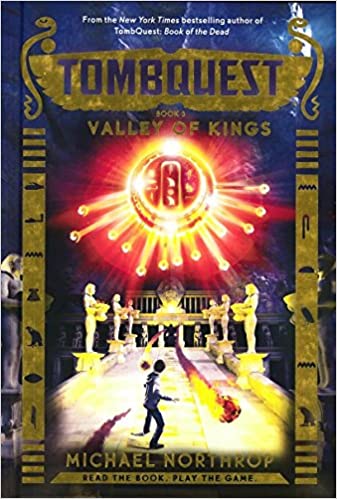
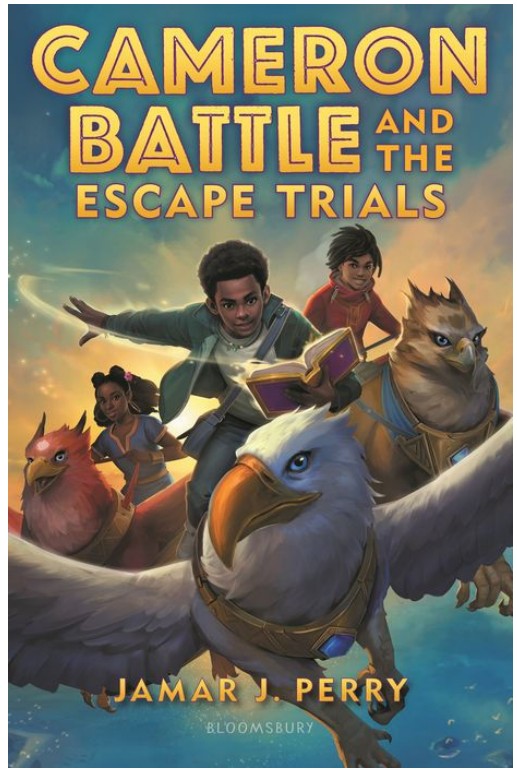
Cameron Battle and the Escape Trials

After the capture of the evil enchantress Amina, Cameron Battle escaped the magical kingdom of Chidani with his two friends, Zion and Aliyah. However, the death god Ekwensu still wants to tear down the magical barrier between Chidani and reality and conquer everything in sight, and Cameron, the Last Descendent, is the only one who can stop him. However, Cameron also must go to school—at least until he’s called back.   

Middle school is not what Cameron is expecting. Bullied by Vince, Cameron must keep his head down and avoid fighting back with the magical fighting style Dambe, which would reveal magic to his entire school. The intelligent, laid-back Zion supports Cameron and helps him see the consequences of retaliation. Yet one evening, Vince attacks the trio on their walk home. During the fight, Vince reveals he’s possessed by a mmo, a terrible supernatural creature working for Ekwensu. The only way to save Vince is to return to Chidani. With this urgent mission, Cameron finally calls forth the Book of Chidani, opening a portal for himself and his friends, Zion and Aliyah.  

In Chidani, the kind and determined Cameron has his priorities straight: retrieve Vince from the Crystal City, heal him, and send him home. The friends encounter the gods Ala and Anyanwu and brave tricky trials, impressing the gods enough to win both Vince’s freedom and clues to magical relics that could defeat Ekwensu. Throughout these escapades, Aliyah proves especially helpful, cleverly outsmarting trials and saving her friends. After sending Vince home with their new clues in hand, Cameron and his friends set out to find the relics and protect Chidani. Along the way, Cameron grapples with his responsibility as the Last Descendent, learning to balance his desire to see his parents with the need to protect an entire kingdom. 

While this novel brilliantly brings Igbo gods and magic to life, the plot is more convoluted than it needs to be. Cameron experiences growth, but Zion and Aliyah don’t develop much as characters. The conflicts are more complex than the character development supports, and Cameron’s happy ending doesn’t quite align with his journey. That said, the accessible language and quick explanations of unfamiliar terms keep readers engaged.  

Fans of all things mythical will love the fierce fight scenes, elaborate magic system, and loyal friendships. Supernatural creatures—from spirits of the dead to violent sea serpents to gryphons—fill the pages. Cameron faces the wrenching choice of whom to protect and is forced to find a solution that benefits everyone or lose everything. Overall, this powerfully creative story delivers a strong message about leaning on friends and the importance of responsibility and decision-making, making it worth reading for its magnificent worldbuilding and entertaining adventure. 

Sexual Content 

  • None 

Violence 

  • At school, Cameron encounters a bully named Vince, who pushes him. Cameron describes the experience, “Something pushed me, hard, from behind, and I fell to the floor, dropping my gym bag in the process. I turned around and there was Vince, standing over me, that same smirk on his face. I thought I saw a red tinge of light surround his body, flickering in and out in the space.” 
  • While walking home, Cameron and his friends, Zion and Aliyah, are again attacked by Vince, and they realize that he is possessed by a mmo, a supernatural creature bent on destroying Cameron. “Zion grabbed Vince by the legs and pulled him back to the ground with all his strength. Vince maneuvered out of Zion’s hands and kicked him in the stomach, sending him flying through the air. Dambe seized [Cameron] as [he] moved. . . [Cameron] caught Zion right before he fell; he clutched at his midsection, yelping in pain.” At the end of the battle, Zion, Cameron, and Aliyah barely have any injuries, and Vince’s condition is unknown since he falls through a portal to Chidani.  
  • While attempting to rescue Vince and Zion, Cameron and Aliyah fight off a monster serpent, called a mgbaji. In Cameron’s words, “I tried to grab the mgbaji once again, but I was too far away now. . . With a swipe, [the serpent] reared around and slammed its tail against my chest, sending me flying to the other side of the pool, my back striking the marble. . . The mixture of water and air slammed into me, sending me hurtling backward, right into the marble again. This time, though, I crashed through the wall and sunk into the rock. Pain radiated through every part of my body as my head jerked from left to right. I tried to gain my bearings, but I shook so violently from dizziness that I retched all over my clothes and into the water around me.” Cameron and Aliyah defeat the serpent, though Cameron has a concussion.  
  • In the journey to find the last magical relic, Cameron, Zion, and Aliyah encounter more evil mmos they need to fight. “[Cameron] connected with two mmo almost immediately, the thought of seeing [his] parents again guiding [his] movements. When [Cameron] slashed [his] sword down, [Cameron] cut them both at the same time, slicing them right across the chest. They screamed, and when they died, they burst open, magma falling to the sandstone.” The fight lasts a full chapter, though none of Cameron’s friends sustain serious injuries. Cameron breaks his nose. 
  • A former Descendent describes her experience with slavery and mmo to Cameron. “After I escaped slavery, I went to Chidani alone. When I grew older, I tried to Summon my [family’s souls] through the barrier, to bring them back to me after years of being the Descendant. I almost destroyed the Book in the process. And I lost my life. You see, if I had succeeded, that which gives us power would be no more, the barrier would cease to exist, and the mmo would take over everything.” 
  • Growing desperate to find the Book, Amina lets the god of death, Ekwensu, possess her. In this form, she battles Cameron for possession of the book. “[Cameron and Amina] engaged in battle again, an equal match. When [Cameron] grabbed her by the shoulders, a look of surprise crossed her face. . . the mmo slashed at [Cameron] with gnarled nails, lifting [them] into the sky to escape [the mmo]. She punched [Cameron] multiple times, but [Cameron] continued to hold [Amina].” The whole battle for the Book and control of Chidani lasts three full chapters. In the end, the Palacia is reduced to rubble, Cameron, Zion, and Aliyah have minor injuries, and Amina dies.  

Drugs and Alcohol 

  • None 

Language 

  • Language is very tame, using words like stupid, idiot, and hell infrequently. 

Supernatural 

  • The book is about three kids who travel to a magic kingdom to save it; therefore, there is magic on nearly every page in this book. There are also supernatural creatures, gods, and humans with magical powers. All characters use a mystical fighting style called Dambe that gives them enhanced abilities and instincts as they fight, no spells needed.   
  • Debating what to do in the aftermath of their first adventure, Aliyah asks Cameron to summon the Book of Chidani to consult it. Cameron describes the experience, “A deep intentional feeling settled upon my shoulders and then into my chest as I willed the Book forward, from its hidden place in my soul. An image of Agbala, the goddess of healing and justice, emerged in my mind as I pushed even deeper. Sweat beaded against my forehead with the effort.” 
  • While being bullied, Cameron notices something strange about his bully. “Vince sneered, staring at me. There it was again, that red glint in his eyes.” This later proves to be a sign that a mmo is controlling him. Cameron explains Vince’s appearance. “His appearance had started to change, to morph into something else. In one second, a dark smoke emerged from his body and a ruby illumination covered him. In another, it disappeared, and Vince became normal again. I knew what this was, but I was too scared to say it aloud, because if I did, then that meant it would be true.” 
  • Vince, Cameron, Aliyah, and Zion are all pulled into Chidani. Cameron describes the portal: “Vince and I continued to struggle as we spiraled through lightning, darkness, and rain. The rip opened into a void; it was full of shadows, swirling around and around, the wind threatening to pull us apart. The tornado we flew in kept us afloat, but I had a horrible suspicion that if we stepped out of its confines, we’d fall into the spinning darkness.” 
  • As Cameron, Zion, and Aliyah reunite with their friends from the Palacia in Chidani, their friend Makai explains that time runs differently between Chidani and the real world. “‘What’s going on?’ Zion asked, struggling out of Makai’s hug. ‘How long have we been gone? For us it was about two months.’ ‘You were gone for just a few days,’ Makai said.”  
  • Amina is being held in a magical dungeon. Queen Ramala takes Cameron and his friends to the dungeon. “The sun encircled [Amina] like chains, binding her into one place as she floated above the ground.” 
  • Going to rescue Vince, Cameron, Zion and Aliyah visit the Crystal City, home of the goddess Ala and the aziza. The aziza are “[magical creatures who] nestled their kingdom in the trees of the Igbo people, hiding in secret, but honoring their duty to the humans by healing them when needed. People believed in them, but none had ever seen them, for they had retreated once it was known that colonizers had breached Nigeria’s waters.”  
  • Later, Cameron describes an aziza. “Soft wings flew behind [the aziza], the color of night. He was tall, taller than an aziza should’ve been from what I had seen. A curved sword was hitched to the side of his clothing, which consisted of a ruby brocade vest, tight shokoto trousers, and light armor. He approached gracefully, almost as if he were floating across the ground.” 
  • While in the Crystal City, Ala binds Zion to the city to incentivize Cameron and Aliyah to participate in the trials. Ala snaps her fingers and “[Zion] gasped and choked, holding on to his neck. He fell against [Cameron]; [Cameron] caught him as his eyes closed, but he felt different. Light. As if all his weight had turned to nothing.” 
  • When they leave the Crystal City, Ala blesses Cameron, Zion, and Aliyah’s gryphons, Ugo, Ike, and Odum respectively, to better aid them in the battle ahead. “[Ugo’s] snow-white color had turned the color of flame, a mixture of different shades of oranges and reds. Connecting to [Ugo] felt familiar, though, as if [he and Cameron] were one. By the time [Cameron] was done marveling at Ugo, Aliyah and Zion had jumped on Odum and Ike. Flames covered our entire area of the desert for miles, the gryphons’ wingspans so large that they encompassed everything.” 
  • After the Crystal City, Cameron, Zion, and Aliyah go to the Sun Kingdom to find the last magical relic they need to defeat Amina. Cameron discovers a special ability—that he can summon gods to him. He summons Anyanwu, the sun god. Cameron describes the encounter, “[Anyanwu] had changed his appearance again, his gigantic nature of earlier now human size. But, even looking at him now, he was nothing resembling normal. An emerald agbada flowed from his neck to his feet, while his hair spilled down his back, golden beads drawn through it. He produced flame out of thin air before walking around the small room, lighting the candles hanging on the ancient sconces in the wall.” 
  • Traveling back to the Palacia with all three magical relics, the trio meets more mmos, supernatural creatures created by Amina to destroy Chidani. “The mmo stepped out from the shadows, some falling to the floor, and some suspended in the air. They were dark-and-gray creatures, their eyes a deep scarlet, their skin the color of stone. Cloaks of darkness shrouded their shoulders as they materialized. However, these mmo were different from those [Cameron, Zion, and Aliyah] had encountered before; their bodies blazed with fire, flames reaching to the sky in place of their hair. Skeletal arms reached out toward us, mixed with gristle and marrow.” 
  • Cameron discovers he can also summon souls and tries it on a volunteering friend, Bakari. “A grunt escaped Bakari’s mouth as it fell open. A white, filmy substance floated out, flying toward [Cameron’s] hand. [He] grasped it, caressing it, as it flitted in and out of [Cameron’s] hands. [Cameron] marveled at it, feeling life teem within [him]. It took much effort to control it, but it was Bakari’s soul. When [Cameron] looked down at [Bakari], [he] noticed that the substance was still attached to [Bakari’s] mouth as he stared at [Cameron], the life in his eyes mostly gone.” Cameron decides not to use this power after this experiment.  
  • With a helpful tip from a god, Cameron discovers that his dad is alive in the underwater kingdom, living as a mondao (a kind of mermaid). “When [Cameron] looked down, [Cameron] noticed that [his dad] only had one foot. A mondao tail snaked to the sand in place of his left one, corded with diamonds and rubies. But when [Cameron] blinked, it changed into a human foot as Daddy took a step forward. While a beautiful necklace surrounded his neck, a deep wound marred his bare chest, right in the middle.” 
  • Growing desperate to find the Book, Amina lets the god of death, Ekwensu, possess her. She offers her soul for the power to destroy Chidani. Amina says, “Use me. Use my body and soul. Fuse yourself with me to directly intervene in the quest to kill the Descendant, Ramala, and take the barrier for ourselves. The pain would be great, but the victory would be greater. I admit I couldn’t do it the first time on my own; if you help me, we can and will win. Just think, if we are able to successfully kill the Descendant and steal the gifts. . . ” There is no description of this physical process. 
  • At the end of the great battle, Cameron meets his mother’s ghost, freed from mmo form. “[His mother] stepped out of the shadows, the most beautiful thing [Cameron] had ever seen in [his] life. She was dressed in a white robe that swept the floor as she walked, as graceful as an angel. Her braided hair fell down her shoulders and to the center of her back. A single necklace wrapped around her neck. A pinkish aura surrounded her.” 

Spiritual Content 

  • The traditional Igbo religion is a spiritual system predating Christianity, centered on a supreme creator god (Chukwu/Chineke) but also involving numerous lesser deities (Alusi) linked to nature, ancestors (living dead), and a personal spirit (Chi). It’s a pantheistic/polytheistic faith, deeply tied to community, nature (like the Earth Goddess Ala), and morality. Cameron meets several of the Igbo gods. 
  • Just like the first book, when Cameron, Zion, and Aliyah travel to Chidani, they encounter elements that have roots in the real world, like the gods of the Igbo culture. They fight with some gods and work with others to save the kingdom from the Queen’s treacherous sister Amina. Given this, the book discusses many creation myths and Igbo religious references. There are also the occasional vague references to Christianity and ghosts. 
  • The Book of Chidani serves as both a guide to the kingdom and a religious text. An example excerpt from the Book reads, “Agbala created the Descendants when she gave the Book to the enslaved Igbos as they were forcefully taken to the Americas. The Book followed them across the ocean, and Nneka was the first one who touched it, becoming the first Descendant, tasked with power and knowledge, to keep Igbo history alive.” 
  • Cameron has a vision of the goddess Mmiri. “[Mmiri] was undeniably beautiful, and immediately recognizable. A crown crested her head, covering it from side to side, silver spikes striking the air around her. A star sat on top of the middle spike, its light almost blinding [Cameron]. What looked like seashells were fastened to her chest and upper arms, multicolored and heavy. Her midriff was almost bare, with a tattoo in the form of a sun emblazoned around her naval. Her iro was cerulean, a skirt that flowed along the wooden floor [Cameron] was lying on. [Cameron] gasped when she stepped forward, as one of her legs was in the shape of a mermaid’s tail.” 
  • In the Crystal City, Cameron, Zion, and Aliyah meet the goddess Ala and another god, her son Anyanwu. “[Cameron, Zion, and Aliyah] took a step back, stunned as [Ala] towered above [them], much taller than any god [they’d] seen so far. ‘Humongous’ was a word that came to mind, but even that didn’t embody all that Ala was. [Cameron] tried to avert [his] gaze from her to the male god behind her—who somehow was firmly asleep—but she snapped her fingers, bringing us back to attention.”  

by Kate Schuyler 

The Jumbie God’s Revenge

Even after everything Corinne has done to protect her village, they still don’t trust her. Her friends—Dru, Bouki, and Malik—have come to look past her jumbie heritage, but others refuse to believe she can help. When a large storm blows in, Corinne volunteers to lead her people to safer ground. As the first winds arrive, Corinne encounters the witch, who hints that not all may be as it seems. Corinne ignores the warning because she has more pressing matters, but as the weather intensifies, she’s forced to admit something supernatural is at work. During a brief reprieve, she seeks out the witch for answers, only to find that she has drowned. 

Determined to understand what’s happening, Corinne goes to Papa Bois, the jumbie of the forest, who reveals that the sky god Huracan has awoken angry and vengeful. If Corinne doesn’t find and appease him, the hurricanes could destroy the entire island. Summoning all her power and allies—including Mama D’Leau’s mermaids, a forgotten mountain village, and a lost monster at the sea’s bottom—Corinne dedicates herself to finding the sky god and saving her home. 

The Jumbie God’s Revenge skillfully weaves Caribbean folklore into the worldbuilding, making for an interesting read and delivering a very creative story. That said, readers averse to horror may want to avoid this book due to the macabre creatures and tone. 

While the book incorporates magical and monstrous elements, the chapters are often too brief, resulting in a jarring rhythm. The frequent perspective changes interrupt the story’s flow rather than enhancing it, especially for a novel with a primary narrator. Additionally, the storm sometimes overshadows the characters, driving the plot more than it should. The ending feels a little too neatly tied, though it provides a satisfying conclusion to the trilogy.  

The Jumbie God’s Revenge presents powerful themes of community and heroism through imaginative monsters, a complex world, and wonderful friendships. The story builds upon previous books, presenting Corinne with more challenging tasks and a larger support system. She discovers that monstrous appearances don’t always indicate monstrous character, and that building community means accepting people for who they are. Ultimately, this story delivers a powerful message through its fierce protagonist: spite doesn’t have to consume people—the more love is freely given, the more it grows. 

Sexual Content 

  • None

Violence 

  • As a direct result of the sky god’s actions, Corinne’s friend, the witch, is trapped in a box and cannot get out during the storm. “The water was up to her bottom lip. As it continued to rise, the white witch sent a final message. It rippled out on the water, stretching out of the swamp and into the sea. And then the witch slept.” The witch drowned.  
  • During the storm, the sea witch, Mama D’Leau, is whipped around. “The water pulled her away and crashed her into the rocks again. She felt the sting of another cut near the end of her tail. The pain traveled up her body and brought tears to her eyes that mixed with the saltwater of the sea. She wrapped her tail around the rock, anchoring herself in place. She would have to wait out the storm there, cowering, angry that it made her feel so small and helpless.” She is injured but eventually heals.  
  • When Corinne dives into the water to confront Mama D’Leau, they fight. “[Mama D’Leau] squeezed harder and pulled Corinne into its depth like a slowly turning screw. When Corinne was wholly engulfed in the tail, she looked directly into a pair of deep blue eyes that blinked out at her from the darkness.” Corinne cannot breathe but Mama D’Leau lets her go and Corinne is fine.  
  • Corinne tries to save her Aunt Severine, who doesn’t remember who Corinne is. Severine attacks Corinne. “[Corinne] crashed into the branches. Some of the sticks stabbed her skin, others scraped her flesh and scales, another gouged her tail. The branches folded into a cage around her. Her plaits were caught and her arms and tail were trapped. Her skin burned in the places the sticks had cut and bruised. She tasted her own warm blood in the cold water.” Corinne eventually gets through to Severine and heals from her injuries.  
  • Corinne confronts the sky god about the storm. “Corinne hurtled to earth [because of the sky god’s powers]. Her flames extinguished and every particle of air burned her raw, exposed body as she fell. She hit the beach hard, sending sand in every direction. Corinne screamed. The combination of the fall and the sea salt against her raw skin ravaged her. She tried not to move.” Her injuries heal quickly, and the sky god doesn’t stop the storm. The fight is described over a chapter.  
  • The storm attacks Corinne. “Each time, Corinne pressed against the side of the mountain for protection, but the rocks still hit her. Larger ones left bruises that made each of Corinne’s movements ache. Sharper ones left scratches that burned in the rain. But [the sky god] wouldn’t stop, so neither would she.” She heals quickly.  
  • After Corinne and Mama D’Leau’s fight, Mama D’Leau is trapped under rocks. When Mama D’Leau tries to get out, she gets cut. “Mama D’Leau refused to be pinned down again. She whipped her tail, cracking it against the current, trying to bend it to her will, but she flailed in the water and had to grab on to the edge of a piece of broken coral to steady herself. The coral cut into her hand but she didn’t let go. As blood darkened the water, Mama D’Leau sensed the smallest of the mermaids trying to reach [Mama D’Leau].” 
  • During the worst moments of the storm, some children end up in the water. The mermaids try to save them but aren’t successful. “[The mermaid] looked into the water and smiled when she saw [the boy she was trying to save], his arms reaching out to her. Her heart caught and she paused, waiting for him to arrive, but his face changed, from calm to anguish in an instant, and he opened his mouth. He gasped bubbles, pulling one hand to his throat. [The mermaid] raced to him and caught his limp hand to drag him to the surface. She turned his face up toward air and patted his back. She pulled him close to her body, hoping to feel his warmth again, but it was slowly draining away. It was too late for him.” He was the only child who died. 
  • During the storm, a boulder gets loose and rolls towards one of the villagers, Victor. “Victor just got his feet under him and looked back to see the rock coming at him from one side and the lagahoo [a kind of jumbie] from the other. The only way to get away from both was toward the cliff. He ran. As the rock closed in, Victor skidded to the edge and tried to come to a stop, but couldn’t. His arms flailed over his head as he teetered on the same ledge that Mama D’Leau had leapt from.” It is implied that Victor dies.  

Drugs and Alcohol 

  • None

Language 

  • None 

Supernatural 

  • This novel incorporates Caribbean folklore and references to the supernatural on nearly every page. Corinne and her friends have many interactions with magic, mostly through magical creatures (called jumbies). Since Corinne herself is half-jumbie, she has magical powers.  
  • The jumbies are aptly summarized while Corinne sits by the ocean, alone with her thoughts. “Corinne hadn’t believed in jumbies before Severine followed her out of the forest. She thought they were only stories that grown-ups told to scare the children on the island, stories about things that came out at night so little ones would stay in their beds. But then she encountered creatures with backward feet, women who shed their skin, and men covered in spiky fur with teeth as sharp as daggers. There was a jumbie who cared for the woods, and one who lived beneath the waves who would turn anyone into stone at a glance and who ruled the mermaids in the sea.” 
  • When Corinne needs information about a strange storm, she goes to the jumbie of the forest, Papa Bois. “The boulder seemed to tremble at the annoyance, and slowly unfolded itself, softening and smoothing, shaking dust and pebbles off its surface until it was a real man with hairy goat’s legs. Matted gray hair entwined with moss and leaves tumbled down the man’s back. Still crouched, the man looked up at the sky, slowly, as was his way. He reached a hand out, and a drop of water plopped into the center of his palm. He brought it to his wrinkled mouth and sipped. The ancient creases of his face deepened, his jaw tightened, and his light brown eyes went a reddish color like the ground that was muddying at his hooves.” 
  • Trying to find a stop to the storm, Corinne has a lucid, psychic dream, where Papa Bois appears and tells her what to do. Her dream ends when Papa Bois uses his powers to engulf her in flames. “Corinne looked down at herself. She was standing in the middle of the fire. Flames licked at her body. But it was not exactly her body. Her skin was gone, leaving only her raw flesh, red like the fire and slick as the rain.” 
  • After Corinne and her friend Dru jump off a cliff, they’re saved by their mermaid friends. “Two mermaids pushed themselves halfway out of the water next to Corinne. Their faces were deep brown with dark eyes, and their long, thick hair was braided in dozens of plaits that fell over their shoulders and down their backs. The smaller of the two mermaids lifted herself out of the water to the dark yellow scales that began at her waist, and slapped Corinne on the back.” 
  • When they need Mama D’Leau’s help again, one of Corinne’s friends, Bouki, offers her a jewel as payment. Mama D’Leau summons Bouki to her. “The surface ruffled and then smoothed. It began to swirl like the water in a drain. Bouki dug his toes into the sand and stood his ground for as long as he could, but the pull of the water got too strong. He closed his fist around the shard of rock as the eddy sucked him under.” 
  • After Bouki is returned to the surface, he can barely breathe after almost drowning. Corinne saves his life. “Corinne reached toward the rock in [her mermaid friend’s] arms and felt until she could sense the heart at the middle of it. She pulled moisture to Bouki’s body, softening the stone until his skin went from dull gray to soft reddish brown, starting at the tips of his toes and trailing toward his stomach and chest.” 
  • Knowing Corinne is looking for him, the sky god Huracan summons Corinne to him. “A strong breeze took [Corinne] higher. She spread her arms, trying to stop herself, but the effort flipped her to the side. She screamed and a tongue of flame burst out, pushing Pierre and the others back.” When she is above the cloud level, she sees Huracan. “[Huracan] was young-looking, with straight hair that fell to his shoulders, a wide, flat nose, and thin lips curled into a snarl, which turned slack with surprise when Corinne wasn’t where he thought she would be. The face disappeared. Corinne felt for the air current again, turning when it turned, trying to see Huracan form again, but he was mist and she had no hope of keeping up. She stayed still.” 
  • After the storm, Corinne finds her jumbie aunt, Severine, in her father’s boat. “A creature peeked out that was Corinne and not Corinne. It had her soft brown eyes and the long hair that Pierre carefully plaited every night, but where Corinne’s bright smile should have been, drool dripped from sharp teeth in a red, angry mouth. Her body was covered in scales, fish-bright on one side and snake-dull on the other. One of her hands was dark as ash with blue flame playing around the fingers. The other was hairy at the knuckles with claws at the end of her fingers. One leg ended in a floppy fish tail with a bright orange fin, while the other was a girl’s leg with a goat’s hoof where the foot should be.”

Spiritual Content 

  • While Corinne and Dru speculate about the origins of the storm, her other friends, Bouki and Malik, interject, insisting that a god is behind it. Malik says, “It’s the god of storms. This god can break mountains, rip up forests, and flatten everything else. When he rages, the sea trembles, the ground, even the sky.” 

by Kate Schuyler 

Extra Yarn

Annabelle, a young girl living in a bleak, wintry town, is surrounded by darkness, cold, and solitude. Everything changes when she discovers a miraculous box filled with colorful yarn—magical, limitless, and full of possibility. As Annabelle knits, her creativity brings people closer and fills the town with color. Her generosity becomes a gift that keeps giving, gaining momentum with each act of kindness and resulting in a surprising twist in the story’s conclusion. This picture book invites children into a world where giving feels wondrous and unexpected, even as a dark force threatens to upend the town’s happiness. At its heart, the story celebrates generosity, creativity, and the triumph of goodwill over evil.  

Extra Yarn has a sweet, simple storyline: a quirky little girl with a dog named Mars begins knitting colorful sweaters and refuses to be discouraged when her neighbor, Nate, teases her. Instead, she knits one for him, too. “And even after she’d made a sweater for Nate and his dog, and for herself and for Mars, she still had extra yarn.” With each new creation, Annabelle always has yarn left over. The idea of extra yarn becomes a repeating motif throughout the story: “but there was still extra yarn.” For parents, the never-ending yarn is a gentle reminder that generosity and kindness have no limits. For young readers, the endless yarn creates a joyful and imaginative adventure. As the story unfolds, more and more color appears in the artwork, mirroring the growing warmth Annabelle brings to her world. 

Colorful knitting gradually appears on neighbors, pets, and wild animals—first as sweaters, scarves, and hats, and eventually even on the town’s trees and buildings. These scenes evoke the real-world art practice of yarn bombing, where public objects like trees, fences, and poles are wrapped in vibrant knitted creations. Comically, “Annabelle made sweaters for things that didn’t even wear sweaters.” Young readers will enjoy artwork revealing a once-dreary town transformed into a colorful, textured landscape. What begins as a simple sweater soon elevates Annabelle to local celebrity status for her miraculous knitting. “News spread of this remarkable girl who never ran out of yarn.” 

In a dramatic turn, a villainous archduke from a faraway land appears, recognizing the magical power of Annabelle’s yarn. He demands that she sell the box to him, offering millions of dollars in return. Annabelle refuses. The same little girl whose endless generosity and creativity have brightened her town has no interest in wealth, and her refusal only fuels the villain’s anger. He hires robbers to steal the box, an act that threatens to destroy Annabelle’s joy. Yet even as the yarn is taken from her, it becomes clear that Annabelle’s true gifts—her generosity, kindness, and unwavering goodwill—can never be stolen. They live within her, radiating a happiness no one else can claim. In the end, the box returns to Annabelle as mysteriously as it arrived. 

Extra Yarn has received many awards, including a Caldecott Honor and a spot on Time Magazine’s 100 Best Children’s Books of All Time. Jon Klassen’s artwork uses striking visual contrasts that complement Barnett’s storytelling. Most of the artwork is rendered in monochromatic or black-and-white tones, with the knitted pieces growing more vibrant as the narrative progresses. Created with a blend of pencil work, selective color, and digital techniques, the illustrations carry a vintage, minimalistic quality. Klassen’s mix of hard and soft edges mirrors the story’s shift from the ordinary to the magical. Each page is enriched with artwork, much of it unfolding in expansive full spreads. Extra Yarn shines when read aloud, especially with thoughtful pacing. Young readers will giggle at the imaginative, silly scenes of animals bundled up in sweaters. The story builds to a captivating finale that restores justice and offers relief when the box finds its way back to its rightful owner. In the end, goodwill wins.  

Sexual Content  

  • None 

Violence  

  • The story touches only lightly on burglary and vengeance, presented in a way that remains gentle and age appropriate. The villainous archduke “hired three robbers to break into Annabelle’s house, and they stole the box.” When he later finds out the box is empty, he yells, “Little girl, I curse you with my family’s curse! You will never be happy again!” The story unfolds much like a traditional fairy tale, complete with a clear antagonist and a moral resolution. 

Drugs and Alcohol  

  • None 

Language  

  • None 

Supernatural 

  • The book carries a sense of quiet magic, the kind that feels whimsical rather than spiritual or supernatural, making it especially gentle and reassuring for young readers. 

Spiritual Content  

  • None 

by Maureen Lowe 

Cameron Battle and the Hidden Kingdoms

A few years ago, Cameron Battle’s parents went missing. Now, his grandmother takes great care of him, though she forbids him from the attic, and the book his parents used to read to him before bed, for reasons she refuses to explain. The Book of Chidani is a wonderful storybook that reminds him of his parents every time he reads it, but he hasn’t seen it since his parents disappeared. So, on the last day of the school year, as Cameron has his friends, Zion and Aliyah, over for a sleepover, they decide to sneak into the attic to find it. As they read the stories, they notice anomalies with the illustrations: they move and shift, seemingly trying to communicate with the trio of kids. Startled, the kids attempt to leave the attic, but the book glows, opens a magical portal to the kingdom it describes, and sucks them in.  

When the kids arrive, supernatural monsters immediately attack them. Running for their lives, the trio stumble into a group of guards who slay the monsters. Noticing the kids’ strange attire, the guards escort them to the palace and present them to Queen Ramala. The queen explains that Cameron is the last descendant of his family’s line—people from the kingdom of Chidani who were forcibly kidnapped and taken to the United States hundreds of years ago during the slave trade. The Igbo gods and the people of Chidani entrusted the Book to his family because it’s a portal home and a lifeline to protect them.   

Now, Chidani is in trouble, and Cameron is the only one who can help. The queen’s jealous sister, Amina, has partnered with the death god Ekwensu, who seeks to destroy the magical barrier between the worlds in an attempt to wreak havoc and gain more power. The guards of Chidani train Cameron, Zion, and Aliyah in an Igbo fighting style, arm them with weapons, and give them gryphons to ride, so they can recover the three magical objects Chidani needs to fight Amina. Cameron, Zion, and Aliyah prove to be brave, intelligent, and kind kids who put their own lives on the line to protect people they don’t know.  

Cameron is a likable, powerful protagonist who grows when challenged, leading by example and standing up to bullies. Cameron, Zion, and Aliyah are incredibly supportive, and they work well as a team. His friends also help him learn how to fight, trust, and stand up for what he believes in. Zion adds humor, where Aliyah adds the heart to the story. They both support Cameron in their own styles, Zion lifts his spirits, and Aliyah helps him work through his problems. Cameron fights an evil enchantress and gods, while also struggling with insecurities and feeling like he is not enough. With strong character development and powerful worldbuilding, the story explores issues of kids’ identity and self-worth, especially for kids of color.  

Cameron Battle and the Hidden Kingdoms’ plot is overcomplicated, with many elements that might be hard for younger readers to track. However, this is a minor flaw in an otherwise very entertaining book. Readers who enjoyed Black Panther, Percy Jackson, and The Jumbies will love the Igbo folklore, the good-versus-evil violence, and the elaborate magic system of Cameron Battle and the Hidden Kingdoms.  

This book is filled with supernatural creatures, from dramatic gods to spooky spirits of the dead and scary enchantresses. Overall, this is an inspiring story with creative twists, action-packed fight scenes, and heart-warming friendships. The book’s message is sweet and teaches kids not to be afraid to ask for help.  

Sexual Content 

  • None 

Violence 

  • Once in the Chidani, Cameron, Zion, and Aliyah are attacked by frightening monsters called mmo. Cameron describes the fight, “The mmo reached out with what looked like sharp nails made of smoke, just as a second group of them slithered up the trees and launched themselves toward the opening in the sky we had just fallen through. The one closest to me growled deep in its chest and tried to strike me across the face, but I parried the attack with my arm. The force sent me sprawling across the clearing. I wiped my nose and picked up a nearby branch, striking haphazardly, not waiting for the mmo to hit first. It stumbled backward, made a gurgling noise as black blood rushed from its body, and then disappeared in a cloud of smoke, leaving behind the stench of rotten meat.” The fight lasts for three pages. They all make it out with light scratches but no serious injuries.  
  • Shortly after the mmo encounter, kingdom guards find Cameron, Zion, and Aliyah. The guards threaten the kids and force the kids to follow them. When the guards take Aliyah, Cameron “ran after her, but the cold pressure of a sword at [his] neck stopped [him]. ‘You follow us, boy,’ a guard said to [Cameron]. [The guard] was tall, with muscles so big, they seemed to bulge out of his heavy armor. His face was striking, as if his features had been carved by the sharpest angles of a knife. His eyes reminded [Cameron] of Zion’s. His skin was dark, like [Cameron’s], and his words were harsh. ‘The queen demands an audience.’”  
  • While in the palace, the guards train the trio to fight. The guards have Cameron, Zion, and Aliyah watch a two-paragraph long demonstration between two of the guards, Halifa and Bakari. “Halifa jumped in the air, coming down on Bakari with a slash of her sword. Equally fast, Bakari shifted, kicking at the sand as he moved out of the way of her sword, dirt flying around them like a tornado. He moved, crouched to the ground, and kicked Halifa’s legs. She fell. A second later, she was up again, moving fast as a bullet, slashing her sword, striking his arm, drawing blood. Bakari yelped but moved away from her attack just as quickly.” 
  • While training to fight, a sword nicks Cameron’s cheek. “By the time [Cameron] turned to [the guard training him, Makai], [Makai] had thrown his sword at [Cameron]. Once [Cameron] saw it flying, [he] moved [his] head to the side, causing the sword to graze [his] cheek as it passed [him].”  
  • Later during the same fight, Cameron gets slammed to the ground. “[Makai] grabbed [Cameron’s] feet, turned [him] around, and threw [him] on the ground. ‘Oof,’ [Cameron] said as blood filled [his] mouth.” Zion and Aliyah experience similar injuries during their own fights. 
  • During their retrieval of Queen Ramala’s crown, Cameron, Zion, and Aliyah encounter more mmo. “[Cameron] opened [his] eyes and grabbed [his] sword from the ground, ignoring the pain that racked [his] body from the slash of mmo nails. . . [He] could make out at least ten other creatures stalking [them] inside the cavern, but [he] could also see the crown glistening on a wall behind the dais. [Cameron] moved forward and started to slash, bringing down mmo. [He] turned to see Zion battling four creatures at once. Three more rushed at [him]. [He] fell to the floor and slid underneath their feet, slashing as [he] went. The mmo fell to the ground. . . [He] slammed [his] legs into their chests; [they] all tumbled to the ground. Before they could move, [he] brought [his] sword down and slashed at their faces; their bodies turned to smoke.” Nobody is seriously injured.  
  • In a confrontation with the god Agwu, Cameron is tortured for information. “At [Agwu’s] words, [Cameron] felt a pain in [his] chest. [Cameron] kneeled on the ground. Something in [him] reached for the god and the lightning radiating through [Agwu’s] body. [Agwu’s] eyes followed [Cameron] as [he] sank to the dead grass.” 
  • During the confrontation with Agwu, Zion is injured. Cameron and Aliyah help hold him down while the goddess Agbala heals him. “[Zion] shifted on the ground and moaned even louder as the bones stitched back together in a sickening crunch. Then suddenly, it was over. [Cameron] watched his breath come back. [Cameron] looked down at [Zion’s] leg again and saw that it was healed.” 
  • In a vision, Cameron watches as Amina sells her soul to gain power from a dark god. “[The god, Ekwensu] pulled back the sleeves of his kaftan and snapped his skeletal fingers. A long blade appeared in his right hand, the hilt of it made from shards of bone. With a swift movement, he swiped down both her arms, leaving blood to fall to the rock. [Cameron] cringed as the blood began to boil, releasing a noxious smell as Amina moaned in pain. Ignoring her agony, Ekwensu thrust forward, slicing Amina in the chest, right in her heart. She screamed as she fell to her knees. . . Whoosh. A substance is extracted from her wound, something milky white.” 
  • Trying to find Amina, the trio kills more mmo. “[Cameron] moved to the side and sliced down, cutting [the mmo’s] arm off. It screamed as the appendage turned to dust and fell to the floor. Before it could regain its composure, [Cameron] sliced straight through its chest. [He] turned just in time to see Zion killing his mmo, too.” 
  • Shortly after Cameron and Zion rescue Aliyah, the two, along with Queen Ramala, battle Amina. “Zion tripped, and when [Amina] slashed at his cheek, he stumbled backward, causing her to advance on him. [Cameron] reached out and kicked her in the back. She turned to me, and the dance began again, Zion, Ramala, and me weaving around one another, striking at her with our swords whenever we could, taking small hits, and retaliating with our own. Amina jumped in the air and twirled in a deadly arc. Ramala jumped after her.” The fight with Amina lasts about three chapters. No one is hurt, except the MMO.  
  • Soon after Cameron, Zion, and Aliyah escape the kingdom, they’re attacked by a mmo that followed them. Cameron’s grandmother comes to the rescue. “Grandma reeled back and threw the knife with all her strength. [Cameron and his friends] ducked out of the way, then heard a scream. [Cameron] stood up to see a mmo standing near the attic’s window. The knife was protruding from its chest. It screamed again before falling to the ground and turning to dust.” 

 Drugs and Alcohol 

  • As Cameron and Zion try to recover a tool to defeat Amina from the god Agwu, they are drugged. Agwu laces the food he offers Zion and Cameron with a substance that forces them to sleep. Agwu says, “It must have been forever since you last ate anything of substance. You are certainly tired and sleepy after all that food. . .” and Cameron and Zion fall asleep.

Language 

  • Words like stupid, idiot, and hell appear frequently.

Supernatural 

  • This book is about three kids who are summoned to save a magic kingdom. Therefore, there is magic on nearly every page. There are also supernatural creatures, gods, and humans with magical powers. All characters use a mystical fighting style that gives them enhanced abilities and instincts without casting spells.  
  • The supernatural creatures are called mmo. They serve the Queen’s sister, Amina, and the Igbo death god, Ekwensu. The first time Cameron encounters them is near his house, in the real world. Cameron describes the experience, “A dark shadow ran across my vision as I stared at Grandma’s house. The rain shower stopped falling, as if someone had pressed Pause. The apparition took on a monstrous, humanoid shape right next to the old shed in the backyard. It was dark, tall, and obscured by shadows.” He later describes them as “spirits whose deaths were so traumatic that they were stuck in a sort of limbo that kept them from passing to the afterlife. They could either be benevolent spirits or malevolent demons, depending on who controlled them.” 
  • When Cameron reminisces about memories of his grandma reading to him, he suddenly realizes that he has seen magic before. Cameron describes the experience, “Grandma read about Queen Ramala, the main character in the Book, and was showing me her picture when suddenly it glowed golden, and I could have sworn the pictures began to move. The queen’s hair, which had been dark brown, started to turn gray before our very eyes.”  
  • Cameron remembers when his parents were reading to him and his friend, Zion. “Mama had flipped back to the page of Queen Ramala on her throne, while Amina stood behind her with no expression. As [Cameron and Zion] watched, the image moved, the sisters moved, and Ramala disappeared. Amina sat on her sister’s throne, a sly smile appearing on her face.” 
  • During a sleepover, Cameron, Zion, and Aliyah are sucked into the Book, landing in a magical kingdom. “Zion’s entire body lifted off the floor. [Cameron’s] grip was slipping, [his] hands beginning to sweat. [Cameron] could feel [Zion’s] fingers releasing. . . [Cameron] tried with all [his] might, but [his] sweaty hands slipped from the carpet, and [Cameron and Zion] were both lifted into the air. It was almost like time stopped for a moment. And then [they] were flying. . . One second, [they] were frozen in midair, and the next, [Cameron, Zion, and Aliyah] were sucked straight through the hole in the wall.” 
  • The palace is coded to use magic in the place of servants if guests choose this option. “Before [Cameron] could respond, the air whipped around [him] and [his] clothes rippled, drowning out Zion’s voice. [Cameron] peeled off [his] soiled clothes and waded deep in the steaming-hot pool, sighing in contentment. Droplets of water lifted from the pool, twirling around [his] head. [Cameron] watched in amazement as they transformed into a comb, a brush, and bars of soap.” 
  • The Book can also be used as a magical map. Cameron describes, “The lines on the map moved, and the pictures came to life, lifting off the page as if we were looking at a hologram. The queen moved her hand, and the images in the air shifted until we were looking at the Royal Court. She pointed at the floating picture, the castle turning in diamond light, gryphons flying in the air. ‘This is where we are,’ she said. She curved her hand downward, the Palacia collapsed back into place, and the scene changed until I was looking at a familiar outline of a location surrounded by water at its southern border.” 
  • To travel freely throughout the kingdom for their quest, Cameron, Zion, and Aliyah bond with gryphons. Cameron thinks about this process, “Connecting with Ugo almost felt like. . . love. The magic in me attached to Ugo’s, and Mama appeared in my mind, granting me access to her own relationship with the gryphon. It was even more of an emotional feeling, too, because the Book gave me visions, even when I wasn’t expecting it.” 
  • Going into the water to recover a magical item, the Book’s magic allows Cameron, Zion, and Aliyah to breathe underwater. Cameron describes this process, “My chest began to glow as soon as we entered the water, and I felt a surge of power. The Book stirred inside me, and I let out a howl of pain, but no water entered my mouth to drown me. Red light spread from my chest and into the arms and bodies of Aliyah and Zion on my right and left. It felt as if my chest was going to burst open, like a weight was dragging us through the water at lightning speed, deeper and deeper into the ocean. I closed my eyes against the excruciating pain.” 
  • When Amina appears to battle her sister, she makes an entrance. “In the middle of a cloud, a deep white line appeared, so bright that it almost burned [Cameron’s] eyes. The rip opened farther and farther until a figure, riding on the back of a fearsome gryphon—much bigger than the ones we had ridden—appeared.” 
  • During the final battle, Amina has a devastating trick up her sleeve; she changes one of the mmo back to human form briefly. “The figure emerged from the mmo like a butterfly from a chrysalis, its hair blowing in the wind, its brown skin shining in the light that surrounded it, its dark-brown eyes trained on [Cameron]. It was dressed in a flowing gown, almost angelic, but its face was contorted in unbearable and unmistakable pain.”

Spiritual Content 

  • While Cameron, Zion, and Aliyah travel to a fictional, magical kingdom, they still encounter elements from the real world, like gods of the Igbo culture. They fight with some gods and work with others to save the kingdom from the queen’s treacherous sister Amina. Given this, the book discusses many creation myths and Igbo religious references. There are also the occasional vague references to Christianity.  
  • When the kids first encounter a god, she heals them from their sparring practice. The goddess describes herself as, “The star goddess, daughter and priestess of the Supreme Mother, Ala. I’m Mother’s justice in this world. I dole out punishment when necessary and heal those who have been hurt.”  
  • Ala heals Aliyah. “The warmth of the magic radiated from Aliyah’s body as the gash on her forehead healed. It felt like [Cameron’s] father’s last hug; it smelled of the peppermints [his] grandma gave [him] during Sunday service to keep [Cameron] quiet and still as the pastor preached his sermons.” 
  • As an example of the creation beliefs, Agbala tells the children about the queen’s history. “Ramala ventured into Igboland, finding the most powerful priests to connect with the gods. With their help, she prayed, telling the gods that she would do anything for their protection. Three gods appeared to her: Ala and two of her sons, Anyanwu and Amadioha. They offered her three gifts—a crown of wisdom, a ring that granted immortal life, and a scepter of thunder and lightning.” It’s those three items that Cameron, Zion, and Aliyah need to find to save the kingdom.  
  • The kingdom itself also has a religious history. “[The bargain the gods made with the kingdom’s citizens was] for their eternal prayers. Meaning, the humans would be closed off from the larger world, and they would never age. The gods would always exist because prayers would feed them. Ramala’s parents believed that a barrier between both worlds that would cause immortality was unnatural, so they would not agree to it, [but Ramala did].” 
  • There are also gods aligned with the queen’s evil sister, Amina. Ramala explains, “We have gained intelligence from the Onitsha clan to my crown’s whereabouts. It is as I feared. Amina has aligned herself with Ekwensu, the Igbo death god. He controls the mmo. I didn’t think it could be true, but this is the reason she has been able to use the mmo to fight you.” 
  • While trying to find one of the magical items, Cameron, Zion, and Aliyah encounter another god. “Welcome to my temple, Nsi said. His mouth didn’t move, but [Cameron] could hear him in [his] thoughts. He wore a long, flowing ivory kaftan, embroidered with rubies. Gold bangles covered his arms, and his hair rolled down his back in waves of green, red, and brown. His dark skin was smooth, in sharp contrast to the flowing water beneath him.” 

by Kate Schuyler 

Dark Rise

In 19th-century London, sixteen-year-old Will Kempen leads a quiet life, closely monitored by his overprotective mother. But when a mysterious group kills her, Will goes on the run and finally learns the truth about the world, his family, and his own identity.  

Long ago, a devastating war raged between the forces of Light and Dark, resulting in the complete destruction of magic—until the present day, when the dead heroes and villains are reborn to reclaim their destiny. Most important is Will. Born from the blood of the Lady, he is prophesied to one day defeat the Dark King. Joining the Stewards, an ancient class of warriors, Will fights against the Dark King’s rise, only to realize that the line between good and evil might not be so clear after all.  

In the beginning, Will is a likable protagonist who is easy to root for. Despite his harsh surroundings, he maintains a kind nature. For example, he warns an opponent of a deadly booby trap even after they try to kill him. However, Will’s character arc takes an unexpected turn. Set up to become the chosen savior, he ends the story as a morally gray figure shrouded in mystery. In a shocking plot twist, Will realizes he is not of the Lady’s blood—he is the reincarnation of the Dark King.  

Some readers may find Will’s past life unforgivable, regardless of the good he does in his current life. While the specifics of the war are only hinted at, readers can infer there were great casualties. Furthermore, despite swearing to kill the Dark King, Will keeps his identity a secret, allowing the Stewards to continue believing their greatest enemy is their savior. However, there are also hints that the war was more complex than the Stewards’ framing of Light versus Dark or Good versus Evil. Considering Will’s kind nature, it is plausible that the Stewards conducted a smear campaign against the Dark King to further their agenda. Since Dark Rise is the first entry in a trilogy, much of the war remains a mystery, leaving Will’s character morally gray at best.  

Initially presented as Will’s love interest, Katherine Kent is revealed to be the true blood of the Lady. She is kind and innocent, yet unafraid to make bold moves to protect the people she loves. For example, she breaks off her engagement after her sister’s safety is threatened and immediately fights Will after learning his true identity. James St. Clair, the Dark King’s reborn right-hand man, follows a similar role reversal. He is initially presented as Will’s enemy but emerges as a possible future love interest. While rules and righteousness stifle the surrounding cast, James is the most dynamic character, often taunting the Stewards and exposing flaws in their morality. Like Will, James had no choice in the role he was born into, but he copes with the opposite response: embracing and even enjoying his perceived villainy.  

Readers will enjoy the fast-paced plot and the building tension between Will, Katherine, and James as they unravel layers of their shared yet unknown past. Dark Rise is told in the third person, with each chapter narrated from a different point of view, but it primarily focuses on Will, Katherine, and their friends in the Stewards. The book would be improved if it focused exclusively on Will, Katherine, and James, but the good outshines the bad. Plot lines from the supporting characters exist only to support the main storyline and are largely forgettable. The most entertaining scenes happen when James is present, causing trouble for the main characters through battles of magic or wits. For example, when the Stewards capture James, he gains the upper hand by strategically revealing information that will cause conflict among the Stewards.   

Overall, Dark Rise offers an interesting take on the Chosen One trope: the hero becomes the villain, the villain becomes the love interest, and the love interest becomes the hero. It explores themes of indoctrination, generational burden, and systemic corruption against a fantasy backdrop while providing mostly fascinating characters to keep readers emotionally invested. Readers who enjoy young adult and dark fantasy will enjoy this book.      

Sexual Content     

  • Will has a spiritual attraction to Katherine. When he reflects on his early meeting with her, he emphasizes “how drawn he had been to her.”   
  • Katherine initiates a kiss with Will, who is reluctant. The kiss helps Katherine unlock her magical powers. As Katherine describes, she “moved in towards Will. . . around her light started to shine as if his touch was conjuring it. . . Will jerked back.”   
  • Will thinks James is a “golden beauty, he might have been carved from fine marble.”    
  • Will’s and James’ past life counterparts – the Dark King and Anharion – are implied to have a sexual relationship. It is mentioned that “[Anharion] kissed the Dark King’s lips.”      

Violence     

  • Will suppresses the traumatic memory of his mother’s assassination for most of the book. However, Will has a flashback about when he arrives home to find his mother “bleeding in the garden behind the house, three dead men on the ground, and more men on the way.” His mother asked for a knife, then she “plunged the knife towards his throat. . .  the knife had gone through his palm instead of his neck. . . he’d pushed her off, gasping in air and clutching his bleeding palm to his chest. . . ” Will flees, and his mother presumably dies of blood loss. The emotional flashback lasts three pages.   
  • Violet, a friend of Will’s, abandons the Dark for the Light after overhearing her father’s plan to sacrifice her to help her older brother, because “[Violet’s brother] can’t come into his true power without killing another like him.”   
  • When Katherine learns Will’s identity, she grabs the ancient artifact that originally defeated the Dark King – the Sword of the Champion – hoping to use it to kill Will. Will warns her that the Dark King’s blood corrupted the sword, and now it will kill Katherine. Katherine assumes he is lying, grabs the sword, and quickly dies. Will describes, “black webbing raced toward her heart. . . she collapsed, pale and cold.” Readers may not feel much sympathy for Katherine, as her death was avoidable if she had not jumped to conclusions and condemned a close friend.   
  • Simon is the main villain and the leader of the efforts to revive the Dark King. He ironically attempts to kill Will under the mistaken assumption that he is the blood of the Lady. Simon wields the Dark King’s sword against Will, which does not work. Then Will stabs Simon, narrating Simon’s death with factual detachment. He describes understanding “the resistance of the body, the strength of muscle and sinew that it took to push the weapon in. . . when [Simon] opened his mouth, blood and not words came out of it.”   
  • Will, along with two Stewards, Violet and Cyprian, plan an unsuccessful sneak attack on James. Cyprian is a Steward who is friendly with both Will and Violet. Using his powers, James throws Violet “violently upward, hitting the ceiling with a cry” and sends Cyprian “flying backward across the room to hit the wall with a sick smash.” Will is not harmed, only “yanked down to his knees and held there.”  Due to their superhuman strength, Violet and Cyprian do not sustain any long-term injuries.  

Drugs and Alcohol     

  • Background characters, like the ship hands, drink beer. However, the main cast does not partake.      

Language    

  • A Steward compares a deserted wasteland to hell.   
  • God is frequently used to express surprise. For example, after learning he killed Will’s mother, Simon taunts, “My God, what is this? Some pitiful boy’s revenge?” 
  • Behind her back, Violet’s father calls her “stupid mongrel” and “bastard girl.”     

Supernatural    

  • There is a world of magic, divided between Light and Dark forces. Characters possess a wide range of abilities.  
  • The Dark King can control minds and revive the dead. The Dark King died before the events of the story, so he is not depicted using his powers. However, it is stated that the Dark King can “draw people to him and wrap them into the shape he wanted.”   
  • The Stewards are extremely strong and can withstand significant damage. For example, Violet is shocked the first time she sees them fight. They “had a strength and speed that wasn’t – that couldn’t be – natural.” A Steward “pushed one of the half-ton crates out of her way with one hand, which was impossible.”   
  • James can move things with his mind. For example, Will unties a rope, causing a crane to fall over James. James “flung out his hand and the crane abruptly stopped, frozen abruptly in the air.”   
  • There are cursed artifacts that carry spells. A collar is cursed to make James obedient to the Dark King, if worn. James does not wear it. However, his counterpart Anharion did, which is a possible explanation for his loyalty to the Dark King, but the past life largely remains a mystery. The Sword of the Champion is also cursed to kill Katherine.     

Spiritual Content     

  • None 

by Kerry Lum  
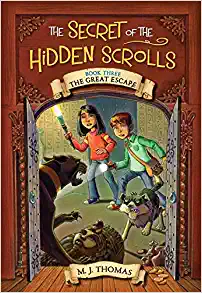
Rise of the Jumbies

Corinne’s evil aunt Severine may have been dealt with, but the villagers are wary of Corinne. Ever since they discovered she is half-jumbie, nobody looks at her the same. Every time she sets up her orange stand in the market, people give her distrustful looks and avoid her. When kids from her village start to disappear, Corinne wants to prove to everyone that they can trust her. She is a kind protagonist who genuinely wants to help others—she isn’t helping solely to trick the villagers into liking her, no matter how much they think that’s exactly what she’s doing.  

To rescue the missing children and clear her own name, Corinne goes deep into the ocean to find Mama D’Leau, the dangerous jumbie who rules the sea. But Mama D’Leau’s help comes with a price. Corinne and her friends Dru, Bouki, and Malik must travel with mermaids across the ocean to fetch a powerful object for Mama D’Leau. The only thing more perilous than Corinne’s adventures across the sea is the jumbie that waits for her back home. 

Corinne and her friends are inspiring characters who engage in spirited banter while maintaining mutual respect even during disagreements. When bartering with Mama D’Leau goes awry, the four friends find themselves being towed by mermaids to Ghana to recover a jewel. Along the way, Corinne’s emerging jumbie powers frighten her companions, creating tension within the group that they resolve through honest communication. Their courage, understanding, and humanistic approach to magical creatures creates a sweet story with a powerful ending. 

While The Rise of the Jumbies contains many amazing elements, they aren’t always well integrated. The plot meanders and feels overcomplicated, and though the language is accessible, the overwhelming number of magical elements could confuse readers. The macabre folklore embedded in the story makes it worthwhile, though readers averse to horror should be warned of some genuinely scary features. Despite these issues, the worldbuilding remains strong, and the creative blend of historical themes with fantasy creates a well-rounded narrative. 

The Rise of the Jumbies offers a creepy atmosphere, imaginative monsters, and youthful wit that will captivate readers. The supernatural creatures have complicated histories and morally gray motives that ground the fantastical elements. As Corinne travels between continents protecting her friends, she learns that some things aren’t black and white and that forgiveness can be powerful medicine. She proves to be a kind and intelligent protagonist who recognizes that monsters are subjective and that chosen family can be stronger than blood. Ultimately, this fantastical story delivers a grounded message: everyone needs a healthy home so that hurt people don’t create more hurt. 

Sexual Content 

  • None 

Violence 

  • While taking a walk in the market, Corinne notices that she’s being avoided because of her half-jumbie status. “Corinne had learned that a slight curve in the lip might mean a cruel thought from one person, a tiny squint signaled suspicion from another, and a stiffness in the muscles meant fear from someone else. These subtle body changes meant Corinne was being judged because of who she was: half-jumbie.” 
  • As Mama D’Leau hunts for food, she eats a fish whole. “She smiled before biting down, leaving a gaping hole in its fat belly. She crunched the scales and fins and bones and slurped the guts, and thought about what she was going to do about this other jumbie.” 
  • During Corinne’s expedition to Ghana, her friends, the mermaids Ellie, Addie, Noyi, and Sisi, and Corinne are all attacked by a sea creature. “One of the tentacles had wrapped around [Ellie’s] tail. She held Dru away from her body, looking for someone to pass her to. Addie and Noyi dodged the other suckers, pulling Malik’s and Bouki’s arms out of the way of danger as they tried to reach Ellie. But with the children to carry, the mermaids weren’t as agile as usual. Noyi passed Bouki to Addie and managed to navigate the field of tentacles to get to Ellie. She tried to pry Ellie loose. Sisi dove and rammed herself into the squid’s rubbery body. She bounced off and turned for another attack. The squid reached for her. Sisi stopped short and changed direction. Corinne’s head bounced and lolled. As Sisi turned, she saw Noyi pull Ellie out of the squid’s grip. But glittering scales and dark red blood trailed behind them.” Ellie eventually dies from her wounds, but everyone else is fine.  
  • While connecting psychically with the mermaids, Corinne relives their memories of a slave ship wrecking in a storm. “The water rolled away and the sounds of screaming voices and screeching chains filled her ears. The ship cracked and ripped at the joints, then sank. Water closed over them. It sealed them in like an iron box. There was a low moan and a loud pop and the beam she was attached to broke away and pitched in the current. Corinne could see the wide, frightened eyes of others below her who were still chained to the ship. Their mouths opened, sucking for air that would never come.” Those aboard either died or were transformed into mermaids.  
  • In an effort to recover the missing children, Corinne encounters Severine, who attacks Corinne. “Severine dove on Corinne, pinning her under the water. Corinne kicked and scratched at Severine with her fingers, but her aunt was much too strong. The people in the crowd moved in, trying to pry Corinne from Severine’s grip, but the jumbie held them off. She pulled Corinne deeper into the water.” Both escape unharmed.  

Drugs and Alcohol 

  • None 

Language 

  • Language is tame, but it includes juvenile insults, such as “stupid,” “idiot,” and “imbecile,” which appear frequently. 

Supernatural 

  • This novel incorporates Caribbean folklore and supernatural references on nearly every page. Corinne and her friends have many interactions with magic, mostly through magical creatures called jumbies and potions.  
  • Corinne has jumbie abilities, like being able to communicate with snakes. For example, while in Ghana, Corinne and her friends find themselves in trouble, running from the local authorities. “[Corinne’s friend] picks up a snake, and Corinne hears a voice. ‘Sssqueeze sssofter, pleassse!’ The only thing that could have been speaking to her was the snake.” 
  • Corinne recounts the events of the past book while explaining a couple of different kinds of jumbies. “Months earlier, Corinne had believed that jumbies were only stories that the grown-ups told to make children afraid. Jumbies were too incredible to be real. Who would believe in a creature like the soucouyant, who could shed her skin and turn into a ball of fire? Or the lagahoo, with knife-sharp teeth and clanging chains? Or worst of all, the douen, with its small, strong body and backward-facing feet? And then there was Severine, who was unlike any of the jumbies Corinne had heard of in stories. At first, with her beautifully wrapped hair and long green dress, she looked exactly like the other ladies in town. Then she turned out to be the strongest and most dangerous jumbie of all.” 
  • While looking for a missing child, Corinne is almost lured into the water by a magical song. “The song became louder and clearer and more beautiful the longer Corinne listened. And the water felt warmer, too, like bathwater left out in the sun. Corinne dove deeper into the darkness after the lulling song. But the rope pulled against her waist, making her movements useless. The song began to fade. She reached in front of her and felt something warm and solid between her fingers. But she was jerked away. She opened her mouth to scream, ‘No!’ and gulped water as she was yanked back to the surface, where she coughed and sputtered, and the song disappeared.” 
  • While trying to summon Mama D’Leau, a powerful water jumbie, Corinne and her friends find themselves able to breathe underwater. “We’re not breathing, Dru said. Yes, we are, said a small, squeaky voice. Malik pointed at his nose. He took a deep breath and blew bubbles out of it.” 
  • Mama D’Leau is another reappearing jumbie who possesses considerable magical power. “Her eyes were the same bright blue as the water around them, and as the water grew darker, they did too. Her hair was long and braided in thick plaits. Some wrapped around the top of her head like a crown, but masses more fell down past her waist. Scales were scattered against her skin at her collarbone and thickened down to her hips, where her tail began. It was long and twice as thick as an anaconda’s, narrowing to a thin, twitching end that was coiled beneath her like a throne.” 
  • When Corinne and her friends swim to Ghana, the mermaids lose their memories of Mama D’Leau. They also don’t remember why they were expected to bring Corinne and her friends all the way to Africa. There is no explicit magic spell that makes this happen.  
  • Panicked about leaving her newly discovered family in Ghana, one of the mermaids, Ellie, tries to drag herself ashore. “Malik dove into the water. He met Corinne on the beach and they took Ellie’s hands and tried to pull her back. Her fingers were brittle as glass and they cracked in their grip. Malik moved to scoop up the mermaid’s body. Corinne followed his lead. They tried to drag her back as her bright scales began to shrivel, becoming as delicate as tissue paper. The line down the middle of her tail darkened and sank inward, separating into two legs. Corinne and Malik tried to move more gently as Ellie’s entire body faded to the color of beach sand. The breeze peeled the surface of her skin like petals on the wind.”  
  • Corinne meets Papa Bois, a powerful woodland jumbie, in the forest. “Corinne felt something like a heartbeat coming up through the soles of her sandals. It was as if the entire forest had come alive. The pulse felt stronger as she moved closer to the boulder. . . The boulder itself moved as if it was breathing. Corinne’s pulse quickened, but she reached a finger out to touch it, and the surface felt soft but tough, like muscle. She jumped back. The boulder rearranged itself. Cracks and crevices twisted in other directions. Some opened up, exposing new muscle beneath, and the surface of the rock shifted. When it stopped moving, the boulder had unfolded into a little old man not much taller than Corinne, with a long gray beard, the legs of a goat, and a pair of tiny horns peeking through his messy gray cornrowed hair.” 
  • Later, Papa Bois demonstrates more magical ability while arguing with Corinne, “a few tears squeezed out of the wrinkled corners of his kind brown eyes. Where they fell to the ground, tiny white flowers sprang up and opened their buds.”  
  • To save the children and defeat Severine, Corinne resolves to sacrifice her humanity to lead Severine away from the island. She asks Mama D’Leau to turn her into a mermaid. “Where Corinne’s legs had been, a shimmering orange tail waved.” 
  • To save one of her friends, Allan, from transforming into a jumbie, Corinne tells him to wish for home, and he’ll become human again. Corinne finds his mom to help him do this. “Allan turned toward his mama again. This time, his feet didn’t move, so his body lined up perfectly. When he stepped forward, his movement was steady and sure. [Allan’s mom] dropped to her knees. Allan ran into her arms and they cried against each other’s cheeks.” 

Spiritual Content 

  • When Corinne and her friends land in Ghana, they meet a boy, Kahiri, who mistakes the mermaids who brought them to Ghana for servants of an African water spirit/goddess named Mami Wata. After Corinne asks Kahiri who that is, he responds, “She’s a water goddess, and she can look like anything she wants. They are mermaids. One of them must be her.” 

by Kate Schuyler 

Stormbreaker

When fourteen-year-old Alex Rider discovers his guardian Ian wasn’t a banker, but a MI6 spy who was killed on a dangerous mission, his world transforms overnight. MI6 director Alan Blunt blackmails the grieving teenager into completing Ian’s unfinished assignment, thrusting him into a morally complex world where institutional power overrides individual choice. Alex must infiltrate Sayle Enterprises, which plans to distribute new computers to British schools—a seemingly kind act that Ian suspected concealed a sinister plot. Grieving his uncle, Alex is thrust into a world of action and violence, where people are crueler than he can imagine and danger lurks around every corner.  

Alone and undertrained, Alex faces SAS training, assassins, and a giant killer jellyfish, relying on skills his uncle taught him and his own quick thinking. Readers will find themselves rooting for Alex for his ingenuity and intelligence. Alex is a hero who maintains strong moral principles even when the adults around him abandon theirs. Alex’s sharp, witty perspective and determination to do what’s right, regardless of personal cost, make him compelling to young readers who see themselves reflected in his character despite his extraordinary circumstances. 

Horowitz delivers fast-paced, violent action while embedding deeper themes about power and sacrifice. The moral complexity of espionage permeates the novel, as MI6 leaders firmly believe that the ends justify the means, even if it means exploiting Alex and putting him in danger. At the same time, he is mostly alone, with no backup. The author creates genuine tension through Alex’s isolation—he operates mostly without backup, making his survival entirely dependent on his own resourcefulness. Yet there remains a sense of heroism, and a confirmation that the good guys will win. Horowitz’s young audience will be thrilled by the action and subterfuge, and more mature readers will enjoy Horowitz’s subtle critique of the British government, traditional spy literature, and the question of what individuals should sacrifice for their country, as well as whether a fourteen-year-old should bear England’s fate on his shoulders. 

Stormbreaker explores more mature themes and features a semi-realistic villain, whose motivations may seem irrational from the perspective of a fourteen-year-old spy. Readers who want to read an action-packed book without violence should consider the City Spies Series by James Ponti and the Charlie Thorne Series by Stuart Gibbs. 

Sexual Content 

  • None 

Violence 

  • Alex’s uncle Ian Rider is killed. Alex is told that he died in a car accident. “Driving home, [Ian’s] car had been hit by a truck at Old Street roundabout and he had been killed almost instantly.” However, Alex later finds out that he was shot. “A spray of bullets had caught the car full on the driver’s side, shattering the front tire, smashing the windshield and side windows, and punching into the side panels.” 
  • When Alex goes to the auto wreckers to find his uncle’s car, he is stuck in the car as it is about to be crushed. His leg is pinned, and he is covered in broken glass. “But the claw of the crane had already flattened the roof, pinning his left leg, perhaps even breaking it. . . The back window exploded and glass showered around his head, dust and diesel fumes punching into his nose and eyes.” Alex escapes with scratches and bruises but is not seriously hurt.  
  • As Alex tries to escape the auto wreckers, men start shooting at him, thinking that he is a trespasser. “Then there was a crack and a bullet whipped past.” The bullets miss.  
  • An MI6 agent shoots Alex with a tranquilizer to kidnap him. “The man fired. There was no explosion. The gun spat at Alex and he felt something slam into his heart. His hand opened and the file tumbled to the ground. Then his legs buckled, the room twisted, and he fell back into nothing.” He is unconscious but wakes up later and is unharmed.  
  • Alex is sent to train with SAS operatives. He has to endure combat training and other survival courses. “He took part in an unarmed combat class and was knocked to the ground so often that it took all his nerve to persuade himself to get up again.” He is bruised but not seriously injured.  
  • Wolf, one of the SAS operatives, is angry at Alex. He pushes him and forces Alex to fail a drill and accidentally set off a stun grenade. “The heel of Wolf’s palm had rammed into his chest, pushing him back with astonishing force. . . The trip wire activated a stun grenade—a small device filled with a mixture of magnesium powder and mercury fulminate. The blast didn’t just deafen Alex, it shuddered right through him as if trying to rip out his heart.” Alex can’t hear for a bit, but he recovers and is mostly unharmed. After training, he is left with cuts and bruises.  
  • Yassen, an assassin employed by Sayle, shoots and kills another employee who drops a case of smallpox. “‘No. You won’t,’ Yassen agreed, and shot him.”  
  • Two men use ATVs to try to kill Alex. They are trying to kill him because he has learned too much about what Sayle’s plan is. After being chased on ATVs, “Alex threw himself headfirst, flat on his stomach. The cheese wire whipped over him. If he had still been standing up, it would have cut him in half. . . One of the riders was carrying a flamethrower! He had just aimed a bolt of fire twenty feet long, meaning to burn Alex alive. . . Whoever these people were, they had tried to run him down, to cut him in half, and to incinerate him. . . Alex felt the first bullet slice past his shoulder. The second ricocheted off the side of his bike, almost causing him to lose control.” Both men die; one gets tangled up in barbed wire, and the other goes off the edge of the cliff. Alex escapes relatively unharmed.  
  • Alex is snooping in Sayle’s facility to report back to MI6, and a guard catches him and points a gun at him. “The gun was a Browning automatic pistol and one twitch of the man’s finger would send a 9mm bullet shattering through his skull and into his brain.” Alex attacks the man by “twisting his body around and driving his elbow into the side of the man’s head, just below his ear.” The man is knocked out. 
  • One of Sayle’s employees, Mr. Grin, attacks Alex because he found out Alex is spying on Sayle’s operation. “But Mr. Grin was quicker. He ducked to one side, then his hand shot out, the side of it driving into Alex’s throat.” Alex falls unconscious from the hit.  
  • The main villain, Herod Sayle, threatens Alex, saying that Mr. Grin will cut Alex. “Tell me what I want to know, Alex, or [Mr. Grin] will cause you more pain than you could begin to imagine. . . The edge of the blade had actually nicked the skin of his neck. He felt a trickle of blood slide down over his collar.” Alex is slightly cut by Mr. Grin’s knife, but he isn’t seriously injured. 
  • Herod Sayle reveals his plan to release smallpox through his computers, infecting schoolchildren. Alex speculates, “I suppose when the computers are turned on, people die.” Sayle confirms, “Because the virus I’m talking about is a form of smallpox. Of course, Alex, it’s been genetically modified to make it faster and stronger. . . more lethal.” 
  • Alex is put into a tank with a Portuguese man-of-war (a type of jellyfish). Alex is worried he will either drown or be stung by the jellyfish. Alex breaks the glass and escapes the tank.  
  • The jellyfish lands on Vole, another of Sayle’s employees, killing her. “The tentacles were wrapped all around her, hundreds and hundreds of stinging cells clinging to her arms and legs and chest.” 
  • Alex attacks a guard. “Alex used the handle of the harpoon gun, swinging it around and up to hit him, hard, under the chin.” He knocks him out, so he is able to escape Sayle’s facility. 
  • Alex sets off a smoke bomb on a plane, forcing Mr. Grin to crash. “He could imagine Mr. Grin blinded, fighting for control. The plane began to twist, slowly at first, then faster and faster. The engines whined. Now it was heading straight for the ground, howling through the sky.” Alex parachutes out of the plane and crashes into a glass ceiling. Mr. Grin dies in the helicopter crash. 
  • To stop the release of smallpox, Alex shoots the prime minister to stop him from pressing the button that would activate the virus. He also shoots Herod Sayle. “Shoot first and ask questions later. . . He emptied the gun. . . The first bullet smashed into the information desk. The second hit the prime minister in the hand, his finger less than an inch away from the mouse. . . Sayle had dived forward, determined to click on the mouse himself. The fifth and the sixth bullets hit him.” Sayle survives and escapes. The prime minister’s hand is wounded, but he is otherwise okay. 
  • Sayle threatens Alex with a gun, forcing Alex to go with him. “But the gun was in his right hand. It was perfectly steady, aimed at Alex’s lower back.” 
  • Yassen, an assassin, shoots Sayle on orders from his unknown boss. Alex initially thinks that Yassen is shooting at him. “Alex looked down, expecting to see blood. There was nothing. He couldn’t feel anything. Then Sayle staggered and fell onto his back. There were two gaping holes in his chest.” Sayle dies, and Yassen leaves Alex alive.  

Drugs and Alcohol 

  • None 

Language 

  • Profanity is used very infrequently. Profanity includes bloody, damn, and hell.  

Supernatural 

  • None 

Spiritual Content 

  • None 

by Abigail Clark

Court of Lions

Amani succeeded in saving Maram, but it cost her everything. Sequestered in the palace as punishment, Amani has no family and no friends. She’s also been torn away from her love, Idris—seeing him would only tempt her to take what she cannot have. That is, until Princess Maram asks Amani to take her place in her wedding to Idris.

Confused about Maram’s intentions, Amani refuses. As they talk, Amani realizes just how hurt Maram has been by everyone in her life. Amani agrees and goes to the wedding in Maram’s place. What Amani doesn’t know is that Maram has been falling in love with one of the royal falconers, Aghraas, and that Amani’s perceived betrayal cuts Maram deeper than Maram knew possible. While both young women torture themselves with love they’re unsure they can have, wedding celebrations await in Idris’s hometown, M’Gaadir.

M’Gaadir changes everything for both of them. The more time Maram and Amani spend together, the more they realize their similarities run deeper than appearances, especially as tension between the Andaalan nobles and the Vathek Empire tightens. With Aghraas’s influence and the discovery of letters containing her father’s horrible secret, Maram grows bolder and agrees to help Amani with the rebel cause. Posing as one person, Amani and Maram strengthen Maram’s political position, relying on both the rebels and the Andaalan nobles to spread word about Maram’s intention to take the throne from her father and free Andaala.

The characters face significant personal challenges alongside their political mission. Idris doesn’t approve of Amani’s rebellious activities because he’s worried she’ll get hurt. Aghraas and Maram can never be seen in public together due to their different social stations. Neither Amani nor Maram has family to rely on for advice or emotional support, forcing them to navigate their complicated feelings and dangerous political situation independently. Maram and Amani emerge as inspiring, determined, and clever protagonists who bravely confront an oppressive colonial system while wrestling with profound emotional turmoil in their personal lives.

Court of Lions focuses on two main characters who rise to face seemingly insurmountable challenges and evolve into people very different from who they were at the beginning of the series. Both Amani and Maram transform into calculating and protective leaders who lead by example, protect their loved ones at all costs, and stand by their moral principles even when doing so puts them in danger.

Somaiya Daud crafts powerful characters in Court of Lions and creates an amazingly complex and fantastical world that weaves rich culture into each poetic chapter. The novel successfully combines political intrigue with deeply personal character development, illustrating how the shaky trust established in the first book evolves into a friendship that can save the world.

Unfortunately, the book has several flaws. Maram and Aghraas’s relationship feels somewhat rushed and isn’t explored thoroughly, leaving readers wanting more depth in their romantic development. The story’s suspense could have been built more effectively. Instead, the king’s assassination is too straightforward, and the series has a disappointing conclusion that doesn’t fully match the complexity of the political maneuvering that precedes it. However, the story delivers plenty of compelling political intrigue, inspiring female characters, and a wonderful science fiction atmosphere that blends fantasy and science fiction together in this tumultuous tale of sisters, sacrifice, and resilience.

The book effectively explores themes of identity and self-acceptance that are inextricably tied to revolution and the dismantling of colonial oppression and power. Overall, Court of Lions is an engaging story with a beautiful message: nothing worthwhile ever comes easily, but what is fought for with determination and sacrifice delivers stunning rewards. The novel stands as a testament to the power of unlikely friendships, the courage required to challenge systemic oppression, and the transformative journey of young women discovering their own strength and agency in a hostile world.

Sexual Content

  • Maram is managing one of her mother’s old properties when she meets and grows close to the master falconer, Aghraas. When Maram receives important letters that change everything, she is emotionally overwhelmed, and Aghraas comforts her. “Aghraas’s mouth was soft and still for less than half a heartbeat. [Aghraas’s] fingers tightened around [Maram’s] waist, and Maram pressed back, the line of her shoulders, the length of her body. For half a heartbeat relief roared through Maram, and then a fire caught, as if it had waited all her life in the embers inside her. There was a soft cry—hers or Aghraas’s she didn’t know—and her hands clung to her shoulders as Aghraas lifted her up onto her lap.” The chapter ends before anything else happens.
  • Before the rebels try to assassinate the king, Idris apologizes to Amani, worried it may be his last chance to do so. She accepts his apology, and they kiss. “His mouth was hard on [Amani’s], and his hands tightened around [her] ribs—[she] felt as if [her] breath had been stolen from [her].”  When he kisses her neck, she pushes him away, saying she needs time.
  • In the aftermath of Maram becoming queen, Aghraas kisses her. “Aghraas bent her head to Maram’s, and her arms came around her waist, and her mouth met hers. She never ceased to be surprised by her warmth or the frisson of pleasure that shot through her from a single touch.” The book ends before anything else happens.

Violence

  • While Amani and Idris are in M’Gaadir, the Vathek government takes Idris’s relative, Adil. There is no description of the violence, but Amani and Idris discuss it. “‘Adil is dead?’ Amani whispered. ‘They sent his body to his parents’ estate—it arrived last night,’ [Idris responded].”
  • To emphasize her commitment to the rebel cause, Amani explains, “We lived in a village that was not a village. It was a kasbah, abandoned by whatever [nobles] had held it before the conquest. Nineteen families made their home there. Shortly before we left, Vath attacked. We were defenseless. Most villages have a magistrate, or a surveillance force. We were in truth homeless and trying to eke out an existence. [Everyone in the village was] slaughtered, [while the Vathek were] looking for someone.”
  • Maram starts distancing herself from Nadine, her father’s steward. Nadine blames Amani for Maram’s distance. Nadine is convinced that Amani is a negative influence on Maram. The next morning, Nadine wakes Amani with a slap. “[Amani] was roused from slumber violently, with a hand that felt like a claw around [her] arm, and pulled unceremoniously from the bed. There was no time to understand who pulled [her] from bed or why. The moment [she] stood a hand struck [her] across the face, sharp and hard. Hard enough that [she] fell again, inches from the fireplace.” Amani has a bruise, but Maram stops Nadine from inflicting more harm.
  • Later on, Nadine tries to attack Amani again. “[Nadine’s] voice did not rise, but it took on a cruel edge and her fingers gripped [Amani’s] chin like claws, as if she meant to rip [her] jaw from [her] face. [Amani] tightened [her] hold on [her] skirts. If [she] took her wrist, if [she] fought back, [she] would have lost [her] chance.”
  • Nadine confronts Amani once again, growing suspicious about the helpful information Amani has been providing about traitors to the Vathek Empire. Amani fears that Nadine has discovered the information is false and deliberately planted. However, Nadine is merely suspicious and hasn’t uncovered the deception yet. To intimidate Amani into revealing more information, Nadine uses a robot to physically threaten her. “[The robot’s] fingers wrapped around [Amani’s] throat and between one breath and the next [she] was suspended in midair. [Her] vision filled with spots, [her] throat ached, [her] heart pounded. Nadine could not kill [her]—she couldn’t. And yet [Amani] hadn’t counted on [Nadine’s] hatred of [her] and [Nadine’s] rage outweighing her sense.” Amani has bruises but is otherwise fine.
  • During the assassination attempt, the king grabs Amani. “[His] grip tightened painfully on [Amani’s] arm.” Afterwards, Amani has bruises.
  • Amani breaks herself free from the king’s grasp, but Nadine quickly grabs her. Nadine points a gun at Amani’s head, to warn the rebels away from them. Idris eventually shoots Nadine. “[Nadine] jerked, her hand still tight around [Amani’s] arm, and then released [her] and fell back.” Nadine survives.
  • While Idris saves Amani, Maram and Aghraas shoot down the king. “[The king] seemed suspended in midair for a long, agonizing moment, then fell to his knees. A moment later, he toppled forward.” The king dies from his wounds.

Drugs and Alcohol

  • When Amani realizes she needs Maram’s help to assassinate the king, she reveals her involvement with the rebels. Maram agrees to join the plot after discovering that the king—her own father—had murdered her mother. Maram says, “He poisoned her so that no one could accuse him of killing the rightful ruler of the planet. She died slowly. And her husband was executed on charges of treason.”

Language

  • None

Supernatural

  • The prologue describes the magic Amani’s people believe. In the story, “a prince hunting [a magical woman, Tayreet] found her; her body had loosed its natural bird shape and taken on a human one. The prince loved her from the first, and Tayreet him.” These birds, called tesleets, exist as symbols to warn or push people towards certain events. It is implied that Aghraas is one of these birds in human form.

Spiritual Content

  • The Andaalans and people on Cadiz have a monotheistic religion. They worship the god, Dihya, and the prophetess, a Jesus-like figure, Massinia. Their religion contains many parables, stories, and prayers that Amani tells to her friends at various points. The prologue concludes with a religious saying, “And from His first creatures He made stars, glowing hot with their fire and warmth. All may see the stars, but few will see their forbears. And those whose eyes see golden fire We say heed Us and listen. For We have sent unto you a Sign. See it and take heed.”
  • After Amani’s sequestration in the palace ends, Maram asks Amani to take her place in her wedding to Idris. The wedding has some religious overtones. One wedding ritual includes people crowding around Amani as she steps into water, a baptism of sorts. “‘Be blessed,’ [Nadine and Maram’s sister, Galene] said, as Galene tipped a small vase of oil over [Amani’s] hair. ‘Be blessed’ echoed back from the crowd, reverberating and out of sync.”
  • Once the wedding is over, Maram insists that Amani also take her place in the following wedding celebrations in a city called M’Gaadir, which has a deep religious history. Amani explains that, “when at last [the tesleet eggs] landed on our planet and hatched, the first of mankind came from their hallowed shells. And because they were far from the sacred flames of their city, they never became what they ought, and remained mortal. And it was from these people that Houwa came and nursed the kernel of magic in her blood. And it was from this legacy that they chose their name—Kushaila, ‘those among the noble.’”
  • Following a busy day with Idris meeting new nobles, Idris tries to relax Amani by taking her to a religious statue. Amani describes it as “a woman sat atop the promontory outside M’Gaadir, the ocean behind her. . . Her daan [a familial tattoo] was a sharp pictograph of a feather, its end situated perfectly between her eyebrows. She cast no shadow.” The statue is of Houwa, a saint among Amani’s people.


by Kate Schuyler

The Bicycle Spy

Marcel loves riding his bicycle, whether he’s racing through the streets of his small town in France or making bread deliveries for his parents’ bakery. He dreams of someday competing in the Tour de France, the greatest bicycle race. But ever since Germany’s occupation of France began two years ago, in 1940, the race has been canceled. Now there are soldiers everywhere, interrupting Marcel’s rides with checkpoints and questioning.  

Then Marcel learns two big secrets, and he realizes there are worse things about the war than a canceled race. When he later discovers that his friend’s entire family is in imminent danger, Marcel knows he can help — but it will involve taking a risky bicycle ride to pass along covert information. And when nothing ends up going according to plan, it’s up to him to keep pedaling and think quickly. . . because his friend, her family, and his own future hang in the balance. 

Told from Marcel’s point of view, The Bicycle Spy shows the effect of World War II by focusing on Marcel’s parents and classmates. Marcel’s love of the Tour de France gives the story a unique perspective and allows him to become friends with Delphine, who shares his passion for the event. Marcel and Delphine also connect because they both have a secret: Delphine is Jewish, and Marcel’s parents are part of the French Resistance. When Delphine’s true identity is revealed, Marcel and his family show bravery and don’t hesitate to help Delphine’s family escape France.  

Marcel is an extremely likable protagonist who worries about everyday things, such as completing his homework, winning a bike race against his friends, and avoiding trouble at school. When he discovers that his parents are helping the French Resistance, Marcel is determined to help the cause. However, he often feels pangs of guilt when he has to lie, even though he realizes that dishonesty is the only way to keep people safe from the Germans. Even though Marcel fears the German soldiers, he doesn’t let this stop him from delivering messages for the Resistance.  

When Delphine’s family is in danger, Marcel is trusted to deliver a message that will help them escape. Even though this means riding his bike a long distance in freezing weather, Marcel is determined to save his friend. “The ride to Porte-Vendres was punishing. He was exhausted, and very, very cold. But then he thought of the riders in the Tour de France. Surely they got tired, hungry, and cold, too.” Marcel gains the strength to continue by thinking about the men who have competed in the Tour de France, as well as the danger that Delphine’s family faces. Marcel’s journey is full of danger and suspense, which makes the book difficult to put down. 

The Bicycle Spy shows how ordinary people helped the Jews escape Hitler’s clutches. Since the story is told from Marcel’s point of view, readers gain insight from a child’s perspective. This allows readers to understand Marcel’s fears and concerns without having graphic descriptions of violence. Reading The Bicycle Spy will encourage children to do the right thing, whether it’s standing up to a bully, helping a friend, or supporting their family.  

Sexual Content 

  • None 

Violence 

  • The German soldiers appear in Marcel’s classroom. “Two officers had come into the room, their shiny black boots heavy on the floorboards, their armbands with the thick black swastikas threatening. Even more threatening were the enormous black guns they carried so casually looped over their shoulders.” An officer talks to the teacher, who shows him the list of students in the class. Then the men leave. 
  • When Marcel encounters German soldiers, he wonders, “What would they do if they knew about his parents being in the Resistance? Drag them from the bakery? Force them to answer questions? Shoot them?” 
  • One of Marcel’s classmates, Thierry, dumped the contents of Delphine’s satchel. When she went to pick up her pen, “Thierry’s big foot got there first. There was an ugly crunch as he ground it under his heel.” Thierry saw a picture of Delphine and her brother and said, “You’re a Jew. . .  A dirty, stinking Jew!” Delphine is so upset that she leaves school and never comes back. 
  • Thierry accuses Marcel of helping “‘a Jew hide. Or maybe even escape and you know what that means.’ He made his hand into the shape of a pistol and pointed it to [Marcel’s] head.” 

Drugs and Alcohol 

  • Marcel saw a German soldier who “pulled out a cigarette and lit it.” 
  • When Marcel goes into town, he sees a man at a café smoking a cigarette. 

Language 

  • Some of the kids call each other names, such as shrimp, loser, jerk, idiot, dope, and liar. 
  • Marcel is riding a bike when a cat runs in front of him. Marcel exclaims, “zut alors,” which means “damn then.”  
  • When Delphine moves to town, one of her classmates asks, “Is your family rich or something? Like all those Jews who are wrecking the country?” Marcel didn’t understand why the comment upset Delphine. 
  • Marcel’s classmate, Thierry, calls Delphine a “dirty Jew” several times. 
  • Marcel’s mother refers to the Germans as “devils.” Later, Marcel’s father refers to Hitler as the devil. 
  • When returning home after a “punishing” bike ride, Marcel “races like the devil.” 

Supernatural 

  • None

Spiritual Content 

  • When Marcel learns that Delphine is Jewish, he thinks, “Everyone he knew was Catholic and went to the church of St. Vincent de Paul on Sundays and saints’ days, or holidays like Easter and Christmas.” 
  • Delphine and her parents pretend to be Protestants because her father “thought that would be easier” than pretending to be Catholic. 
  • Marcel needs to take a hidden note to someone working for the Resistance. He prays, “no one had spotted him and wondered where he was going and why.” 
  • The school closes so the town can celebrate Saint Francois-Xavier. “Everyone would be in church” to honor the saint. 
  • After Delphine and her family flee, Marcel’s mom says, “I am praying that they are [safe].” 
  • When Marcel’s father doesn’t come home, Marcel goes to search for him. Marcel’s mother says, “Go with God.” 

The Ballad of Songbirds and Snakes

As a member of one of the wealthiest families in the Capitol, 18-year-old Coriolanus Snow is destined for greatness. At the top of his class, Coriolanus excels in his studies at the Academy, charming students and faculty alike. But underneath this guise of wealth and class, Coriolanus hides a shocking secret. The Snows are broke; their fortune lost due to the war that plagued Coriolanus’s childhood. If anyone discovered the Snows’s true financial situation, they would be disgraced. But Coriolanus sees a path to success. The 10th annual Hunger Games, a televised competition in which children from the twelve districts that serve the Capitol are selected to fight to the death, is approaching. If Coriolanus successfully mentors the winning tribute in the Games, he will win a prize great enough to pay his university tuition.  

When Coriolanus is assigned to mentor the female tribute from District 12, his hopes of winning the prize diminish. Nobody from District 12, the poorest and most downtrodden of the districts, has ever won the Games. But when Coriolanus’s tribute, Lucy Gray, enthralls the audience by serenading them shortly after being selected to compete in the Games, Coriolanus holds out hope that he can put her on a path to victory. As affections grow between Lucy Gray and Coriolanus, Coriolanus must decide how far he is willing to go to protect her and win the prize. Despite the bloodshed and brutality, will the Hunger Games offer Coriolanus a chance at power, wealth, and love? Or will the pressure send Coriolanus down a path of destruction? 

Coriolanus is a deeply complex character that will have readers rooting for him against their better judgment, as fans know that this character will grow up to be the main villain in the Hunger Games trilogy. Initially, Coriolanus is motivated by a desire to provide for his family and have a successful career. He is shown as being caring toward his cousin and grandmother, although there are hints that a darker side to him lurks beneath the surface. As the story progresses, this darkness becomes more apparent as Coriolanus reveals himself to be callous, calculated, and manipulative. Behind his generous acts lies a calculated effort to cultivate his public persona and climb the ladder of success. Eventually, Coriolanus has fallen so far that he kills and betrays his own loved ones to benefit himself. Readers will find themselves disturbed by Coriolanus but will be interested in seeing this gifted boy with great potential transform into a corrupt and cruel man. 

The story of Coriolanus’s fall from grace and rise to power is driven by interesting supporting characters. Coriolanus is drawn to Lucy Gray, who looms large at the center of this tale, showcasing her talents, wit, and will to survive through her actions both within and outside the Hunger Games arena. Lucy Gray serves as a foil to Coriolanus, as her free spirit and creativity contrast with his rigidity and reliance on order. Coriolanus’s treatment of Lucy Gray reveals flaws within his character, such as how he treats her as a means to an end and believes that he can control her. Much like the fictional audiences within the book, readers will be charmed by Lucy Gray. 

Coriolanus is often irritated by his classmate Sejanus Plinth, a rebellious and emotional boy who, much to Coriolanus’s dismay, is characterized by his sympathy for the tributes and the districts, and his anti-Capitol ideals. At the Academy, Coriolanus is tormented by the jaded Dean Highbottom, who seems to be the only faculty member not to have fallen for Coriolanus’s charms, and the sinister Dr. Gaul, who delights in creating mutated animals. These characters help to drive Coriolanus’s decisions and behavior, while serving as a unique contrast to Coriolanus himself.   

The Ballad of Songbirds and Snakes is centered around human nature and asks if humanity is inherently good or inherently evil. Opposing viewpoints are presented, as Sejanus believes that the tributes behave brutally in the arena due to their circumstances, while Dr. Gaul insists that mankind is inherently violent. Coriolanus’s opinion on this matter shifts as Dr. Gaul mentors him. This debate relates to questions about whether the Capitol should exercise the amount of power it currently holds. Sejanus believes that the Capitol is cruel and oppressive to the districts, while Dr. Gaul believes the people living in the districts are naturally brutal and must be controlled. While reading this novel, readers will consider both viewpoints and explore why each character has certain beliefs.  

While The Ballad of Songbirds and Snakes can be read independently, fans of The Hunger Games trilogy will appreciate familiar surnames and settings like the Capitol and District 12. Set 64 years before the original series, this prequel introduces new characters while maintaining Suzanne Collins’s distinctive style—though uniquely written in third person rather than first. Unlike the survival-focused original trilogy, this novel centers on power and perception as Coriolanus obsesses over his family’s reputation and control. The book matches the trilogy’s tone and maturity level, though its large cast of characters may challenge some readers.  

The Ballad of Songbirds and Snakes is an entertaining and shocking novel that promotes introspection. The moral and philosophical questions raised in this novel will stick with readers, as will the engaging plot and characters. Longtime fans will be interested to see the nefarious President Snow, portrayed as a young protagonist, rise to power. At the same time, new readers will be enthralled with this fast-paced plunge into the Hunger Games universe. This is a must-read novel that teaches important lessons about the dangers of complicity, violence, and selfishness. It encourages readers to think outside their comfort zone and consider new perspectives. The Ballad of Songbirds and Snakes is an interesting, memorable, and important installment in the Hunger Games series. 

Sexual Content 

  • Before Lucy Gray goes into the arena, Coriolanus and Lucy Gray say goodbye. They share a kiss. Coriolanus describes it as “a real kiss on the lips, with hints of peaches and powder. The feel of her mouth, soft and warm against his own, sent sensations surging through his body.” 
  • After Coriolanus and Lucy Gray reunite in District 12, they kiss. “Then, almost shyly, she kissed him, sending shock waves through his body.”
  • Lucy Gray and Coriolanus kiss a few more times during scenes they share together. The kisses are described simply. For example, “She greeted him at the back door with a kiss.”

Violence 

  • The mayor of District 12 hits Lucy Gray in the face after she slips a snake down his daughter’s dress. The mayor “made a beeline for [Lucy Gray], and struck her in the face so powerfully that she was knocked to her knees.” The mayor attempts to hit her again, but is stopped, and Lucy Gray recovers. 
  • During the war, Coriolanus witnessed his neighbor cut the leg off a maid’s corpse. Coriolanus watched as his neighbor “carved the leg from the maid, sawing back and forth with a terrifying knife until the limb came free. He wrapped it in the skirt he ripped from her waist and then bolted down the street that led to the back of his townhouse.” The neighbor and his family ate the leg. 
  • Coriolanus gets into a fight with a boy as they are riding in a truck together. “The boy’s hands came up fast, encircling Coriolanus’s throat with his long, scarred fingers and slamming him back. His forearms pinned Coriolanus’s body against the bars. Overpowered, Coriolanus resorted to the one move that had yet to fail him in schoolyard scuffles, driving his knee up hard into his opponent’s crotch.” The boy releases Coriolanus, and the fight stops. Both boys are unharmed.   
  • Coriolanus’s classmate, Arachne, taunts the tribute with food, so the tribute kills her. “Coriolanus could see the tribute’s face darkening, the muscles tightening in her neck. He could see something else, too. Her fingers sliding down the bar, darting out, circling the handle of the knife . . . In one movement, the tribute yanked Arachne forward and slit her throat.”  
  • After a tribute kills Arachne, Peacekeepers shoot the tribute. “The bullets pierced her body, slamming her into the bars. She slipped into a heap as her blood commingled with Arachne’s.” 
  • Coriolanus’s friend, Clemensia, is bitten many times after she is asked to retrieve papers from a tank full of snakes. Clemensia “yanked her hand from the tank, but not before half a dozen neon snakes sank their fangs into her flesh.” The venom from the snakes makes Clemensia very ill, but after several weeks, she recovers. 
  • While the mentors and tributes are touring the arena where the Hunger Games will take place, bombs go off. “Burning debris rained down on [Coriolanus]. Something struck his head hard, and the heavy weight of the beam landed diagonally across his back, pinning him to the ground.” Lucy Gray helps free Coriolanus from under the beam, and he recovers from his injuries.  The bombs kill several people. 
  • Marcus, a tribute who escaped from captivity before the Hunger Games began, is recaptured and beaten. He is chained to a beam in the arena, visible to viewers before the start of the Games. “At the center of the structure, Marcus hung from manacled wrists, so battered and bloody that at first Coriolanus thought they were displaying his corpse. Then Marcus’s swollen lips began to move, showing his broken teeth and leaving little doubt he was still alive.” He remains chained to the beam as the Games begin.  
  • A tribute named Lamina kills Marcus, presumably out of mercy. Lamina “swung down, and drove the ax blade into the curved side of Marcus’s neck. Once. Twice. And on the third time, in a spray of blood, she succeeded in killing him.”  
  • A tribute named Dill dies of tuberculosis. “Dill’s body convulsed with a final, violent bout of coughing, and a gush of blood soaked her filthy dress.” 
  • Sejanus, upset with Marcus’s death, goes into the arena. Coriolanus is sent in to retrieve Sejanus. While in the arena, Bobbin, a tribute, attacks Coriolanus. Coriolanus “spun around just in time to see Bobbin bringing down his knife. The blade glanced off his body armor and sliced his left upper arm.” Coriolanus retaliates: “Coriolanus’s fingers closed around a two-by-four, and he brought it up, catching Bobbin in the temple hard, sending him to his knees. And then he was on his feet, using the board like a club, bringing it down again and again without being sure where it made contact.” Coriolanus beats Bobbin to death with the board, and he and Sejanus escape the arena. 
  • A tribute named Coral kills another tribute with a trident. “After a brief chase along the bleachers . . . Coral killed her with a trident to the throat.” 
  • A tribute named Jessup contracts rabies and attacks Lucy Gray. To deter him, Coriolanus and his friend send bottles of water into the arena using drones. “Jessup froze, and his eyes bulged with fear. As the drones closed in on him, he pawed at them but failed to connect. When they started releasing the bottles of water, he lost all control. Explosive devices could not have elicited a stronger response, and the impact of the bottles smacking into the seats whipped him into a frenzy.” As Jessup tries to evade the bottles, he falls over the edge of a wall. “The sound of snapping bones that accompanied his landing surprised the audience, as Jessup had landed in a rare pocket of the arena with good audio.” The fall kills Jessup. 
  • Coral kills Lamina during a fight. “After Lamina managed to block the first few jabs with her ax, Coral wove the trident in a twisting move that distracted the eye before it plunged into her opponent’s abdomen.”  
  • Coral kills a tribute by stabbing him in the back with a trident. “Coral drove the second trident into his back.” 
  • A tribute named Wovey dies after drinking a poisoned bottle of water. “After a few gulps she sank back against the wall and gave a small belch. A thin stream of silverish liquid trickled out the side of her mouth and then she went still.  
  • Venomous snakes bite a tribute named Circ. “Circ stumbled over a rusty, old spear and the snakes overtook him. A dozen pairs of fangs pierced his body. . . Circ struggled to breathe for about ten seconds before he died.” 
  • A tribute named Mizzen is swarmed by malfunctioning drones while he stands on a beam high above the ground. Because of this, “he lost his balance and plummeted toward the ground, snapping his neck sideways on contact.” Mizzen dies from the fall. 
  • A tribute named Teslee is killed by another tribute that sneaks up on her with an ax. Teslee’s attacker “seemed to appear out of thin air, making a gigantic leap into the frame and bringing his ax down on Teslee in one fell swoop. She had barely taken a step when the blade connected with her skull, splitting it open and killing her instantly.” 
  • A tribute attacks Lucy Gray with an ax, and she defends herself by putting a venomous snake on him. When the tribute noticed the snake, he “tore something from the back of his neck. His hand shot into the air, fingers gripped tightly around the bright pink snake. Then he collapsed to his knees and smashed it into the ground, again and again, until he fell dead in the dirt, the lifeless snake still clutched in his fist.” Lucy Gray escapes unharmed. The tribute and the snake die.    
  • A man named Arlo was hanged because he killed three people. “The clap of the trapdoor release and subsequent twang of the rope cut him off mid-word, drawing a gasp from the crowd. Arlo dropped fifteen feet and seemed to die instantly.” 
  • The mayor of District 12’s daughter, Mayfair, overhears a group of people conspiring to run away with stolen weapons. Thinking that she will turn the group in, Coriolanus shoots and kills Mayfair. “Coriolanus reflexively reached for the Peacekeeper rifle and fired toward Mayfair’s voice. She gave a cry, and there was the sound of her collapsing to the floor.” 
  • After Mayfair is killed, her boyfriend, Billy Taupe, becomes violent. . . “Without hesitating, Spruce shot Billy Taupe through the chest. The blast carried him backward, and he crumpled to the floor.” 
  • It is discovered that Sejanus was conspiring to free a woman from prison. “As the drumroll began, Coriolanus squeezed his eyes shut, wishing he could block out the sound as well. But he heard it all. Sejanus’s cry, the bang of the trapdoors, and the [birds] picking up Sejanus’s last word, screaming it over and over into the dazzling sun.” 
  • Snakes bite Coriolanus. “He’d just registered the snake when it struck, uncoiling like a spring and digging its teeth into [his] forearm.” Coriolanus recovers from the snakebite. 
  • Coriolanus, thinking that Lucy Gray is going to kill him, tries to shoot her. “He estimated her to be about ten yards away, lifted the rifle to his shoulder, and released a spray of bullets in her direction.” Her fate is left ambiguous, and both the reader and Coriolanus are unsure if she is alive or dead after this attack. 
  • Coriolanus kills Dean Highbottom by mixing rat poison in a painkiller called morphling and leaving it for Highbottom to use. “There was nothing to make Dean Highbottom suspicious of [the morphling] when he pulled it from the trash and slipped it into his pocket. Nothing when he unscrewed the dropper and dripped the morphling onto his tongue.”    

Drugs and Alcohol 

  • Coriolanus drinks a sip of posca at a school banquet. Posca is “a concoction of watery wine laced with honey and herbs.”  
  • Dean Highbottom is addicted to morphling. Coriolanus notices that Highbottom is under the influence of the drug at a school banquet. Coriolanus says Highbottom “presented himself to the students with all the verve of a sleepwalker, dreamy-eyed and, as usual, doped up with morphling.” 
  • Coriolanus and his friends trade baked goods for a bottle of moonshine. “They ended up in possession of a quart bottle of clear liquid so potent the stuff made their eyes water.” 
  • Lucy Gray and her band play in the market, and the audience is described as “companionably drunk.” 

Language   

  • After she is selected to compete in the Hunger Games, Lucy Gray sings a song that includes the line “you can kiss my ass.” 

Supernatural 

  • Lucy Gray and her band perform a song about a girl, and it is ambiguous if the girl is alive, dead, or a ghost. After Coriolanus hears this song, he thinks, “Oh, a ghost story.”

Spiritual Content 

  • None

by Kelly Barker 

The Jumbies

Young Corinne La Mer isn’t afraid of anything, especially things that go bump in the night. While all the other kids in her small island village are scared of the creatures in the forest, Corinne lives on its edge and has seen nothing to validate her friends’ fears. After her mother passed, Corinne refused to be afraid of anything anymore.  

A practical and shrewd protagonist, Corinne is suspicious of a new woman who arrives on market day. The other children avoid her like the plague, whispering that she reeks of the forest, and their murmurs intensify when she approaches the witch’s table. Yet this mysterious figure intrigues Corinne. When the stranger stops at Corinne’s fruit stand, Corinne greets her politely. The woman, who introduces herself as Severine, raves about the oranges and insists they possess an almost magical quality. Soon, Severine seems to be everywhere in Corinne’s life—seducing her father and attempting to mother her. The longer Severine stays, the more strange phenomena occur.  

Strange incidents begin plaguing the village: Corinne’s friend Bouki nearly drowns while playing by the river, the local witch grows increasingly on edge with ominous warnings about Corinne’s family, and an unnatural stench fills Corinne’s house whenever Severine attempts to cook. As an accomplished cook herself, Corinne refuses to let her father eat anything Severine prepares. But one evening, she returns home late to find her father in a strange trance, staring at a bowl of Severine’s soup. 

Severine then reveals her true nature as a jumbie—a supernatural, hideous forest creature who claims to be Corinne’s aunt. She insists that Corinne is half jumbie herself, which explains her extraordinary talent for growing divine fruit. Severine demands that Corinne join her in reclaiming the village and island for the jumbies. When loyal, honest Corinne refuses, Severine uses magic to banish her from her own home and begins controlling the villagers one by one, starting with her father. 

Left with no resources and shaken by questions about her origins, Corinne recruits several friends to defeat Severine and protect their village—because failure means none of them will have a home to return to. 

The Jumbies is a wonderfully macabre story with a straightforward plot and accessible language, perfect for younger readers. However, readers averse to horror may want to avoid it due to some heavy, scary elements. The adult characters, aside from the witch, play disappointingly weak roles—Corinne’s father succumbs to Severine’s influence with little resistance, which feels somewhat lazy. Despite this flaw, the novel proves inspiring and creative, expertly weaving Caribbean folklore themes into well-crafted worldbuilding that remains descriptive without becoming overly complicated. 

The Jumbies offers a creepy atmosphere, imaginative monsters, and youthful wit that will captivate readers. The book features supernatural creatures ranging from evil to good, and Corinne discovers that many are simply seeking a better home in a world that has banished them to the forest. While some use horrifying methods to reclaim their territory, Corinne proves to be a kind and intelligent protagonist who recognizes that monsters like Severine don’t represent all of her kind. Ultimately, this beautiful story delivers a sweet message: blood doesn’t define family, and home can always be found elsewhere. 

Sexual Content 

  • None 

Violence 

  • When Corinne first meets brothers Bouki and Malik, they steal her necklace, tie it to an animal, and giggle as Corinne runs into the forest to retrieve it. When she returns with her necklace, she finds one of them “[holding] a small frog in his hands over the top of the well. It was struggling, but he held it firmly. Their next victim, Corinne thought. Corinne let [her necklace] dangle from her fingers. Its smooth surface gleamed. The smile slid off the boy’s face.” The boys run away, though they later become friends with her. 
  • When Corinne sets up her food stand, a woman insists that Corinne stole her spot. “‘Go somewhere else, darling,’ the seller said. Her lips smiled, but her eyes were as hard as pebbles.” Corinne decides it isn’t worth fighting and sets up elsewhere.  
  • To get back at Bouki and Malik, Corinne sets a trap for them, making them fall into a pit of scorpions. Bouki “barely noticed the small insect that scrambled up the rope and out of the well. Soon there was another and another. Bouki jumped back. ‘Scorpions!’ he cried out. Malik dropped the rope and ran to his brother. There was a scorpion hanging onto Bouki’s tattered shirt.” Nobody is hurt, and this settles the score between Corinne and the brothers. 
  • While Corinne swims in the river with her friends, Severine attacks them. The witch notices Severine trying to drown Bouki and dives in after Severine. “[The witch] knocked [Severine] away from the children. The jumbie turned and dug her bony fingers into the witch’s flesh. She bore down hard. The witch raised her right arm and struck mightily at the jumbie’s chest. At the same time, she felt a sharp pain as her other arm snapped in two.” The children are fine, but the witch loses her arm. The scene is one page.  
  • After Corinne kicks Severine out of her house, Severine storms into the forest. In her anger, she kills an animal. “[Severine’s] hand shot out and grabbed a small furry creature by the neck. It wriggled as Severine squeezed tighter and tighter with her thumb and forefinger until the small bones snapped and the creature became still.” 
  • When Severine cooks a trance-inducing dinner for Corinne and her father, Corinne refuses to eat it. “Severine pushed the bowl of stew toward Corinne. Corinne jerked away, causing Severine to slop stew onto the floor. Severine grabbed Corinne’s wrist and shoved her to the ground, right into the foul-smelling stew. ‘You can’t resist me!’ Severine shrieked.” The stew burns Corinne. 
  • There is a brief mention of slavery as Severine recounts her history with her sister. “I had a sister. She pitied people. She went inside the ships and saw that some of the people were chained below. She helped them escape and swim to the island while I dealt with the others. Some of the people [on the ship had] chained up others and left them to rot in the bottoms of their ships. My sister felt sorry for them. I never did.” 
  • Corinne tries to escape from Severine with her father, Pierre. “Corinne grabbed her papa around the waist and tried to hoist him out of the chair. He was much too large and heavy and they both fell on the floor. She got up and began to pull him away, but Severine grabbed his other hand and pulled Pierre back into his chair. Then she picked Corinne up by the neck. Corinne struggled and kicked at the air as Severine’s fingers began to squeeze tighter and tighter around her throat.” Corinne escapes with minimal bruising. 
  • Frustrated with Corinne, Severine decides to call all the monstrous creatures of the forest to her aid. One of them, a soucouyant, attacks Bouki and Malik. “As they crawled back toward the fighting, they picked up several stones and shoved them into their pockets. When they were finally at the side of the road, they loaded up their slingshots and started to shoot. The soucouyant backed up at first, but then it barreled toward them in a blur of flame. Just as it was about to engulf the boys, an oar smacked it to the ground.” The boys and Hugo, the baker who saves them with the oar, are unharmed. 
  • In the aftermath of the creatures attacking their village, Corinne describes the bloody scene. “Every now and then, the children stepped over gory tracks where the wounded had been dragged off into the woods. Whether the victims were human or jumbie, they could not tell. The island had never been so quiet.” This is the only part of the battle described.  
  • However, the jumbies soon come back for Bouki and Malik, kidnapping them and dragging them to the forest. “A little jumbie man was right behind Malik. Bouki grabbed Malik’s arm quickly, but the [jumbie] caught Malik’s other arm and Bouki’s leg in a vicious grip. It dragged the brothers back between the trees. The fighting adults never noticed. In seconds, all that was left of the brothers was one fake coconut husk foot and the small straw hat.” The boys are recovered unharmed.  
  • Corinne’s friend Dru has to fend off a jumbie alone when she gets separated from her friends. She sets her attacker on fire. “The smell of burning fur filled the air. The lagahoo rushed forward and fell against the bush that had entangled Dru. The force of the crash freed Dru. Only torn bits of her shirt and a few strands of hair were left behind.” Dru is unharmed; however, she loses most of her hair. 
  • When Corinne confronts Severine, Corinne’s father is under Severine’s control and restrains Corinne. “Pierre put his hands over Corinne’s mouth. She stamped on his feet and struggled to get free but it was no use. Fishing out on the sea had made her father a strong man, and now that Severine had changed him, he was even stronger. Corinne looked at the fallen oranges. She brought her foot down on a large one and turned her face away as the juice flew right up into Pierre’s face. He howled again and loosened his grip long enough for Corinne to pull away. Corinne grabbed another orange and threw it right at her father’s face.” Corinne’s father gains control of himself, and no one is harmed.  
  • After Pierre frees himself, Severine accidentally falls off a cliff. “Severine flailed and managed to grab onto the rock face, but her green cloth snagged in the branches of the tree. She tugged at the cloth. The tree tipped again and tore away from the cliff. A branch swept her hand off the rock, and Severine spiraled down, down, down with the tree toward the sea far below.” There is no description of her beyond this, and the story implies that Severine is dead.  

Drugs and Alcohol 

  • The story features magical potions, though characters only reference them rather than actually drinking them. While advising Corinne, the witch explains that “everybody wants a fast, easy solution. Maybe if you took care of your skin, you wouldn’t have gotten the boil in the first place. Maybe if you worked harder, you would make more money. Maybe that person isn’t the right one for you. Maybe if you found a better way to farm, your crop would come up better. But nobody wants to hear those things. They want a bottle. Instant success! Something to drink, or sprinkle, or spill on the ground. They want magic from nothing.” 
  • In an effort to kidnap Corinne, Severine drugs Pierre. “Severine leaned in to make sure every single drop went in. She watched him intently as the liquid went down his throat, and something in his eyes began to change. They became cloudy, as if a storm was swirling right in his eyes. She watched Pierre scoop more of the stew into his mouth. Then he dropped the spoon and attacked the bowl like a greedy animal.” 

Language 

  • Language is tame, but words like stupid, idiot, and hell appear frequently. 

Supernatural 

  • This novel uses Caribbean folklore and references to the supernatural on nearly every page. Corinne and her friends have many interactions with magic, mostly through magical creatures called jumbies and potions, though Corinne does have abilities of her own.  
  • For example, Severine is a jumbie. Before obtaining human form, Severine cries about her missing sister, and as her tears hit the ground, “they turned into centipedes that scattered over the graves.”  
  • The villagers have many stories about jumbies. Corinne explains that the villagers talk about “creatures with backward feet, and women who could shed their skin, and women with hooves for feet. Even though her papa told her these stories were not true, there must have been a reason no one ever came this far into the forest.” 
  • While saving Bouki from drowning, the witch notices Severine “turn herself invisible.” 
  • When Corinne figures out that Severine is a jumbie, Severine lets her façade fade. “Severine came closer. As she did, her body shrank down a little. Corinne could see insects were crawling up and around Severine’s body. Hundreds of millipedes and centipedes, cockroaches, and beetles crawled in and out of the crags of her body. They dashed in and out of the fine fur and bored their way through her chest, so that Corinne could see straight through it like an old rotten tree.” 
  • Severine studies Corinne’s necklace and notes that “it was Forming Magic, an ancient power that was created at the same time that the very earth was made. It was bigger and more powerful than she herself — more powerful than anything she had ever known.” This is why Corinne can grow oranges unnaturally well.  
  • When Bouki and Malik defeat the soucouyant, they describe her. “She was a soucouyant — a malicious fireball that would suck the lifeblood out of anyone, even a baby. Her skin pooled around her, leaving Bouki holding the empty shell of her hand. He shuddered and let it fall with a slap against the rest of the discarded skin while the flame-body gathered up into a ball and hovered a few feet above the ground.” 
  • Standing a ways away from where the jumbies are attacking her village, Corinne spots a jumbie who has clearly broken away from the fight. “When Corinne looked up, the woman smiled, then shed her skin and burst into yellow flames.” 
  • In her final confrontation with Severine, Corinne cries out of hopelessness. However, “The tears that streamed down Corinne’s cheeks had formed a tiny, muddy pool around [a] seed. The seed trembled. Then it split open at the bottom and a tiny shoot of the palest green emerged from it and rooted itself into the ground. Corinne blinked. This was not the witch’s magic. It was her own.” The tree grows and tempts Severine to climb it.  
  • In the aftermath of Severine, Corinne and the witch heal the village by planting new orange seeds. “‘Grow,’ [Corinne and the witch] said together. The seeds began to sprout. A few people in the crowd gasped. The orange trees curved upward. They hardened and turned brown as they grew into each other and formed a solid wall that reached far into the sky. The trees looked beautiful, but more than that, they smelled delicious. The people in the village couldn’t resist picking the fruit and eating it on the spot.” 

Spiritual Content 

  • The book begins on All Hallows’ Eve. While walking with her father, Corinne overhears villagers talking about how “the spirits are out tonight,” and the children whisper about wanting to stay inside for fear of jumbies and the spirits.  

by Kate Schuyler

Mirage

All eighteen-year-old Amani has ever dreamed of is her coming-of-age ceremony. She loves her community and her home, even though she lives on the planet Andala’s more impoverished moon, Cadiz. Growing up, Amani’s family’s finances never worried her. She always focused on the positives: her family’s two farms, plenty of room to run wild, and her distance from the Andalan capital, Walili. Living on Cadiz, she can fully immerse herself in her favorite forbidden hobby: poetry. Ever since the Vathek Empire appeared in Andalan skies twenty years prior, the Empire’s been trying to erase their culture. The Vathek Empire only cares about important nobles and revolutionary leaders. No one worries about her family living on the edge of the world. Or at least, that’s what Amani believes. Then, Imperial soldiers appear at her coming-of-age ceremony and kidnap her.  

Trying to be brave despite her fear, Amani proves herself to be a strong and fierce protagonist with relatable flaws. She is taken to the Ziyaana, the Vathek palace in Walili, and left at the feet of the princess, whom she bears a strong resemblance to. The half-Vathek, half-Andalan princess, Maram, is on the cusp of receiving her inheritance, the Vathek Empire. However, the entire Andalan population despises Maram due to her cruelty. Therefore, Maram requires a body-double—and that is Amani.  

Imprisoned by the Empire, Amani is forced to contend with manipulative courtiers, Maram’s handsome though mysterious fiancé, Idris, and a stubborn underground rebellion that waits for her allegiance. Amani isn’t sure where to turn or whom she can trust. She doesn’t even know if she can trust Idris, for whom she is developing feelings. She only wants one thing: to go home. The longer she stays, the more danger she is in, as any wrong step would condemn her to death. However, she also realizes how much power this position gives her and that no empire can last forever, especially one as spread thin as the Vatheks.    

Amani is an independent and clever character who grows when challenged, leading by example and standing firm in her moral principles. The light romance between her and Idris doesn’t distract her from her goals. She exhibits a capacity for kindness and acceptance in both her budding love for Idris and for the family and friends she cultivates and learns to trust along the way. Overall, by following Amani’s example, the other characters grow and learn from their mistakes.  

Daud crafts powerful characters with unique personalities. Unfortunately, their development sometimes feels too rushed and is not as thoroughly explored as it could be. The Emperor, Mathis, is flat, and his daughter, Maram, goes from overly cruel and abusive to kind and sincere too quickly. While this doesn’t happen with Amani, it does detract from the overall story, which is very creative and complex in a fun way.  

The story is easy to follow, though there are occasionally words in Arabic that aren’t explained, but they’re simple to deduce from context clues. On the whole, Mirage boasts plenty of interesting political intrigue, inspiring female characters, and a wonderful science fiction atmosphere, all while incorporating elements of Middle Eastern and North African culture.  

Readers who enjoyed Children of Blood and Bone, Cinder, and Iron Widow will love the flair of the court drama, the otherworldly technology, and the fierce rebellion of a teenage girl who finds her voice in Mirage. The book is filled with people trying to find their place in the world, even when their culture, traditions, and religion are being stolen from them. Mirage tells a beautiful story with an uplifting message: true leadership potential exists in everyone, regardless of their economic background, family lineage, or personal doubts—they simply need to find the courage to advocate for themselves first. 

Sexual Content 

  • Amani and Maram’s fiancé, Idris, fall in love. Then, he discovers she is not Maram. Soon after he tricks Amani into revealing herself, they have a deep, emotional conversation and go swimming together. While in the water, “[Idris’s] hands tangled in the wet mass of [Amani’s] hair. [She] felt as though [her] whole body was waiting for his kiss. [Her] fingers tightened in his and [she] rose up on her toes to meet him. . . He drew [Amani] closer until the lines of [their] bodies were pressed against one another.” It ends after the kiss.  
  • After an argument with Maram, Idris finds Amani, and they play a game together. At the end of it, “[Idris] leaned forward and kissed [Amani].” They kiss, but they break away quickly, going to sleep individually.  
  • While visiting his family, Idris gifts Amani his parents’ old poetry book. It contains a lot of romantic poetry, including the lines, “I urge you to come on feet faster than the wind, /Come and rise over my breast and take root in me and plough me. /And no matter what befalls you while we’re entwined, / Don’t let me go until you’ve flushed me thrice.” Amani blushes from reading it and sets it down. They talk a little more, and Idris kisses her goodnight. 
  • After an assassination attempt on Amani, Idris finds her, worried about her. “[Amani’s] heart gave a painful thud as he leaned down and kissed [her]” to calm her down. He asks her to run away with him, and she declines, so he leaves.  

Violence 

  • When Amani is abducted by the Imperial droids and taken from her coming-of-age ceremony, the robots attack her friend, Khadija, and her brother, Husnain. “There was no sound as the phaser went off, only the sudden weakening of Khadjia’s grip around my hand. Her fingers slipped from mine, and her body fell forward. Her knees hit the ground, and then she fell sideways, eyes open in shock. Red bloomed on her shoulder like a flower, staining the green lines crisscrossing her arms.” As Husnain protests Amani being taken, he is “[thrown] back nearly halfway across the courtyard. He landed against the fountain with a bloodcurdling sound, then fell to the floor, unmoving.” Neither of them dies from their wounds.   
  • As Amani meets Maram, she talks back to her, angry about being taken from her family. In response, Maram “move[s] quickly, like a viper, and backhand[s] [Amani] with her ringed hand. Pain was quick and hot; it radiated over [Amani’s] cheekbone and down [her] jaw.”  
  • After the slap, Amani continues to talk back to Maram. Maram calls for her pet bird and orders it to attack Amani. “The [bird] was silent as its claws slammed and then dug in [Amani’s] shoulders. They clenched, digging into flesh and bone, before it lifted [Amani] off [her] feet and dragged [her] back several feet.” The bird releases her, and Amani is dismissed from Maram’s presence. She heals quickly from the shoulder wounds. 
  • Maram’s fiancé, Idris, is an Andalan hostage, forced to be engaged to Maram as part of a peace treaty. When Amani asks her servant, Tala, about his history, she discovers that he was forcibly taken from his family. Tala says, “There was no trial, no warning. A year passed. And then one night, Vathek forces stormed the strongholds of all the dissident families, pulled them from their beds, and shot them. Idris was allowed to live.” This is the extent of the violence described in terms of the Vathek takeover of Andala.  
  • As Amani poses as Maram in a council meeting, the emperor, Mathis, suggests that they “bomb the coastal cities” to quiet the rebellion. They just discuss it during the meeting, but they don’t take action. 
  • During Maram’s coronation as the official Imperial Heir, Amani is again posing as Maram when there is an assassination attempt against her. “One of the [guards] collapsed in front of [Amani]. [She] stared at him for a moment, uncomprehending, and watched a red stain spread across his chest.” The assassin approaches Amani, but she reveals herself as Maram’s body-double, and he pauses. The guards apprehend the assassin and handcuff him with no further violence. It is unclear if the shot member of the guard died or not.  
  • When Maram and the emperor’s steward discover that Amani knew about the assassination before it happened, they punish her by showing her a live feed of her family being attacked. “One of the [guards] moved on screen, and slammed the butt of his gun against the back of her head. [Amani’s] mother was silent, though her face contorted into a grimace.” Nobody is fatally injured. After Amani begs, the steward shuts the live feed off, leaving Amani crying on the floor.  

Drugs and Alcohol 

  • None 

Language 

  • None 

Supernatural 

  • None 

Spiritual Content 

  • The Andalans and people on Cadiz have their own monotheistic religion. They worship the god, Dihya, and the prophetess, a Jesus-like figure, Massinia. Before her secular coming-of-age ceremony, Amani thinks about how “when Dihya wanted to give you a sign He slipped a feather into your hand [from a bird]. When He wanted to command you to a calling, to take action, He sent the bird itself. It was a holy and high calling.” At the end of the novel, Amani receives one of these birds, a sign she believes to be a reminder to stay brave. 
  • Before her coming-of-age ceremony, Amani explains that “Massinia was the prophetess of our religion and though we all loved her, I loved her above all other things in our faith.” 
  • Sent in Maram’s place to visit her grandmother’s palace, Amani visits the catacombs under the building, finding a religious statue. Amani “was transfixed by the image of [Massinia] on a horse, her black robes whipping in an unseen wind.” Amani comes across similar statues of Massinia during her travels and duties as Maram’s body-double. 

Baker’s Magic

After running away from her abusive foster family, the protagonist, Bee (short for Beatrix), finds herself in Zeewal, a small village in the struggling kingdom of Aradyn. After failing to steal baked goods, Bee quickly earns an apprenticeship with the town’s baker, Master Bouts. Bee learns all there is to know about baking, and she soon discovers that she has the magical ability to infuse her treats with her emotions, causing customers to experience her happiness, pain, and annoyance. Her skills lead Master Bouts’ bakery to be summoned to deliver pastries to Master Joris, the kingdom’s head mage and de facto ruler. This allows Bee to begin an unlikely friendship with the orphaned Princess Anika, Joris’ ward, who will soon inherit the kingdom of Aradyn.  

However, when Bee learns of Joris’ plot to marry Anika off to a neighboring kingdom and steal her throne, Bee devises a plan with her friend, Willem (Wil), to take Anika away from Joris. Wil, Anika, and Bee go on a journey to find the Island of the Mages, hoping that the mages’ council can protect Anika and put a stop to Joris’ reign. On their adventure, they encounter the Tulip Pirates of the ship the Egbertina-Henriette, thieves who steal the lucrative tulips that Joris grows in Aradyn. With help from the pirates, a wizard named Bartholomew, and a few tree spirits, Bee and her friends learn just how harmful Master Joris has been to Aradyn. This causes Bee to grow ever more determined to rid the kingdom of the mage once and for all. 

Bee is an inquisitive and caring protagonist whose self-assurance and sense of identity grow throughout the book. She begins as an orphan with a lonely and miserable past, but through her own determination and kindness, she unites her past and present and finds a true family. Despite being only twelve years old, Bee displays a strong moral compass that propels her to do everything she can to help her friends and her kingdom. Bee’s friendship with Wil quickly develops into a strong connection, marked by laughter and selflessness. Their loyalty to each other contributes to the heartwarming atmosphere of the novel. 

Princess Anika is sheltered and naive about the outside world, but she never displays the haughtiness expected of her. The unlikely friendship that the three of them form exemplifies the book’s message that our differences are less than our similarities, and heroes can come from anywhere. Another central idea of Baker’s Magic is the importance of trees. Joris uses his magic to banish all of Aradyn’s tree life before the book begins, and this results in flooding and food shortages. The characters gradually learn the importance of trees, educating audiences along the way. 

Come along for Bee’s exciting adventure across land and sea. Each stage of the journey brings new twists and turns, from the humorous Council of Mages to the lonely floating islands. Audiences seeking minimal interpersonal conflict will appreciate the good-natured characters. The central antagonist, Master Joris, is the source of every problem and the only irredeemable figure, so his defeat solves every conflict. This results in a clean, yet simple narrative that is best suited for younger readers. The stakes are high, but the book is ultimately low-stress.  

Lighthearted, comedic characters like the Tulip Pirates serve to counteract the looming threat of Master Joris, and there are helpful figures around every corner that aid the central trio on their journey. However, Bee’s history of abuse may be disturbing for some readers, and the young protagonists are often in life-or-death situations. The back of the novel contains a recipe for the most popular baked good in the story, the “Bouts Bun,” which adds a unique participatory aspect to the book. Overall, Baker’s Magic is an uplifting and entertaining read that puts a fantastical spin on the world of baking. Readers can take another magical adventure by reading The Very Nearly Honorable League of Pirates Series by Caroline Carlson and The Grimmelings by Rachael King. 

Sexual Content 

  • There is no explicit sexual content or mentions of sex, but there are minor references to romance and attraction. For example, Wil, the loyal son of the Zeewal blacksmith, kisses “Anika’s limp hand” before going into battle alongside the pirates. 
  • Princess Anika kisses Captain Zay, a pirate and the leader of the ship called the Egbertina-Henriette (Egg Hen), on the cheek. 
  • Anika and Wil form a relationship by the end of the novel – “the princess, in love with the blacksmith’s son!” 

Violence 

  • After attempting to steal from Master Bouts’ bakery, Bee is tripped and falls to the ground. “She landed on the hard stones with a bone-jarring thump.” Bouts grabs her “in a painfully tight grip.” 
  • Long before the story begins, Bee’s mother drowned in a shipwreck that nearly killed Bee as well. 
  • After opening the closet in the palace kitchen, Bee’s shoulder is injured by a falling broom handle. “A broom handle popped out, smacking her hard on the shoulder.” 
  • The kingdom of Aradyn is threatened by large storms that destroy houses and drown civilians. Past storms have given Master Bouts a fear of floods and drowning. 
  • Wil is apprenticing as a blacksmith, so he has many burn scars. “He held out his hands, and Bee noticed, for the first time, the scars on nearly every finger, the back of his hands, his wrists.” 
  • Bee confides in Anika about her former foster family. “The master shouted and threw things. And the mistress beat me.” 
  • Master Bouts attempts to save a burning omelet but forgets “to use a cloth,” resulting in his hand burning. 
  • To escape an arranged marriage, Anika runs away from Master Joris, the conniving head mage of Aradyn. He sends magic after them, but they escape unharmed. This tense escape scene lasts two and a half pages. 
  • Master Joris uses his magic to send rocks after Bee, Anika, and Wil as they try to escape him on a boat. “Then, all at once, splashes surrounded them, and something crashed against Bee’s temple, so hard that the night sky spun before her eyes.” Bee’s injury causes her to bleed from her head, and Wil is bruised. 
  • Bee nearly drowns when her boat sinks, but pirates save her. “Something grabbed her by her cropped hair and yanked, pulling upward. Oh, it hurt!” Wil and Anika are also saved from drowning. 
  • The pirates go into battle with a Zeewal merchant ship to steal their supply of tulips. Bee and Anika watch as a merchant’s sword nearly slices Wil. “The blades flashed as Wil bent backward over the rail, his sword raised against the oncoming steel that threatened to slice down onto his neck.” Captain Zay saves Wil by cutting the sailor, and the blood makes Wil vomit. No lives are lost in the battle, and the scene lasts for two and a half pages. 
  • Bartholomew, a hedge wizard and Bee’s long-lost father, uses magic to turn the entire tree island clockwise. He loses control of it, and Bee is nearly tossed off the island by the centrifugal force. The spinning only ceases when Bartholomew is thrown from his feet due to the force of the spinning. 
  • Bee, Wil, and Bartholomew are attacked by Joris’ taxidermy collection. A fox, a mole, a rabbit, and a mouse attack first, and Bee is bitten by the mouse. Birds then peck at them from above, and the next wave is a horde of flying, stinging, and crawling bugs. This scene lasts for three pages. 
  • When Bee is trapped in one of Joris’ snow globes, Bartholomew sends rocks to break the glass of her prison. “The glass showered down over Bee, and she rolled into a ball to try to protect herself from the bombardment of shards and stone. One ricocheting rock hit her in the ribs, and she gasped with the pain of it.” 
  • Master Bouts is being kept in the palace prison when Joris’ magic causes it to flood, and Bee momentarily thinks that he has drowned. Anika also almost drowns, but Captain Zay saves her. 
  • Pepin, Anika’s pet hedgehog, bites Joris’ leg to prevent him from escaping Bee, Anika, and the pirates. “Master Joris let out a shout and tried to shake Pepin off, but he hung on, his sharp teeth embedded in the mage’s calf.” 
  • Joris is ultimately defeated by anthropomorphic trees that return to Aradyn from exile. The trees use their roots to grab him and take him underground. “The mage let out a shriek of terror and tried to kick and twist free. But the roots held him tight as he struggled. Slowly they pulled him downward into the mire.”

Drugs and Alcohol 

  • Alcohol is mentioned sparsely throughout the book. For example, Master Bouts and Wil mention a cooper whose wine “tasted better than the palace’s own vintage.” 
  • Master Bouts smokes a pipe, but tobacco is never mentioned by name. 
  • Wil’s father, Master Weatherwax, drinks a “tumbler of ale” after dinner. 
  • On the pirate ship, Bee bakes cookies with “sugar, flour, and rum.” She later uses beer to make the Bouts Buns’ dough rise on the ship. 
  • Captain Zay puts rum in her and Bartholomew’s coffee, but she refuses to give any to Bee, Wil, or Anika due to them being underage. 

Language   

  • Bee and Wil often call each other names, either jokingly or out of anger. When Wil calls her baking “off,” Bee angrily responds, “It’s you who’s off!” 
  • Wil angrily shouts to Bee and Bouts, “The cursed door’s locked!” 
  • When Joris figures out that Bee is hiding in the castle, he demands, “Come out of there this minute, you sorry wench.” 
  • The pirate Limmo tells his crewmates, “It ain’t suppertime yet, you feckless oafs.” 
  • The pirate Haleem mentions a parrot that “used to curse a blue streak.” 
  • One of the members of the Council of Mages calls their fellow mage an idiot. 
  • The pirate Filmon says that, when Captain Zay was under Bee’s truth spell, “She told us we were rogues and rapscallions and should go to the devil. . .” 

Supernatural 

  • Hedge wizards and witches are regular people who “have some magic.” With practice, they can increase their skills and become mages. 
  • Bee has the power to infuse her baked goods with her emotions, causing her customers to feel her feelings. As Master Bouts puts it, “I think your pastries make people feel the way you do.” She inherited this magic from her father, a hedge wizard. 
  • Master Joris is “the mage of all Aradyn,” a powerful magic-user who can control every aspect of the environment but has no sway over water. Each kingdom has a head mage appointed by the Council of Mages. 
  • Joris creates sparks when he walks. “Bee noticed, to her astonishment, that as his heels struck the ground, small sparks flew upward.” Joris can also create elaborate firework displays. 
  • While staying on the island of the Council of Mages, Bee, Wil, and Anika are able to ask for what they want, and it magically appears. Bee loudly yells for water, and a tiny storm cloud appears to rain into a water basin. 
  • The “moss maidens” are spirits connected to trees. When Joris banished Aradyn’s trees to a floating island, the moss maidens were trapped with them. The maidens can communicate with their trees, and with Bee’s guidance, they use tree roots to paddle their island prison toward Zeewal. These trees later grab hold of Joris and imprison him underground. 
  • After being called a murderer by Bartholomew, Joris stamps his foot in rage and creates a large crack in the earth. “The crack in the ground became a cleft and then a crevice, and it widened with every passing second.” 

 Spiritual Content 

  • None

by Gabrielle Barke 

My Survival: A Girl on Schindler’s List

The Nazis forced eleven-year-old Rena Finder and her family into the ghetto in Krakow, Poland. Rena worked as a slave laborer with scarcely any food and watched as friends and her father were sent away. A Girl on Schindler’s List details Rena’s experience as a young Jewish girl during the time of Nazi rule.  

Rena’s time in the ghetto was miserable, but things were going to get worse. Rena and her mother were marched to the Plaszów concentration camp, where they experienced Nazi terror firsthand. Near the end of the war, Rena and her mother were relocated to Auschwitz, where they met Oskar Schindler. In Auschwitz, they were put on Schindler’s list, which allowed Jewish prisoners to work in Schindler’s subcamp. Rena was one of the lucky few because the individuals on Schindler’s list were treated better than other camp members. They were given food, water, and Schindler’s factory also provided them with shelter from harsh winter conditions and death marches.  

Young readers will relate to Rena’s confusion about the world around her and empathize with her as she loses her childhood innocence and the rights she once had, such as the ability to play and learn like the non-Jewish children around her. She feels lost and scared when she is called a “dirty Jew,” and she wonders, “Why did that girl call me dirty? I’m not dirty, I took a shower just this morning.” Many of the chapters end in a question, which solidifies the feeling of confusion. She loses so much at such a young age, and young readers may feel the weight of this loss. As Rena matures, she begins to understand the harsh truths about the world and how much hurt hate can cause. 

Joshua M. Greene works to paint an accurate picture of the horrors Rena faced, making A Girl on Schindler’s List a quick and eye-opening read for young readers. The book includes depictions of murder and death, but the descriptions are handled with tact and grace. The descriptions are from Rena’s point of view, which provides a more innocent perspective on World War II. Each chapter flows smoothly into the next, advancing the story at a steady pace. However, the ending speeds up significantly, making the conclusion feel rushed.  

A Girl on Schindler’s List serves as an accurate first-person account of the horrors of the Holocaust. This novel serves as a tool to enlighten younger readers on the realities of World War II and Nazi Germany. A basic level of background knowledge about World War II is required to understand the context of this novel. The book is worth reading due to its accurate and nuanced perspective on the Nazi regime during World War II. It is narrated by a young girl, which lends it a unique perspective that few other Holocaust books possess. Readers who want to learn more about World War II should read Survival Tails: World War II by Katrina Charman and I Survived the Nazi Invasion, 1944 by Lauren Tarshis. 

Sexual Content 

  • None

Violence 

  • Rena hears about the torture in camps from adults. “In some camps, prisoners were worked to death. In other camps, prisoners were suffocated in gas chambers and their bodies burned to ashes in crematorium ovens.” 
  • Rena’s grandparents were taken away as punishment for hiding from Nazi guards. “I will never forget the expression on my mother’s face watching her parents walking away to be murdered.” Rena never sees her grandparents again. 
  • Amon Goeth, a Nazi guard at Auschwitz, finds pleasure in torturing Jews. “Each morning, he aimed his rifle at people coming and going and killed people at random.”  
  • As Rena and her mother are taken to Auschwitz, Rena hears gunshots outside the orphanage. She hears someone sharing the fate of the children: “Someone came up and whispered that the children in the orphanage were being murdered.” 

Drugs and Alcohol 

  • Vodka is used as a bartering tool once Rena and her mother are freed from the camp. 

Language 

  • The word “Jew” is occasionally used in a derogatory way. For example, a girl yells, “Go home, you dirty Jew,” to Rena.  

Supernatural 

  • None

Spiritual 

  • Rena and her parents practice the Jewish religion. “We secretly held religious services at our apartment.” Religion is only mentioned once because the story is from Rena’s perspective, and being Jewish is just another part of her everyday life.   

Star Wars: The Skywalker Saga

A long time ago in a galaxy far, far, away. . .  

On the remote desert planet Tatooine, a young slave named Anakin Skywalker dreams of freedom. One fateful day, two Jedi knights discover that Anakin is exceptionally strong in the Force. Anakin grows up to become a powerful Jedi and a hero of the Republic in the Clone Wars, but eventually is seduced by the dark side. Now, the evil Sith Lord Darth Vader, Anakin, betrays the Jedi Order and helps his master establish the first Galactic Empire. 

Anakin’s son, Luke Skywalker, grows up on Tatooine, raised by his aunt and uncle and watched over by his father’s former master, Obi-Wan Kenobi. When two droids with an important mission show up on his farm, Luke joins Obi-Wan to rescue Princess Leia, destroying the Empire’s feared Death Star in the process. Now a hero of the Rebellion, Luke trains to become a Jedi knight, learning the truth of his father’s identity. In a final confrontation with Darth Vader and the Emperor, Luke resists the temptation of the Dark Side and helps redeem his father from the evil he had been consumed by, saving the galaxy and restoring peace. 

Thirty years later, a girl named Rey has spent her entire life as a lonely scavenger on the planet Jakku, yearning for a sense of belonging in a harsh world. Drawn into the ongoing conflict between the Resistance and the First Order, Rey discovers her sensitivity to the Force. Upon uncovering the location of the missing Jedi Master Luke Skywalker, she is shocked to learn that Luke is not interested in returning to the fight. The older Jedi reluctantly agrees to train Rey as she tries to find her place in the galaxy while avoiding the temptation of the dark side. 

The Skywalker Saga is an entertaining retelling of the first eight films of the Star Wars saga, specifically told through the lens of each trilogy’s main protagonist—Anakin, Luke, and Rey. There are eight chapters, one for each film. The stories do not begin when the film starts, but with the introduction of each protagonist.  However, the overall plot is identical to the films. The Skywalker Saga is essentially an illustrated chapter book, with an average of seven to ten sentences on each page, and features beautiful illustrations by artist Brian Rood that almost appear to have been taken directly from the movies, reminiscent of Drew Struzan’s iconic Star Wars poster art. The images are large; some take up entire pages. The combination of a concise, engaging retelling by author Delilah S. Dawson and Rood’s illustrations makes for a compelling combination.  

Overall, Star Wars: The Skywalker Saga would be a good introduction to the saga for young readers and a key addition to any Star Wars fan’s book collection. Even if you’ve seen the movies a million times, Dawson still makes the story entertaining. The Skywalker Saga streamlines and simplifies complex plot points, making them understandable and engaging for readers of all ages. 

Sexual Content 

  • While enslaved by Jabba the Hutt, Princess Leia is forced to wear a metal bikini. “Leia was dressed in dancing clothes and forced to sit near Jabba’s throne.” 

Violence 

  • In The Phantom Menace, “Obi-Wan watched in horror as Qui-Gon sprang into action, only to be stopped forever by a swift slash of the dark warrior’s red saber.”  
  • Anakin watched in horror as “the blue electricity enrobed Master Windu and hurled him out the window to his death.”  
  • During Attack of the Clones, after Anakin discovers the Tusken Raiders have held his mother captive, Anakin “showed no mercy . . . he slaughtered the entire encampment.” 
  • In Revenge of the Sith, Anakin chops off Count Dooku’s hands in a lightsaber duel, before ultimately beheading him. “Finally, he found his Jedi calm, and with one swift stroke, he sliced off Count Dooku’s hands and caught the Sith’s lit red lightsaber midair.” 
  • In Revenge of the Sith, Darth Vader uses the Force to choke his pregnant wife Padme “to silence her, to punish her for hurting him so.” The Emperor later confirms that this led to her death. “The Emperor gave him a pitying look. ‘It seems, in your anger, you killed her.’” 
  • In A New Hope, Luke Skywalker “found smoke rising from their ravaged home. Luke’s aunt and uncle had been killed by the Empire.” 
  • In A New Hope, Obi-Wan Kenobi confronts his former apprentice, Darth Vader, on the Death Star. To buy Luke and his friends time to escape, “He held his blue lightsaber and closed his eyes. As Luke watched, helpless, Darth Vader struck the old man down with a fatal blow.” 
  • During the climactic final duel in Return of the Jedi, when Luke refuses to join the Dark side, “the Emperor snarled and began his final blast of Force lightning to kill the young Jedi, once and for all. Suddenly, Darth Vader picked up Emperor Palpatine and threw him down a shaft at the center of the Death Star!” On the next page, there is an illustration of the Emperor falling to his death. 
  • In Return of the Jedi, Leia, a captive of Jabba the Hutt, “wrapped her chain across Jabba’s neck and choked the powerful gangster who had dared to treat her as a slave, ending his cruel reign.” There is a two-page illustration of Leia choking Jabba.  
  • In The Force Awakens, Kylo Ren murders his father, Han Solo, during a tense confrontation on Starkiller Base, “just as the sky outside went dark, he ignited the red blade, driving it through his father.”  
  • In The Last Jedi, Kylo Ren shows Rey an altered vision of himself, with his former master (and uncle), Luke Skywalker, confronting the younger Kylo with a drawn lightsaber. Kylo “lit his lightsaber to block the killing stroke, then used the Force to pull the temple down on top of his master.”  
  • In The Last Jedi, Kylo Ren later betrays his master, Supreme Leader Snoke, by “slicing him in half” with a lightsaber. 

Drugs and Alcohol 

  • In A New Hope, Luke Skywalker and Obi-Wan Kenobi visit a cantina on Tatooine. During an altercation between Luke and a pair of aliens, Obi-Wan offers to buy one of them a drink. 

Language 

  • The book contains examples of mild language throughout. For instance, in The Empire Strikes Back Princess Leia calls Han Solo a “stuck-up, half-witted, scruffy looking nerf herder.” Generally, the profanity in Star Wars is toned down compared to its real-world counterparts.  

Supernatural Content 

  • In A New Hope, the Force itself can be interpreted as some form of supernatural entity. As Obi-Wan explains to Luke, “It’s an energy field created by all living things. It surrounds us and penetrates us. It binds the galaxy together.” 

Spiritual Content 

  • The Force is viewed as a form of religion by some characters, most notably Han Solo, who initially doubts the Force and its powers. As Han tells Luke in A New Hope, “Hokey religions and ancient weapons are no match for a good blaster at your side, kid.” 

Glass: A Cinderella Tale

In a grand glass house, there was a girl named Bess whose power would, one day, change the fate of her family. . . Bess Wickham has always felt like a bit of an outcast among her family of extraordinary glassblowers, but then an immense, magical power that’s lain dormant in her bloodline begins to emerge. So, when she suspects her family’s business has taken a sinister turn, Bess must find the strength to defeat dark magic and save a certain cinder girl. But will she shatter under the weight of such evil or get her happily ever after? 

Glass is a prequel to the Cinderella story from the perspective of the young fairy godmother, Bess. While readers will sympathize with Bess’s situation, many readers will have difficulty connecting with Bess. Bess’s family does not understand her, so she often escapes into the forest with her animal friends. Much of the conflict revolves around Bess’s inner turmoil, and when she eventually runs away, she spends most of her time alone. Unfortunately, Bess’s personality isn’t given much room to shine, and although she eventually becomes Ella’s fairy godmother, their connection feels weak and forced. 

When Ella’s grandfather dies, Ella is forced to leave the Royal Observatory in Greenwich and go to live with her distant cousins, the Wickhams. Soon, Ella is forced into slavery. Luckily, Bess’s owl friend Ulli sweeps in and saves Ella’s life by bringing her warm clothes, blankets, and food. Although Bess knows about Ella’s horrible situation, she is too fearful to confront her family about their cruel behavior. Like Bess, most of Ella’s interactions with the family are described second-hand, which makes it difficult to understand her suffering. Likewise, when Bess finally decides to help Ella, her motives are unclear. This makes their happy ending seem like a coincidence that lacks a reason to celebrate. 

One of Bess’s attributes is her love of the natural world, including plants and animals. Unfortunately, Bess’s love of plants leads to long descriptions, which slow the plot down. Likewise, Ella loves the stars and dreams of becoming a comet chaser. Like Bess, Ella describes the night skies with excessive detail. Both Bess’s and Ella’s descriptions are full of jargon, and some of the language will be difficult for readers to understand. For example, one page uses the following words: social stratifications, keenly, pertaining, astral tables, relics, curators, spectroscopic studies, and lickspittles. 

Readers who want an exciting and adventurous story will find Glass lacking both. However, readers who love the natural world and exploring characters’ inner thoughts will enjoy Glass because of its unique twist on the Cinderella story. Since the book includes complicated magic and long descriptions, Glass is best suited for strong readers who don’t get discouraged when encountering new vocabulary. Readers who want a more playful story and are eager to enter the fairytale world can find magical stories by reading Maggie and the Flying Horse by E.D. Baker, If the Shoe Fits by Sarah Mlynowski, and The Prince Problem by Vivian Vande Velde. 

Sexual Content 

  • None

Violence 

  • An owl gets impaled by a glass plant. “The blossoms were red, bloodred, and the needles were sharp. And there, hanging from the needles, was the owl she had seen. The owl her father had cursed and threatened to shoot now hung bleeding from the Blood Thorn lilies. Its white-speckled breast feathers were drenched in blood.” Bess treats the owl’s wounds, and it heals. 
  • One of Bess’s animal friends, a wolf, is shot. Afterward, Bess’s mother says she will taxidermy “just the head, my dear. They’re cutting it off and sending it over. But we are also going to make a glass casting of it.”  
  • Bess’s mother traps a titmouse and turns it into a figurine. Bess’s sisters “glanced at the shattered mirrors and the torn-up body of the titmouse. With one wing askew, the other was caught in a strange wild flight of its own, with no body attached. A glistening vaporous cloud began to form in the mirrored box over the remnant body parts of the titmouse.” A few seconds later, the titmouse had lost its soul. 
  • When Ella reveals her glass slipper, her family “seize her.” Ella “felt her dress ripping as Charles seized the skirt. Then Olivia grabbed her hair. The two together were wrestling her to the ground. . . [Ella] sunk her teeth into Olivia’s ankle. Charles was cursing her and reached down to grab her neck, but she raised her knee and kicked him in the groin.”  
  • To help Ella escape, Bess uses magic. “Estrella gasped as she watched Rose, Olivia, and their parents suddenly grow rigid and, then within seconds, turn transparent. Their eyes glared in a glassy, paralytic horror. . . The noise grew louder and was followed by the din of shattering glass as the Wickham family, one by one, crashed to the floor.” Bess had turned them into glass. 

Drugs and Alcohol 

  • None 

Language 

  • Bess’s father says, “My Lord” one time. 
  • Bess’s father describes her as being hek-ish. “He touched his heart as he said the dangerous word—as he did any word to do with witches or witchish things. It was an ancient custom to touch one’s heart when one said a forbidden or dangerous word like hek-ish.” Later, he says, “Hek-ish, by God!” 

Supernatural 

  • Some people believed that Bess’s grandmother was a witch. Grannie said, “Witchcraft nonsense. Your mamma would have lost that hand she burned when she was learning to take the glass off the blowpipe if I hadn’t bound it in sphagnum.”  
  • Bess talks in the wolf’s language and then faints. Her father says, “It was as if you were seized by some. . . some unnatural spirit.”  
  • Bess worries when her father uses the term unnatural spirit. “Two words from the witch-burning times in England. . . Surly her parents didn’t think she was a witch.” Her parents do believe Bess is a witch.  
  • Bess’s family uses magic to trap animal’s souls and turn them into glass figurines. “The creature is fed an ominous brew of melted crystals sweetened with honey. The animal quickly becomes addled and loses its bearings. If it’s a frog, it might hop backward or sideways. Jumping up when it means to go down. . . They surround the creature with mirrors. Handblown glass mirrors. It becomes confused and finally smashes into the mirrors, which then break. This is the sign that the soul has been extracted.” The smashed glass is turned into a figurine.  
  • Bess goes to visit her Grandmother’s grave. “When the trees bleed white with frost and every limb and pine needle is shrouded in ice, it is said that the hoar spirits come like ghosts from the frost in the night.” That night, Grannie speaks to Bess and gives her a magic wand.  
  • Bess’s grandmother knew druid rituals. For example, when Bess’s parents were married, “Grannie drew the sun around us for good luck and happiness. She held up the wand and made a circle over our heads in the direction of the sun. . . I know Pastor Filkins was simply mortified. Only heaths do these old druid things.”  
  • Bess learns how to use the magic wand by casting a spell: “Cruthaichidh mi mar a smaoinicheas mi agus a labhras mi.” In order to make the magic work, Bess has to imagine what she is trying to create. “One had to think something, figure it out, before the magic worked. One could not just wave a wand around and babble some spell.”  
  • Bess’s sister, Olivia, puts a three-tine fork under Bess’s bed. A three-tine fork “was sometimes considered a tool of the devil. To use them meant to invite temptation and evil into a house, but to throw them away could also cause evil across the land.” 
  • While transporting the three-tine fork, “a sprig of heart wort” was put in the box with it. 
  • When Bess was born, “the birth sac was around her head. . . that is supposed to be good, bring luck. It means a gifted child.” Bess’s mother believes it was a curse. “There is a particular way one must bury the sac, and I’m not sure Grannie did it right.”  
  • Bess learns how to become invisible.  

Spiritual Content 

  • After Grannie dies, Bess believes she is in the Summerlands. Bess doesn’t know what that is, but Grannie “used to talk about the Summerlands sometimes. . . I think it’s something from long ago. . . in the time of the druids.” 
  • When Bess asks about the shape of a spoonbill’s beak, she is told, “The roseate spoonbill’s beak was designed by the good Lord so it could scoop up the delectable delights of the shallows. . .”  

A Tale of Witchcraft

Brystal Evergreen knew that becoming the icon of the fairytale world was going to be a large responsibility, but the immense pressure as the newly-appointed “Fairy Godmother” is more than she can handle. In addition to public appearances, fixing local issues, and campaigning for fairy rights, she’s also the new headmaster of The Celeste Weatherberry Memorial Academy of Magic, which has gone from ten students to a thousand overnight. Additionally, a sect of revolutionaries called the Righteous Brotherhood are rising, ready to return magic to the crime it once was.  

If that wasn’t enough, Brystal’s resolve falters when Lucy and Pip, two of her trusted friends, decide to leave the Academy to join a strange woman named Mistress Mara at her school for witches, Ravencrest. As Brystal fails to juggle these tasks, thoughts of inadequacy and giving up start to plague Brystal’s mind. The one break in Brystal’s constant onslaught of responsibilities is her budding romance with “Seven,” otherwise known as Prince Gallivant, seventh in line for the throne of the Southern Kingdom.  

Meanwhile, Lucy begins to practice witchcraft at Ravencrest, trying her best to put her life as a fairy behind her. However, Mistress Mara’s teachings start to rub Lucy the wrong way. Witchcraft requires Lucy to hurt others, and it’s not without a price – Lucy starts to change physically too, growing feathers instead of hair. Skeptical, Lucy decides to investigate Mistress Mara’s affairs, and uncovers a secret plot to curse Brystal and destroy the reputation of the fairies. She flees from the academy to warn Brystal but it’s too late: Brystal has already fallen into the Righteous Brotherhood’s trap.  

Mistress Mara and Seven, who reveals himself as the Righteous Brotherhood’s leader, have cursed Brystal to think negative thoughts. After Seven frames Brystal for the King Champion’s murder, her weakened resolve from the curse and Seven’s betrayal compels her to surrender. Seven, having also killed his other six siblings, kills Brystal and aims to turn public opinion against the fairies. However, Brystal postpones her death by making a mysterious deal with Death himself facilitated by Mistress Mara, and comes back to life just in time to be rescued by Lucy and her allies, The Fairy Council. Reconnected with her friends, Brystal remembers why she works so hard: to give others hope. With renewed willpower, Brystal is ready to fight her curse and stop the Righteous Brotherhood from destroying everything she’s built.  

In the sequel to A Tale of Magic, the drastic changes made at the end of the last book – such as the rapid growth of the academy and the legalization of magic, have brought new challenges to Brystal’s door. It’s natural that she starts having some reservations. Brystal is now facing tougher challenges than ever, and the curse that afflicts her brings these questions to the forefront of her mind: “Am I good enough? Can I save everyone? What happens if I fail?” Brystal says, “I got so busy changing the world I forgot to change myself with it.”  

We all might not have experience changing the world, but anyone can relate to the feeling of the world moving on without you; where you wish you could stop time and get ahold of your own feelings before tackling another issue. Brystal has to learn the hard way that time doesn’t stop for anyone, magical or not. The way she struggles through these issues and moments of weakness make her a well-rounded and relatable narrator.  

While the conflict with the Righteous Brotherhood is the main event of the story, Brystal’s mental state, as well as her relationship with Lucy, is at the forefront. Early on in the story, Lucy discovers that Brystal has been keeping Madame Weatherberry’s identity as the Snow Queen a secret. She lashes out at Brystal and Brystal has her removed from the Fairy Council, which prompts Lucy to leave and join Mistress Mara’s school of witchcraft. This test in their relationship weighs on both their minds, as they had come to trust and support one another, but they are both left without their best friend in such a trying time. Brystal leans on Madame Weatherberry’s advice: “The only thing in life that lasts forever is the fact that nothing lasts forever. . . Just like the weather, people have seasons, too – we all go through periods of rain and sunshine – but we can’t let a particularly rough winter destroy our faith in the spring, otherwise, we’ll always be stuck in the snow.”  

As she spends time away from Lucy, Brystal decides to let go of her anger. Brystal and Lucy don’t let one bad “season” spoil their friendship. Because the emotional development between the characters takes the stage over battles and new plotlines, this book is a bit more mature, yet even more purposeful than Colfer’s Land of Stories Series. Beyond a compelling world of magic is an inspiring girl on a journey to discover herself, who demonstrates fierce loyalty to her friends, and can find hope even in the darkest of times.  

 Sexual Content 

  • None 

Violence 

  • Prince Gallivant, aka Seven, describes how he lost his family in an attack. “When I was three, we [the royal family] were travelling to the countryside when our carriage was attacked by an angry mob. . . I don’t remember much besides all the screaming. My parents shielded me, otherwise I wouldn’t have survived.” 
  • The Righteous Brotherhood attacks Brystal while she’s at her brother’s wedding. “In a matter of seconds, the wedding became a war zone. . . Brystal spotted a row of smoking cannons on the top of a nearby hill. . . BOOM! A cannonball whirled right past Brystal’s head. . .” They use cannons and crossbows to fire at her. “The [soldier] fired his first shot. Seven jumped in front of Brystal, and the arrow hit the front of his leg. He fell to the ground screaming in agony.” After Seven is shot, the attackers retreat. He is the only person mentioned who is injured. Brystal later finds out this attack was a ploy to help build her relationship with Seven. 
  • Seven kills Mistress Mara. “FWITT! Suddenly, Mistress Mara felt something hit her chest. She looked down and saw an arrow was sticking directly into her heart. . . The witch dropped to her knees and black blood poured down her body. . . Her eyes rolled into the back of her head, she collapsed, and then became deathly still. Like a dying fire, her body started to smoke, then she slowly disappeared from sight.” 
  • When the Fairy Council rescues Brystal from the clutches of the Righteous Brotherhood, Mrs. Vee, the cook at the academy, comes too, fighting more ruthlessly than anyone. “The bubbly housekeeper twirled her arms like a maestro conducting an orchestra as she assaulted the Brotherhood with her kitchen supplies. She smacked their faces with wooden spoons, she beat them over the head with baking sheets, and she poked their eyes with whisks and forks. Mrs. Vee unleashed such a powerful and ruthless attack the fairies almost felt sorry for the Brotherhood.” 

Drugs and Alcohol 

  • Lucy compares flying on a broomstick to Fabubblous Fizz, a bubbly drink, but it’s unclear if this is alcoholic or not. She says, “I feel like I just drank a barrel of Fabubblous Fizz!” 

Language   

  • While repairing a dam with the Fairy Council, Lucy says, “Dam!” Brystal says, “Watch your mouth, there are children—” Then, Lucy says, “No! Look at the dam!”  
  • Lucy says Tangerina “sounds dumb” when she speaks.  
  • Seven calls his soldiers “idiots.”  

Supernatural 

  • In the Fairy Tale world, magic exists. Magic is mentioned frequently in the story and used for everything from household chores to fighting. Every member of the Fairy Council uses magic that has to do with a ‘specialty,’ such as Tangerina, who controls bees and has hair made of honey. 
  • Brystal uses magic to repair a cracked dam. “Brystal waved her wand at the damage below her. The giant crack was magically filled with a golden seal. . . [and] the spewing water finally stopped. . . To help matters more, Brystal flicked her wand again and this time sent a powerful breeze through the city that dried up all the streets, shops, and homes.” 
  • Many magical creatures are mentioned in the book, such as unicorns and trolls. Unicorns are sometimes mentioned as means of travel or messengers, such as when a unicorn delivers a letter from the Fairy Council to a king. 
  • Mistress Mara, a witch, travels in a large carriage with wooden, spider-like legs that operates by magic. “[The] large carriage was shaped like a human skull. . . [it] crawled on eight wooden legs like a massive spider.”  
  • Brystal’s usual means of travel is by bubble. She creates a bubble with her wand and floats from place to place, able to steer it with her wand. “She quietly opened the windows of her office and floated outside in a large bubble. . . She landed on a snowy mountainside and popped the bubble with her wand.” She does this a few times in the story. 
  • Brystal visits Madame Weatherberry, the Snow Queen, who is living far from civilization in a cave in the mountains. Madame Weatherberry has used a spell to separate herself from the Snow Queen. She appears as a ghost-like figure to Brystal. “Brystal ran across the cavern to embrace her former mentor, but she passed through Madame Weatherberry like she was made of air. . . ”  
  • Madame Weatherberry explains how she became a ghost. “Living in seclusion made the Snow Queen stronger. . . I searched the mountains for a place to imprison her and discovered this cavern. I froze myself in a wall of ice to trap her, and just in case it melted, I blinded myself so she would never find a way out. With my last bit of strength, I performed a detachment spell to separate us. As long as the Snow Queen exists, I’ll exist like a phantom outside of her.”  
  • Ravencrest, Mistress Mara’s school of witchcraft, has an invisible butler, moving paintings, and staircases that move in all directions.  
  • Mistress Mara distinguishes witchcraft from fairy magic by four things – jinxes, hexes, potions, and curses. There is a lesson for each in the story. Jinxes alter one’s appearance, behavior, or function in a negative way, such as when Pip, a student, jinxes a mirror to show an ugly reflection. A hex is a jinx applied to a living creature. Pip hexes someone to have two left feet. Potions are non-magical. Lastly, a curse is a long-lasting or irreversible spell that can take over an environment, inanimate object, or a living thing, and is fueled by anger.  
  • Lucy curses girls who used to make fun of her by turning them into swans. Curses leave something called a “curse counter” behind, a token of the cursed person that shows how long the curse will last. Whenever Mistress Mara curses someone, a jack-o-lantern appears. If its candle is burning, then the curse is still active. 
  • Witchcraft also causes a “recoil” effect to those who use it. The spellcaster’s body is altered with non-human traits. When Lucy uses witchcraft, she grows feathers like a goose. When Pip uses witchcraft, she starts to grow whiskers. Mistress Mara has cast so many spells that she looks like a skeleton. The witches use magical golden necklaces to conceal their true appearances. 
  • Lucy and the witches travel by broomstick once in the story.  
  • Mistress Mara curses Lucy to contain a Shadow Beast, a creature that is used as a sacrifice for an incredibly powerful spell. Lucy has the Fairy Council expel the Shadow Beast from her. “Lucy’s body surpassed her original height and weight and kept growing as she blew up like an enormous balloon. The fairies were shocked as Lucy swelled before their eyes. They could hear something growling inside of her. . . The fairies grabbed hands and recited the chant. . .  Lucy’s body stopped expanding. The Shadow Beast started to howl from inside her. . . Lucy’s body started to twitch and shake. . . Suddenly a dark vapor erupted out of Lucy’s mouth. Her body deflated and she shrank to her original size. The Shadow Beast whirled around the office like a black cloud.” It escapes out the window and finds Mistress Mara.  
  • Mistress Mara sacrifices the Shadow Beast to raise an undead army of former members of the Righteous Brotherhood. “The witch twirled her arms through the air and the Shadow Beast grew into a massive cyclone. The storm whirled around the courtyard. . . The Shadow Beat split into ferocious animals. The creatures scattered to different parts of the fortress and disappeared into the walls and sank into the ground. . . Suddenly, hundreds of decaying hands emerged from the dirt and shot out of the stone walls. . . corpses clawed their way out from their resting places. The corpses faced their leader and saluted him, like a platoon of skeletal soldiers.” 

Spiritual Content 

  • After Seven kills Brystal, she goes to a place in between life and death. She describes it as a “gray field with a perfectly smooth surface.” There, she meets Death, a ten-foot-tall hooded figure with a cloak made of “darkness itself.”  

All Tide Up

The unsinkable detectives Mango and Brash are back in InvestiGators: All Tide Up, a high seas adventure that takes the hit series by John Patrick Green into uncharted waters!

When a delirious cruise captain is found drifting at sea, the search begins for his missing passengers and ship. Did it sink? Was it boat-napped? Are supernatural forces at play? And can the InvestiGators unravel this maritime mystery before a second cruise befalls a similarly unfathomable fate? Seas the day and find out in this new nautical adventure! 

When a cruise ship mysteriously disappears, Brash and Mango come face to face with a brand-new villain: the “dread pirate ghost, Willy Nilly.” In addition to Willy Nilly, the InvestiGators also meet new friends along the way. These new characters give the book an interesting twist and keep the reader guessing as to their motives. When a group of pirates board the ship, it allows for new puns as well as some funny suspense. 

Unlike the previous installments of InvestiGators, All Tide Up can be read as a singleton because the book neatly wraps up the mystery of Willy Nilly by the end. Similar to previous installments of the series, a combination of human and animal characters blend together to make a ridiculous story with humorous wordplay. Readers will enjoy the puns and the pirate talk, as well as the mystery of the ghost of Willy Nilly. 

This imaginative story comes alive in brightly colored artwork that shows the characters’ wide range of emotions. The illustrations and unique storyline with Brash and Mango will appeal to even the most reluctant readers. Each page has three to eleven sentences per page. The sentences range from one word to more complex sentences. The varied sentence lengths add to the humor while keeping the story accessible to all readers. 

Readers familiar with the InvestiGators Series will have a splashing good time with All Tide Up. While the majority of the story can be understood if you haven’t read the other books, there are some small references to previous books that may confuse new readers. While All Tied Up is full of humor, it also reminds readers that friendship is more important than money. In the end, “The real treasure is the friends that you’ve made along the way.” 

Sexual Content 

  • None 

Violence 

  • When Sven, an octopus, was a child, an eel stole his toy. Sven’s cousin, a squid, “could’ve let Sven fight his own battle. But I stepped in, and things got out of hand. . . literally!” Sven loses a tentacle, and it never grows back. 
  • Pirates tie Mango and Brash up, then discuss the InvestiGators’ fate. One pirate says, “I say we stomp ‘em! Then we keelhaul ‘em!” The InvestiGators are forced to walk the plank, but they manage to create a raft out of balloons and eventually, they are rescued. 
  • The owner of a cruise ship tries to escape, but a man stops him by waving a sword at him. Then, Mango and Brash tie him up.  
  • Sword-wielding pirates surround the InvestiGators. A squid jumps to their aid and hits the pirates with his eight legs. In the process, one of the squid’s tentacles is chopped off.  
  • A man delivers a cruise ship to a deserted island so the ghost of Willy Nilly can throw the passengers into a fiery pit. Later, the reader discovers that all of the people are alive and well.  
  • Mango and Brash confront the ghost of Willy Nilly and throw him into the fiery pit.  

Drugs and Alcohol 

  • None 

Language 

  • Name-calling is used infrequently. It includes fool, scum, slimy sea slug, lily-livered scallywag, and bilge rat. 
  • Mango calls a ghost a “spectral scuttlebutt.” 
  • When Pirates take over a cruise ship, they call the captives names such as lily-livered landlubbers. 
  • Dang, darn, and drat are used infrequently.  

Supernatural 

  • The pirate Willy Nilly was cursed, and his ghost comes back 300 years later; this is the time period the book is set in.  
  • According to legend, “Nilly was cursed to pay back the debt by delivering a thousand souls to the island before the three hundred years pass. If he failed, his stolen fortune would disappear forever!” 

Spiritual Content 

  • None 

A Tale of Magic

Brystal Evergreen is a young girl who lives in the Southern Kingdom, where strict laws created by the town Justices prohibit women from becoming more than wives and mothers. Brystal and other women aren’t even allowed to read (although Brystal finds herself lost in stories of magic that her brother secretly supplies). Brystal considers herself lucky because in comparison to the other four kingdoms which punish magic users with the death penalty, the Southern Kingdom is praised for its mercy – those found practicing magic are sentenced to a life of hard labor at the miserable Bootstrap Correctional Facility. Brystal never expected to be one of them.  

When Brystal reads a magical incantation, she’s caught by the town guard and swiftly sentenced to life imprisonment by her own father, a Chief Justice. Brystal is sent to the Bootstrap Correctional Facility to be “re-educated.” The future seems bleak for Brystal until she is rescued from the academy by a mysterious woman named Madame Weatherberry, a self-proclaimed fairy who recruits Brystal to start an academy of magic. Madame Weatherberry explains to Brystal that there are two types of magic users, witches (who use dark magic for evil deeds) and fairies (magic users who use their power to do good). By creating the academy, training fairies, and using magic to help others, Madame Weatherberry wants to change the world’s perception of magic.  

Once Brystal accepts her place at the academy, she starts to develop her magic, as well as friendships with the other students. She also develops a close bond with Madame Weatherberry, although her teacher keeps disappearing for long periods to fight an evil witch called The Snow Queen whose growing power threatens to cover the world in snow.  

When Madame Weatherberry disappears, Brystal convinces the other students at the academy – her friends Lucy, Xanthous, Emerelda, Tangerina, and Skylene – to save Madame Weatherberry. The destruction of the north is devastating, shocking Brystal, but that is nothing compared to how surprised she is to discover that Madame Weatherberry and the Snow Queen are one in the same. Madame Weatherberry admits she can’t fight the Snow Queen any longer and asks Brystal to kill her, thus proving to the world that it needs good fairies to protect from evil witches. But Brystal believes that the world isn’t so black and white. Despite the evil and anger in Madame Weatherberry, Brystal chooses to see the good. Brystal says, “I’ll never understand why you chose violence as a road to peace, I’ll never understand why you chose fear as a remedy to hate, but I will not repeat your mistakes.” Brystal convinces Madame Weatherberry to keep fighting and allows her to escape. Brystal returns to her friends with a newfound determination to find a peaceful way to change the world’s perspective on magic. 

A Tale of Magic is a prequel to The Land of Stories Series that details how Brystal Evergreen later becomes Brystal Bailey, the Fairy Godmother. This story’s setting is set solely in The Land of Stories making it easier to read than The Land of Stories Series. If you’ve already read The Land of Stories Series, you should definitely check out this prequel series to learn more about the Fairy Godmother and how the Fairy Council (Brystal’s name for the coalition of fairies bringing about change) is formed. If you haven’t read either series yet, even though this book is a prequel, you should start with the Land of Stories because that book sets up the world in detail. A Tale of Magic is written under the assumption that the reader already knows what the Land of Stories is. Start with The Land of Stories to get the context you need to understand A Tale of Magic.  

A Tale of Magic is narrated by Brystal, who is an empathetic narrator. She cares deeply about others and sees the best in them even when they can’t see it themselves. Even though Brystal’s magic specialty is compassion, Brystal still has moments of anger and doubt, but these make her both relatable and realistic.  

This book’s theme may seem contradictory to Brystal’s character: rebellion. At first, Brystal is afraid to go against the path society has laid out for her. However, Brystal questions what she’s been told and aims to prove the innocence of magic, even if it means turning against the people she loves most. One of the most poignant scenes in the story is when Brystal stands in front of her father—the Justice who sentenced her to the correctional facility—and demands that he change his intolerant ways. Brystal questions her faith, her society’s criminalization of magic, and the patriarchy.  

Madame Weatherberry teaches Brystal that, “Ignorance is a choice. Hatred is a choice. Violence is a choice. But someone’s existence is never a choice or a fault, and it’s certainly not a crime.” People can choose to be intolerant, or they can choose to accept people for who they are. And Brystal chooses to support her friends no matter what. Similarly, Brystal extends this compassion to the world and Brystal ends the story determined to ensure that future generations will have a happy ending. 

Sexual Content 

  • None 

Violence 

  • In most of the kingdoms, the punishment for witchcraft is death. “In the Northern Kingdom, perpetrators and their families were put on trial and promptly burned at the stake. In the Eastern Kingdom. . . [they are] hung in the gallows. In the Western Kingdom, suspected witches and warlocks were drowned without any trial whatsoever.” 
  • When Brystal is imprisoned for practicing magic, she hears prisoners being tortured: “Bloodcurdling screams of prisoners getting whipped echoed through the halls.” 
  • At the Bootstrap Correctional Facility, the young girls are physically abused. Those who deserve worse punishment are subjected to the “dunker.” This is a well where a girl is repeatedly submerged and eventually drowned. Brystal is sent to the dunker but is saved before she is plunged into the icy water. 
  • Mrs. Edgar, one of the wardens of the Bootstrap Correctional Facility, slaps Brystal when she questions Mrs. Edgar’s perception of the Book of Faith and the nature of the Lord. Brystal said, “’What if you’re wrong about the Lord? . . . What if the Lord invented magic so people could help each other and enrich their own lives? What if the Lord thinks you’re the unholy ones for abusing people and making them believe their existence is a –’ WHACK! Mrs. Edgar slapped Brystal so hard her whole head jerked in a different direction. . . blood dripped from the corner of her mouth.” 
  • Xanthous, one of the academy students, reveals that his father beat him after coming home from the pub where he found Xanthous doing something “unspeakable.” Afterward, Xanthous sets his home on fire, and his father perished. Xanthous explains, “As he was hitting me, I became angry – really angry. I felt all this heat building up inside me like a volcano. . . next thing I knew, there was fire everywhere. . . Our house burned to the ground and my father. . . ”  
  • Emerelda, an academy student, tells a story about the Snow Queen. Emerelda says, “Many years ago, the Snow Queen was just a simple witch with a specialty for controlling the weather. One night, an angry mob found her home and killed her family.” Afterward, the Snow Queen turned evil. 
  • Brystal and her friends witness a fight between trolls and goblins. “Brystal and her classmates watched the brawl in horror—they had never seen such violence in their lives. The creatures ruthlessly bludgeoned and stabbed one another, and when their weapons gave out, they resorted to twisting noses and pulling ears.” Brystal and her friends run away before they see anyone get seriously injured. 

Drugs and Alcohol 

  • The academy students find a bottle of “Fabubblous Fizz” when they break into Madame Weatherberry’s office. Xanthous asks, “There isn’t any alcohol in there, is there?” No one knows the answer. The students only have one sip each. It causes them to be able to blow bubbles out of their mouth. 
  • It is mentioned that Xanthous’ father beats him after coming home from the pub drunk.  

Language 

  • Heck is used twice. For example, when a witch breaks into his castle, the king of the Southern Kingdom says, “Who the heck are you?”  
  • Brystal’s friend, Lucy, plays the tambourine. When Lucy says she’s going to give up magic and go back to playing the tambourine, Brystal calls the tambourine “stupid.” 
  • Lucy insults witches by calling them “gizzard suckers.” 
  • The Snow Queen calls Brystal a “stupid, incompetent girl.” 

Supernatural 

  • In this world, magic can be used for just about everything from everyday tasks to creating storms, talking to animals, healing wounds, and more. It can also be used to turn one item into another; the possibilities are endless. 
  • Some magic users have a specialty, a type of magic or spell that they are very good at. For example, Tangerina, one of Madame Weatherberry’s apprentices, controls bees. Magic users also tend to have physical attributes that represent what they’re good at. For example, Tangerina has a beehive of orange hair that drips honey and is home to a swarm of bees.  
  • Madame Weatherberry can create storms. Her body is frostbitten due to creating powerful snowstorms. 
  • Skylene, one of Madame Weatherberry’s apprentices, controls water and has water for hair that evaporates at her feet. 
  • Madame Weatherberry has a magical carriage made of gold that is pulled by unicorns. Inside, there are plants that produce berries in every color of the rainbow. Madame Weatherberry can make the carriage into a brooch for easy transportation, which she does occasionally throughout the story. 
  • Xanthous, an academy student, controls fire. His power is hard to control, so Madame Weatherberry gives him a medal called a Muter Medal, which allows him to suppress his abilities.  
  • The castle that is home to the academy is magical and expands as needed. When new students arrive, a new bedroom grows in the castle. Madame Weatherberry explains, “The castle grows extra bedrooms based on the number of residents and designs the chambers around the occupant’s specific needs.” For example, Brystal’s room is a library, while Xanthous’ room is fireproof. 
  • A few magical creatures, such as goblins, gryphons, and unicorns, are mentioned in the story.  
  • Horence, a knight who protects the school grounds, is a spirit that can’t speak and rides a three-headed horse. Madame Weatherberry tells Brystal a story of how Horence was created. “Horence was in love with a witch. . . after he was murdered, the witch used witchcraft to bring him back to life. The spell was so dark and vile, the witch died in the process.” 
  • Brystal finds a Tree of Truth that can answer any question. The tree can speak to Brystal in her mind. 

Spiritual Content 

  • The Southern Kingdom’s religion comes from the Book of Faith. The religion is not described in detail but there is a “God” or “Lord” that is referred to occasionally with phrases like, “By God” and “God have mercy.”  
  • Brystal reads in a banned book that the Book of Faith has been rewritten many times to fit lawmakers’ political agendas. “If the Book of Faith was as pure as the monks claim it is, there would be no need to amend it or publish versions over time. However, if you compared a current Book of Faith to one from a hundred years ago, you would discover vast differences between the religion of today and the religion of yesterday.” The book says that the law and faith should be separate, but the Justices of the Southern Kingdom have made the Book of Faith and the law the same, thus “any activity or opinion that questions the government is a sin… The Book of Faith no longer reflects the Lord’s will, but the will of men who use the Lord as a tool to manipulate their people.” 
  • Brystal prays to God by saying, “Please, God, I need more than just faith to keep going. . .”  

Dungeon Academy: No Humans Allowed!

Welcome to Dungeon Academy, where monsters and creatures train for the dark world that awaits just beyond the dungeon walls! But Zellidora “Zelli” Stormclash is a bit—different. She’s the one thing monsters and creatures of the Forgotten Realms fear the most: Zelli is a human!  

Knowing she’ll never be accepted, Zelli’s parents disguise her as a minotaur in hopes she’ll blend with the academy’s monstrous surroundings. Zelli does her work, keeps to herself, and becomes “invisible” to everyone.  

While in History of Horrible Humans class, Zelli learns of the great human adventurer, Allidora Steelstrike, who oddly resembles her. Could Zelli also be a Steelstrike? Seeking answers to her true lineage, Zelli embarks on a dangerous adventure.  

But she won’t be alone. A vegan owlbear, a cowardly kobold, and a shapeshifting mimic will join Zelli on her quest for truth in a world that holds no place for them. And who knows? Perhaps these monstrous misfits may discover some truths of their own.  

Dungeon Academy: No Humans Allowed! is told from Zelli’s point of view. Like many middle-grade readers, Zelli wonders where she belongs. At first, she tries to isolate herself from others. But when she stops a bully, Zelli gains a group of unlikely friends. Each creature in the friend group goes against the usual stereotype for their species. For example, Hugo is an owlbear who is kind and has no desire to use his strength to defeat others. This allows the author to reinforce the importance of embracing each other’s differences.  

Readers who are not familiar with the world of Dungeons & Dragons may have difficulty understanding Zelli’s world. In addition, some readers will struggle with the book’s advanced vocabulary such as rudimentary, vambrace, begrudgingly, baldric, surreptitiously, and necromancy. The book also uses made-up words which at times can be confusing. For example, “The goblins ate with goblins, the oozes slorped with the oozes, and the myconids multiplied with the other myconids.” 

Since the story takes place in a fantasy world full of strange monsters and creatures, the book includes illustrations that are black and white with pops of orange. The illustrations, which appear every two to five pages, give readers a visual of all of the strange creatures as well as the battle scenes. Even though the battle scenes are described in detail, the illustrations do not show any gory details.  

Dungeon Academy: No Humans Allowed! is best suited for readers who are already familiar with Dungeons & Dragons. The unique characters highlight the importance of accepting yourself, even if you’re different than others. In addition, the story makes it clear that everyone makes mistakes—the important part is to learn from those mistakes. While the story has positive life lessons, the book’s long descriptions slow down the book’s pacing which breaks up the action and suspense. In addition, most of the action begins in chapter 11, which makes some of the adventure unexciting. Despite this, readers who are familiar with Dungeons & Dragons will enjoy entering the world where monsters, creatures, and humans come together to defeat evil. Readers who enjoy Dungeon Academy: No Humans Allowed! should also read the Dungeoneer Adventures Series by Ben Costa & James Parks. 

Sexual Content 

  • None 

Violence 

  • While in the forest, Zelli and her friends are surrounded by a pack of wolves. The group believes they are doomed, but Zelli’s friend Bauble transforms into a tambourine. “Zelli couldn’t believe what she was seeing—the banging and the noise actually worked. The wolves shied, showing their teeth, yellow eyes glowing with hungry intent, but gradually their shaggy gray heads bowed. . .slinking back toward the edge of the forest. . .” 
  • Zelli’s classmates are put under a spell and walk mindlessly into a deep cave. Zelli and her friends follow and discover a human, Allidora Steelstrike, fighting a necromancer. Steelstrike is cornered and “five skeletal warriors dove at Allidora Steelstike, overwhelming her, slamming her to the ground . . . Steelstrike’s sword tumbled out of her grip, spinning away uselessly, lost under a tide of skeletal feet.” The battle is described over four chapters. 
  • Zelli and her friends jump in to help Steelstrike. Zelli’s “sword collided with the nearest skeleton, and the impact hit her not as a human, but as a minotaur. Swinging her weapon, throwing her weight around, she felt strong and sturdy. . . she bowled [the skeletons] over easily while [Zelli’s friend] lashed out with his shield at any that managed to get by.” 
  • Soon, Zelli and her friends are surrounded by skeletons. Then Bauble [a mimic] turns into a ball and bounces through the skeletons. “Flash [a blink dog] popped out of Hugo’s bag, appearing the next instant inside the rib cage of the skeleton. . . making the skeletal minion explode in a shower of bone fragments.” The fight against the skeletons continues for a page.  
  • A necromancer, Lord Carrion, creates a fire, but Zelli’s friend, Snabla, who is a kobold, uses his shield to get through the flames. “Lord Carrion turned on the kobold, striking with the end of his staff. . . the heavy wooden weapon connected hard with Snabla’s shield, sending him flying to the floor. Dazed, Snabla tried to rise again, but Lord Carrion’s skeletons descended. . .”  
  • Lord Carrion uses a spell to freeze Steelstrike and others. Then, Lord Carrion puts the owlbear, Hugo, under his spell. Hugo’s eyes, “Suddenly filled with hatred. . . Hugo gnashed his beak and lashed out at [Nelli and her friends] with lethal claws, gouging a long scratch into Snabla’s mighty shield. His eyes flashed purple, his claws elongating, glowing like otherworldly dangers. . . Again and again, Hugo’s glowing claws beat against the shield, and Snabla did his best, but he was just a young kobold . . .”  
  • Zelli attacks Hugo with her sword, but “the owlbear’s crushing grip landed around her upper arm and with ease, he hoisted her into the air, opening his beak wide to tear out her throat. Zelli kicked and punched but to no avail . . . She thrashed and hoped he would at least miss her neck and land somewhere less vital.” 
  • When Hugo attacks Zelli, his “sharpened beak came down with a snap on her shoulder joint, and she heard the crunch of bones and felt the hot splatter of blood against her chin as the owlbear took the first bite.” The taste of flesh brings Hugo to his senses and he stops his attack on Zelli. 
  • The fight with the skeletons continues. “Hugo, now enraged in his own right, bashed [the skeletons] with his heavy fists . . . Minion after minion flew across the cave, crumbling as their frail bodies hit the stone.” The blink dog “popped up just in time to catch a broken leg bone before it could reach the floor.” 
  • Once the skeletons are defeated, Snabla goes after the necromancer. “Snabla slammed right into his legs, sending the necromancer end over end and into a dusty, musty corner. . .” The necromancer begins a speech, “But Bauble had heard enough. . . The mimic changed rapidly into an iron pan, and Zelli had the strength left. . . knocking the necromancer out of his wits before he could finish his vile spew.”    

Drugs and Alcohol 

  • None 

Language 

  • There is some name calling including sneak, slimeball, fart breaths, dummy dumb, fiend, and witless worm. 
  • “By Bane’s Black Hand” is used as an exclamation once. 
  • After Zelli and her friends leave the school without permission, one of the teachers says, “By all the gods and oaths, what were you four thinking?”

Supernatural 

  • The world has magic and many monsters and other creatures. 
  • Bauble is a mimic that can change shapes. For example, when it gets scared, “the mimic shrank down into a small box with a lid and enameled handles, a miniature dancer turning behind a glass pane, gentle, tinkling music drifting out into the icy cold dungeon. Then it transformed again, this time into a quill; then it returned to its initial book form.” 
  • One of the instructors is “undead” and he is “merely a floating bespectacled skull engulfed in blue flames.”  
  • When Zelli and her friends run away from the school, they go through the Endless Forest. “The forest recognizes those who are welcome and allows us passage but anyone else will wander and wander for days until, well. . .” 
  • Part of the story deals with necromancy, which is communicating with the dead. 
  • Zelli and her friends find a blink dog, which can disappear and reappear someplace else. 
  • The necromancer opens a portal and sends monsters and creatures through it where his master will turn them into his army.  
  • Zelli is given a Steelstrike emblem that is “enchanted with powerful magic. They call to each other. . .” Her biological mother says, “Should you need me, simply hold the emblem tight and speak the words, ‘By sword and by light, Talos guide my sight, summon my kin, call the Steelstrike.’” 

Spiritual Content 

  • None 

Heroes of the Water Monster

Edward isn’t sure about this whole “step-brother” thing, especially now that his dad is moving in with his girlfriend and her preteen son, Nathan. Their new place in Arizona may be nice, but relocating is already hard enough due to their family’s Navajo—also known as Diné—heritage. According to the Diné, children lose communication with the Holy Beings once they hit puberty, and Nathan’s already started the process of becoming a man. For most people, this is part of growing older, but Nathan has become the guardian of a young water monster named Dew. Nathan’s ability to see her is fading, so he quickly has to entrust Dew’s care to Edward.  

To make matters more complicated, Dew’s older sister, a powerful water monster named Yitoo, is coming to The Fourth World—Earth—to teach Dew the traditional songs of the water monsters. Having been away in the Third World for nearly 150 years, Yitoo’s return is ruined when she discovers that something is wrong in the Fourth World. The waters from her river are depleted and the environment is suffering. Alongside Dew, Edward, and Nathan, Yitoo travels the length of her river to find the source of the cutoff. To her dismay, the city of Pheonix, Arizona has redirected her river to service the population’s waterparks, golf courses, and sprinkler systems. This frivolous use of her precious resource prompts her to vow revenge on humankind. 

Together, Dew, Edward, and Nathan team up to stop Yitoo from using her water monster power to unleash a massive hurricane on the Phoenix area. They meet other creatures and people from Diné creation stories who give them advice and special gear for their final confrontation. Eventually, the team of friends is able to stop Yitoo before she can punish humanity. As Nathan sees Dew, Yitoo, and the other Holy Beings for the last time before growing up, he and Edward promise to keep their Diné heritage alive and work towards a future where humans treat the natural world with respect.  

Heroes of the Water Monster’s plot is a straightforward save-the-world type of story, but the traveling between different worlds and mythical creatures can be confusing at times. As for the narrators, the story switches between the perspectives of Nathan and Edward. Nathan’s point of view is more mature and forgiving towards others, while Edward is more impulsive and childish. Edward is also half Diné, half white, which creates interesting tension as he struggles with his mixed identity. The difference between the narrators gives a unique perspective on the events of the story, especially when Edward and Nathan disagree on whether or not to help Yitoo. Because Edward and Nathan are both likable and thoughtful narrators, the reader understands why each boy feels the way they do. Despite their different ages, both Edward and Nathan had valuable input and opinions on the story’s events. 

Heroes of the Water Monster is an interesting tale filled with many cultural references. If readers have no prior experience with Navajo/Diné culture, this story may be a bit difficult to read. However, in order to understand the story, some readers may need to use the glossary provided at the end of the book.  

The main theme of Heroes of the Water Monster is generational trauma, which is showcased through the water monster Yitoo. While Yitoo is the villain in the end of the story, she is also Edward and Nathan’s friend. She has lived for hundreds of years, which means that she lived through the forced relocation of the Diné. She exhibits the rage that displaced people experience when they are horribly mistreatment and the destruction of the sacred environment they once called home.  

At first, Edward and Nathan don’t know if they have a right to stop Yitoo, but they realize that they have a shared history, and a shared future, too. While they may not be the legendary Twin Heroes who defeated fearsome creatures of legend in Diné stories, they do have the power to impact the world their descendants will inherit. A Holy Being advises Nathan and Edward that, “It stands to reason that a Modern Enemy would surrender to Modern Heroes.” 

Thus, the modern heroes, Edward and Nathan, work to convince Yitoo and themselves that they can’t hold the current population responsible for what their ancestors did. A better future isn’t achieved through revenge, but by educating and making changes for the better. Edward, Nathan, Yitoo, and Dew all have to grapple with their identity and the painful past that comes with it. In order to heal, they have to accept the past as part of their identity and use their grief in constructive ways. Edward’s father says, “We Diné, like all Indigenous Nations, have a past filled with heartbreak and devastation. But we also have a brilliant, shining future.” 

Sexual Content 

  • Janet, Nathan’s Mom, and Ted, Edward’s Dad, greet each other. “Janet . . . walked into [Ted’s] arms. They kissed.”   

Violence 

  • Occasionally, the Diné’s forced relocation is discussed. These stories mention some of the abuse, murder, torture, and death of the Diné at the hands of the U.S. government. One story mentions two brothers whose parents were killed in front of them. “From the cornfield, the boys saw their dad arguing with a soldier. The other solider pointed their rifles at the mom and dad. . . [They] covered their eyes but still heard the loud shots.”  
  • After killing their parents, the soldiers kill all their livestock and force the boys to walk to Fort Defiance, Arizona where they are imprisoned. They were almost fed poison, but were saved by a handful of nurses who tossed their food on the ground. “[Those] who had eaten the rations became deathly ill. . . The sick were left to die. . . The rest were forced to march in many long lines eastward. . .” 
  • On the trail, there was more hardship and death. Those who fell behind were killed. Elderly, young kids, and even pregnant women. The Diné were also forced to swim across a river, and one of the brothers drowns. “The elderly and the young people around them struggled against the strong current. . . A sound more disturbing than the screaming of the drowning grew. It was silence. Many bodies sank beneath, did not rise again, and drifted downriver. Halfway across, the river took [the] younger brother.” 
  • Yitoo describes her perspective of the aforementioned story: the forced relocation of the Diné crossing her river. “One by one, the Diné walked down the hill and into the river. The elderly and youth struggled around the strong current. Blankets of water smothered them. I did my best to calm the waters. But I couldn’t sing. I was too shocked at everything around me. . . A curtain of bubbles arose from all the violent thrashing of the drowning. Their screams quieted. Their bodies became cold. When I’m alone, I still hear their screams. When I sleep, I dream of the faces of those who sank beneath the river and did not rise again.” 
  • When Nathan and Drew try to stop Yitto from attacking Phoenix, Yitoo attacks them with her water. “A rope of water wrapped around [Nathan’s] waist and Dew’s neck and pulled them into the crater. Warm water invaded every atom of Nathan’s being. . . He couldn’t stop the invisible force yanking his waist. . . Just then, Dew appeared in front of him. With a mighty jaw snap near his belly button, she severed the pull.”  
  • Edward, Nathan, and Dew are attacked by a Guardian when visiting a sacred mountain that takes the shape of a mountain lion. The Guardians are creatures meant to protect the mountains from intruders. “Edward yelled in horror as in seconds a mountain lion with velvet fur, the color of sunflower petals, had already snuck up on them. It leaped into the air and landed in front of them with an earthquaking thud. . .  Its tree-thick tail slammed into Nathan’s chest, sending him flying yards away from them. The Guardian lifted a paw and slapped Dew across her jaw. Dew dizzily walked forward and then was pinned under the Guardian’s other paw. . . Then the most horrifying thing happened. The Guardian bit down into the back of Dew’s neck. Dew squealed a blood-curdling wail that made Edward nauseous. Dew’s body went completely silent and limp.” Dew survives.  
  • The final fight between Edward, Dew, Nathan, and Yitoo lasts nearly 30 pages. Much of the confrontation is conversation, but it does get violent when Yitoo fights back against Edward, Nathan, and Dew. Yitoo has impenetrable armor that protects her for the majority of the fight, but the armor is weakened when the boys use one of the Sacred Arrows against her, and it breaks open a spot in Yitoo’s armor that Edward stabs. “Edward jabbed the tip of the knife against Yitoo. Immediately, ribbons of lightning raced across Yitoo’s body. They covered her entire body from head to tail, shoulders to toes, and entered her throat as she howled in pain. Even if she wasn’t his favorite Holy Being, [Edward] hated hearing how much pain she was in. Still, he held the knife on to her. More and more bolts of lightning raced from the tip of the knife throughout her massive body. But finally, after a few seconds that felt like an hour of seeing Yitoo squirm and spasm, the lightning disappeared and her entire body fell against the ocean, creating one last final wave. . . Yitoo lay limp, and smoke emerged from her mouth.” This does not kill Yitoo, and she is exiled to the Fifth World.  

Drugs and Alcohol 

  • Nathan’s Uncle Jet, who is briefly mentioned, deals with PTSD which led to his alcoholism and depression. He is not shown drinking during the story. 

Language   

  • Yitoo calls the behavior of “The Pale People,” a term for white colonists, “damnable.” 

Supernatural 

  • Water monsters are a type of Holy Being that play a large role in the story. They are creatures of legend that inhabit bodies of water. They have many powers, including controlling water, turning it to ice, using it to travel long distances and more. They use these powers frequently, which is done by singing.  
  • Yitoo and Dew are both water monsters. Water monsters look like lizards. Edward describes Dew as “a tiny Komodo dragon” with “diamond designs like a Diné rug” on her back and stomach. They can also speak.  
  • Nathan learns water monster songs, which gives him some control over water. Water monsters are also able to control their size by taking in or expelling water, such as when Yitoo grows herself into a massive size to create the hurricane.  
  • Yitoo can keep her water as jewelry and unleash it at will.  
  • Nathan has a ring made of turquoise that allows him to communicate with all beings. He uses it to speak to the water monsters. Later, Edward gets one too. 
  • Two Holy Beings called Jet Stone Boy and Jet Stone Girl meet Nathan. They have crystal-like skin and travel on a rainbow. 

Spiritual Content 

  • There are countless references to Diné beliefs. The main ones include creation stories, Holy Beings, and the water monsters. The Diné language is also used frequently, which can be translated using a glossary in the back of the book.  
  • Some of the Holy Beings include Spider Woman, a legendary weaver, Father Sun, who created the universe, Mother Earth, Moon Lady, and Tall Woman. 
  • In addition to the Holy Beings, which are typically good or neutral beings, there are evil beings called Enemies who, in Diné legend, are defeated by the Twin Heroes, two Holy Being brothers who fought the Enemies. Edward gives examples of the Enemies: “Thunderbird, who could summon dangerous lightning storms; and Wild Boar, who could run at unheard-of speeds to hunt humans for hundreds of years.”  
  • One of the references in the story is to the Third World, Fourth World, Fifth World, and Celestial Realm. The Third World is a realm where Holy Beings, such as the water monsters, come from.  
  • Yitoo came from the Third World. She was the first water monster to come into the Fourth World, Earth. “Yitoo was the first one. She’s so powerful that she bit into the ocean of the Third World and brought that water [to the Fourth World].” The Fifth world is a mystical land beyond these worlds that Yitoo travels to when she is exiled. 
  • Diné Bikéyah is the term for the holy land of the Diné, located between the Four Sacred Mountains.  
  • Three times in the story, sweetgrass is discussed. The burning of sweetgrass is a native ritual practice used to purify the spirit. “Nathan asked Yitoo for some of her energizing sweetgrass. She happily provided some from her medicine bag. . . Nathan lit the tips of the sweetgrass and then immediately blew them out. A thin trail of smoke wafted in the air. Both Nathan and Edward inhaled. The delicious smoke flowed into their nostrils. . . The dark shadows underneath Edward’s eyelids disappear[ed] and his posture straighten[ed]” 
  • Edward and Nathan climb one of the sacred mountains, Tsoodził. After sprinkling corn pollen on the ground as a sign of respect, Edward says, “Ted had said that only medicine folk were allowed to set foot on the mountains to gather sacred medicine and sands. The medicine folk had to sing ceremonial songs the entire time they were on the mountain to protect themselves and as a gesture of respect.” Each of the scared mountains are protected by a Guardian, a powerful creature meant to kill intruders.  
  • Edward and Nathan obtain two objects when visiting the Celestial Realm, the Obsidian Armor and Sacred Arrows. The arrows can create various magical effects, such as a bright light or a rainbow, and the Obsidian Armor will protect the wearer against Holy Beings and fit them perfectly.  

Valley of Kings

If Alex and Ren are going to stop the Death Walkers, they must find the powerful Lost Spells. So, they head to the Valley of the Kings, deep in the Egyptian desert — where they discover that Egypt is in the grips of madness. Voices in the air whisper dark secrets and flashes of light burn across the night sky. Plus, their hunt for the Spells keeps getting sabotaged. Every step they take, The Order is hot on their trail. There’s no dodging, no hiding. Is someone leaking their secrets? Is there anyone they can trust?

With the help of his best friend, Ren, and his cousin, Luke, Alex continues his search for his mother. When they get to Egypt, The Order – “a criminal cult that had haunted Egypt for thousands of years” – is on their trail, leading to many action-packed chase scenes. Soon, the three kids are heading to the Valley of Kings. While there, their search for clues proves fruitless.

Along the way, the kids meet King Tut, who is looking for his heart. King Tut’s appearance adds some much-needed humor and teaches about ancient Egyptians. While the kids do fight a Death Walker, most of the story is focused on keeping away from The Order. In the end, the Death Walker’s demise is anticlimactic because he rarely appears and his strange powers are never explained. 

Valley of Kings is a disappointing installment in the TombQuest Series. Alex and his companions spend too much time running away from thugs and not enough time investigating his mother’s disappearance. The Order ramps up the violence and shows that they are willing to kill innocent people to gain power. But by the end of the story, Alex is no wiser and has no new information about his mother or the Order. In addition, there is a shocking betrayal that will leave readers confused and heartbroken. King Tut is the one bright spot in the story. However, readers interested in learning about King Tut and Ancient Egypt’s culture would do better to wrap their hands around The Curse of King Tut’s Mummy by Kathleen Weidner Zoehfeld. 

Sexual Content 

  • None

Violence 

  • A man who works for The Order takes a new employee named Abdel to a warehouse. Abdel opens a door, “releasing a rush of stinking air and a swarm of dark whispers so strong that Abdel could feel them, like snake tongues on his skin.” Abdel sees an “abomination.” The other man pushes Abdel into the room and locks the door.
  • After being locked in a room, Abdel hears “ten thousand whispers combined. . . Unleashed, the heavy whispers cut into him, no longer tongues but teeth! Each one grabbed a piece, tore it off, gobbled it down. It wasn’t his body they were devouring; it was his soul.” The man dies as his body “was torn to bits, devoured.”
  • When Alex and his friends get to Egypt, a cab driver tells them about a doctor who “heard voices and then attacked a patient with a metal crutch.” 
  • When Alex sees an Order thug, he “gripped his amulet tighter with his left hand as his right shot up and unleashed a spear of concentrated wind that knocked the man back against the wall. . . his head hit the bricks and his eyes fluttered closed.” Then, “a flash of crimson light lit the Egyptian dusk and people began to fall to the ground.” Alex and his group run and hide.
  • The Order tries to find Alex and his group. They break down a door and Alex “turned just in time to see the last figure in line glide silently into the house: a very thin woman wearing a pale white mask — the skull of a lioness. . . As she disappeared inside, the doorway lit up red. The Order had followed the wrong trail and someone else had just paid the price.”
  • Peshwar and other members of The Order break into a museum to kidnap Alex and his friends. Tired of running, Alex grabs his amulet and “his right hand shot up, his fingers spread slightly. . . a column of desert air rose up and rushed forward. . . the lioness [Peshwar] staggered backward a few steps. . . A heavy main door slammed shut. A thick crunch and a pitiable wail could just be heard over the shipping winds as the forearm of the man about to enter was pinned in place. . .”
  • Peshwar goes on the offensive. “Alex looked up in time to see a red glow sprout from Peshwar’s closed right hand and form itself into something like an icicle: A jagged, uneven shard of crimson light. . . The glowing energy dagger flew through the air.” To save Ren, Alex jumps in front of her. “The blood-red slice of light pierced the elbow of Alex’s outstretched left arm.” The light causes pain, but no lasting damage. 
  • As Alex and his group flee, Alex hears “the thick whisper of a silencer — Frummp! — and then a bullet plinked off the heavy stone sarcophagus.” No one is hit.
  • Hessan, the museum curator, helps Alex and his friends escape. As a diversion, he goes to fight Peshwar and her group. Alex “heard the sharp sound of a pistol handle to the skull and the dull thump of Hessan’s stocky body hitting the floor.” Alex and his friends escape through a secret tunnel. The chase scene is described over seven pages. 
  • While on a train, The Order drugs Alex and tries to kidnap him. When a man tries to zip tie Alex, Luke “clocked the intruder in the head with a shiny new ten-pound dumbbell . . . the man collapsed heavily to the floor.” The two boys “dragged the guy out into the hall” and push him off the train. “They watched the man tumble limp-limbed down a sandy bank.”
  • Alex and his friends discuss King Tut. “A lot of people think he was murdered. His heart was missing when they found him. And my mom says there was a hole in his head.”
  • Alex and his friends go into an Egyptian tomb and find grave robbers. When Alex questions them, he hears the cock of a gun. The grave robbers threaten them but then leave.
  • In King Tut’s tomb, Alex finds human bones and “scraps of scorched uniforms; the remains of a pistol, its melted barrel drooping down like a water faucet; two skulls, two large rib cages.”
  • While in the Valley of Kings, a Death Walker tries to kill Alex and his friends. “A pulse of pure white light flashed out from the man’s eyes. All three friends called out in pain and surprise. Every inch of exposed skin had been suddenly and severely sunburned. . .” 
  • The kids run from the Death Walker, who creates a “rolling ball of fire” and prepares to throw it at Ren. Alex uses his amulet. “A wind more powerful than Alex expected rose instantly and swept across the floor of the valley. . . Alex saw the glow of the flaming orb smothered completely. . .” The kids escape. The scene is described over eight pages.
  • Peshwar and her goons steal ancient sacred stones. “A few men tried to get in front of the truck as it pulled away. A warning shot was fired in the air. There were angry shouts, but in the end the men moved. . .. “
  • While walking at night, an adult friend of Alex is attacked when by a random man. The man stepped out and “Todtman saw a kitchen knife in his hand. The blade flashed out fast—but not fast enough. The man was already spinning up and away, tossed through the air like a Frisbee. He hit the pole of the streetlight. . .” The man dies.
  • The story ends with a multi-chapter face-off between Alex, his friends, and the Death Walker. The Death Walker, Akhenotra, creates a fire ball. “Alex swung his head back around and flame filled his vision. The Walker had released his fire ball, and it was rocketing toward him. . .” Alex holds up a book which the fire hits. “Alex was left shaking his burned fingers.” 
  • The Death Walker tries to destroy Alex and his friends so he can eat their souls. “Akhenotra’s jaw suddenly dropped open. Flame poured from his open mouth. Alex lurched to the side and tried to fall back out of the way. . .he screamed as he felt the searing flames burn through his shirt and bite into the soft flesh of his left shoulder.”
  • Akhenotra tries to kill Tut by throwing a fire ball at him. “But Tut merely pressed both hands together in front of him as if praying. The flames broke on his hands like a wave splitting against a pier. Tut was shrouded in fire, but uninjured.”
  • During his life, Akhenotra stole Tut’s heart in order to use it as an offering to the sun God. Now, Tut attacks to take his heart back. Tut brought “his sword down hard only to have it blocked by the thick handle of the mace. He brought his sword up and down four more times in quick succession, each blow blocked. . . The heavy curved blade of Tut’s khopesh [sword] cut clean through the handle of the mace and sunk deep into the Death Walker’s chest. Both halves of the mace thunked to the floor.” However, the Death Walker cannot be killed because he’s already dead. 
  • Alex reads a spell from the Book of the Dead. Afterwards, Alex looks up to see “Tut was standing with his own bronze sword buried deep in [Akhenotra’s] chest, the blade no longer aflame but still sizzling slightly. . . And Akhenotra—Alex gazed at the space in front of Tut—Akhenotra wasn’t standing at all.” 
  • When Alex is in Tut’s tomb, “the crack of a rifle and the ping of a bullet jarred him back to brutal reality. . . An energy dagger exploded into the sandy ground at Alex’s feet with a vicious crackle. . . A chorus of rifle fire followed, and the two remaining friends dove for cover.” 
  • Alex and Ren try to hide. Ren sees “the toe of a boot poke out from the side of the altar. One of the gunmen had reached them. . . [Ren] brought the sword up and down. . . blood rushing out the chopped-off end of his boot.”
  • To escape The Order, Luke runs into the desert. “The valley floor in front of him lit up rose-red. . . The energy dagger sank into his back with a dull crackling sound and a pain more intense than he’d ever imagined possible. He fell to the hard desert ground, full-speed and face-first, like a gazelle gunned down mid stride.” Luke dies.

Drugs and Alcohol 

  • None

Language 

  • The Order drugs Alex, who “tried to get up but his body felt so heavy that the best he could do was roll out of his bunk. . . his numb body barely registered the impact.” Both his mind and body become numb.
  • When asked to use her amulet, Ren thinks that it isn’t like “freaking Google!”
  • Luke calls Ren and Alex “nerds” and “Goofball-ese.”
  • The Death Walker calls Alex a “little heretic.”

Supernatural

  • Alex’s amulet “was a symbol of resurrection in ancient Egypt, and his amulet dealt with life, death, and rebirth.” It gives Alex the ability to control wind.
  • While walking in the Valley of Kings, Ren sees a man change. “His loose clothing shimmered and faded away, gone just like the heat haze that had surrounded him. In its place, an ancient outfit: a white tunic laced with golden thread. . . the face beneath it was dark tan . . . and horribly blistered.” The man was a Death Walker. Later, the Death Walker changes shape again.
  • “The ancient Egyptians believed that if they had a statue of themselves built before they died, they could, like, inhabit it in the afterlife. Their spirit could take on its shape.”
  • The Death Walker has the ability to create fire balls.
  • Alex and Ren run through a false doorway that leads into the afterlife and then pop out in some unknown location.

Spiritual Content 

  • The Egyptians believed that after someone dies, they must pass the weighing of the heart ceremony — “a test to get into the afterlife.” The Death Walkers were “beings evil enough that they knew they would fail the test. . . they had clung to the edge of the afterlife, in between life and death, waiting for an opportunity to escape.” 
  • During the heart ceremony “the god Thorth stood by to record the result: Would the heart be weighed down by guilt or Ibe destroyed forever?”
  • After meeting King Tut, Luke describes him as a “total dive.” Alex explains Tut’s behavior: “Pharaohs were told they were living gods. I could see that going to your head.” 
  • King Tut appears in the Valley of Kings. He tries to pet Pai, but when the cat hisses, Tut said, “Fine, you little beast, flea receptacle. All I did was restore the worship of the old gods, your master included. All I did was rebuild their temples.” Later Tut explains that his father “banned the old gods, worshiped the sun — my whole childhood I was sunburned from praying to the thing.”
  • Inside a tomb, the chamber has the Aten on the walls. “The sun disk—the symbol of the pure light religion imposed by Tut’s father.”
  • During mummification, the Ancient Egyptians always left the heart in the body. “Tut was the only pharaoh ever discovered without one. . . Without the heart, Tut couldn’t go through the heart ceremony to gain entrance into the afterlife. He would be forever between worlds.”

The Great Escape

Back for their third adventure, siblings Peter and Mary journey back in time to Egypt, where Moses fights for the Israelites’ freedom and plagues wreak havoc.

The Secret of the Hidden Scrolls Series follows siblings Peter and Mary and their dog, Hank, as they discover ancient scrolls that transport them back to key moments in biblical history.

In The Great Escape, Peter, Mary, and Hank journey to the pyramid-studded desert of ancient Egypt. When the trio becomes friends with the Pharaoh’s daughter, Princess Shephara, they witness first-hand as Moses petitions the Pharaoh for the Israelites’ freedom. Plagues wreak havoc as the group races to decode the scroll, gets chased by a panther, and battles the Pharaoh’s cunning advisor, the Great Magician.

Peter and Mary’s third adventure into the past is an exciting story because the Great Magician and his panther try to stop God’s plan. Through it all, the Pharaoh’s daughter stays by the siblings’ side, which gives Peter and Mary perspective into the Pharaoh’s reasoning. When the twins are in imminent danger, the angel Michael swoops in to help the kids. Even though the reason for the Pharaoh’s stubborn behavior is unclear, the ultimate message is clear: God is with us even in the midst of our troubles. 

Black and white illustrations will help young readers visualize the story and understand the plagues that affected the Pharaoh’s people. As each day ends, Peter uses a journal to document his activities; this helps readers keep track of the important events. Readers who want to learn more about Pharaoh and the plagues will find a list of related Bible chapters at the end of the book.

Readers who are interested in learning about the Bible will enjoy The Great Escape series. In each book, Satan appears as a different person which may confuse some readers. However, the angel Michael always appears to give the siblings help and guidance, and readers will look forward to the angel’s return. Link to time traveling book. 

Sexual Content 

  • None

Violence 

  • The Pharaoh’s magicians turned their staffs into snakes. “Snakes slithered everywhere! . . . The snake rose up and was face-to-face with Princess Shephara. Its forked tongue flicked between sharp fangs. . . Mary spun and kicked the snake in the side of the head. It fell to the floor with a thud!”
  • The captain of the Pharaoh’s army takes Peter’s bag and begins looking through it. “Mary ran straight at the Captain, who was still bending over. She jumped in the air and did a spinning kick right to his backside. . . The Captain fell flat on his face. The sword and the royal dagger slid across the floor.” The kids escape.
  • Peter and Mary are trapped in a room with the Great Magician and his panther, Midnight. “Suddenly, a rushing wind blew through the room, extinguishing the candles. A ball of light flew into the room and slammed into Midnight. The panther slid across the floor. . . The ball of light transformed into Michael.” 
  • Moses explains how, according to God’s plan, “At midnight, all of the firstborn sons in Egypt will die. . .He pointed to a lamb lying dead on a small table. . .Moses picked up a small bowl filled with blood from the lamb.” He paints the door with the lamb’s blood which protects them.
  • The Great Magician tries to follow the Israelites through the Red Sea. When the man takes away Peter’s scroll, “Peter saw a glowing ball in the water. It grew bigger and burst through the wall of water. It flew into the chariot and knocked the wheels off. . . The ball of light became Michael.” Michael saves Mary from the panther and helps Peter get the scroll back. The scene is described over two pages.

Drugs and Alcohol 

  • None

Language 

  • None

Supernatural

  • With the help of a scroll, Peter and Mary transport back in time. When the seal is broken, “the walls shook, the floor quaked, and books flew off the shelves. . . The library crumbled around them. Then everything was still, quiet, and hot—very hot.”
  • Moses told the Pharaoh, “The God of Israel said to let his people go.” The Pharaoh wanted to see a miracle so Moses’ brother, “Aaron threw his staff on the ground. It turned into a big slithery snake.” The Great Magician was also able to turn his staff into a snake.
  • When Aaron waves his staff, “frogs flooded out of the river. Thousands of frogs were hopping everywhere.” The Great Magician also waved his staff and “mumbled some mysterious words. . .Two tiny frogs hopped out of the fountain.”

Spiritual Content 

  • The Great Magician teaches Shephara that there are over a hundred gods. But Peter says, “I believe there is only one true God.”
  • The Great Magician believes the Israelites’ God is weak because he has allowed the Israelites to become slaves. Peter says, “God is strong. . . Maybe he is waiting for the right time.”
  • Peter and Mary realize that the Great Magician is Satan.
  • The Great Magician, Satan, mocks Peter and Mary, saying “Where is God? You’re all alone.” Peter is unafraid because he believes, “God is always with us.” 

Latest Reviews