
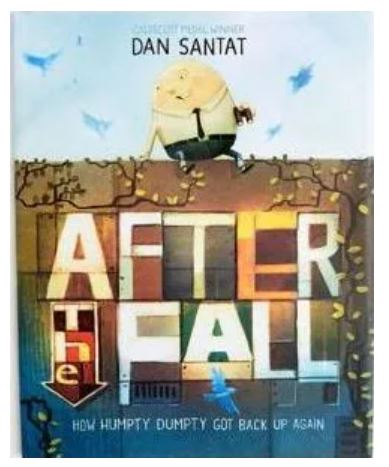
After the Fall: How Humpty Dumpty Got Back Up Again

Readers of all ages know about Humpty Dumpty, the tragic figure of a very simple and deeply unsettling four-line nursery rhyme. Since it was published over a century ago, the “Humpty Dumpty” story has been retold countless times, each retelling mixing in some new details along the way. From the original, undetailed Humpty Dumpty has come an optimistic—if fatefully naïve—character who also happens to be an anthropomorphic egg and who can sometimes be found visiting Wonderland. Despite these changes, Humpty’s story has always ended with the same Great Fall. Now, author and illustrator Dan Santat delivers today’s young readers something that previous generations have rarely seen from Humpty’s story – a happy ending.

After the Fall, is a truly delightful read. Santat takes children’s literature’s most famous failure to teach readers that failure is not something to define themselves by, and that their ability to accept and eventually overcome failure is the best path to finding who they really are. In doing so, the picture book gives readers an entirely different view of the age-old character of Humpty Dumpty. 

After the Fall twists the final line of “Humpty Dumpty” to reveal that all the king’s horses and all the king’s men were in fact able to put our poor egg together again. Santat begins his story with Humpty emerging from the hospital. He’s all patched up, without a crack left on him, and by looking at him you would never know he suffered a terrible accident in the first place. 

However, the fall left other marks on Humpty that cannot be seen from the outside. While he has no cracks on his shell, Humpty finds a new, possibly bigger danger to worry about: a horrible fear of heights. Climbing tall heights used to be a part of Humpty’s everyday life. He used to visit his grocery store and climb to the highest shelf of the cereal aisle, where his favorite brand sits. He used to spend his free time climbing to the top of the tallest wall in town, where he would sit and watch the birds fly by. But now, Humpty can’t imagine climbing such heights and feels he must settle for the bland, flavorless cereal located on the lower shelves. Now, he watches birds from the ground, which gives a much less exciting view. Readers will join Humpty as he learns to navigate life after the Great Fall. With Humpty, they will learn not to define themselves by failures or tragedies, but by their courage and perseverance.

Alongside its thoughtful writing, the story is strengthened by its illustrations. Since the story takes place over the course of a year, the book features several double-page drawings of each season, with beautiful mixes of fall colors, winter grays, and sunlit springs and summers. Through its clear illustrations and brief one to seven sentences of narration on each page, After the Fall is a relatively quick and easy read. It is also a thoughtful, uplifting, and emotionally resonant read that will undoubtedly satisfy any reader who picks it up. 

If you’re looking for more books that encourage readers not to let failure conquer them, pick up a copy of Splat the Cat with a Bang and a Clang by Rob Scotton.  

Sexual Content 

  • None

Violence 

  • None

Drugs and Alcohol 

  • None

Language 

  • None

Supernatural

  • None

Spiritual Content 

  • None

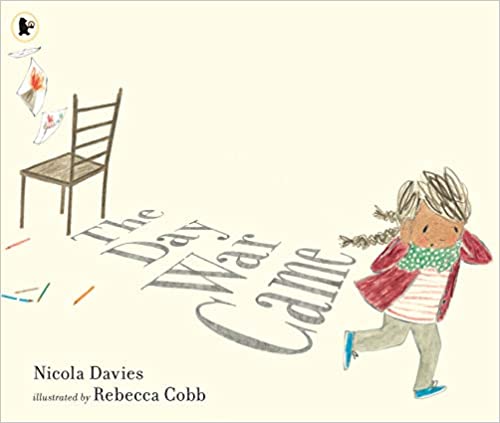
The Day War Came

The day started with a young girl having breakfast with her family. Afterwards, she heads to school, where she and her classmates learn about volcanoes and the life cycle of frogs. Then just after lunch, war came, and the school was brought down around the girl. All the people she had been with that day, from her teacher to her classmates to her family, were taken away from her. What follows is a moving story that is equally heart-wrenching and thought-provoking, as the girl flees her country and is faced with the possibility that the war may follow her wherever she goes.

The Day War Came uses simple vocabulary and childlike illustrations to introduce young readers to the real-life issues of war and child refugees. The illustrations are drawn to mimic a child’s drawings, making the story more accessible to young readers while also placing them in the perspective of the book’s child protagonist. The book does not specify which war it describes and does not show the resulting violence in its illustrations. Still, the presence of the war and its impact on the protagonist can be felt on nearly every page. 

The arrival of the war is indicated by tall clouds of dark smoke, along with a destroyed skyline of buildings. These drawings, along with the narrator’s description of the attacks, portray the confusion and chaos without directly showing its violence. For example, the narrator describes, “at first, just like a spattering of hail, a voice of thunder. . . then all smoke and fire and noise that I didn’t understand.” The book does not shy away from the reality of war and the struggles faced by war refugees, as the narrator travels across mountains, roads, and seas before arriving in a town where people shun her. 

The story ends with a message of hope, as the children of the town come together to give the narrator a seat in their classroom. On the last page of the book is a note from the author, Nicola Davies. Davies explains that she wrote the book after hearing a story about a child refugee who had been rejected by a school because there wasn’t a chair for her to sit in. Davies hopes that through this story, young readers will be taught the importance of these issues and will be inspired to act for a better future. If you are looking for a book to help your child understand the serious and continuing issue of war and child refugees, The Day War Came is an honest and straightforward guide.

Sexual Content

  • None

Violence

  • Although no violence is explicitly shown, the narrator says that the war “came across the playground. It came into my teacher’s face. It brought the roof down and turned my town to rubble.”
  • After the first attack, the narrator describes herself as “ragged, bloody,” although no blood is shown in the illustrations.

Drugs and Alcohol

  • None

Language

  • None

Supernatural

  • None

Spiritual Content

  • None

Luke McClain

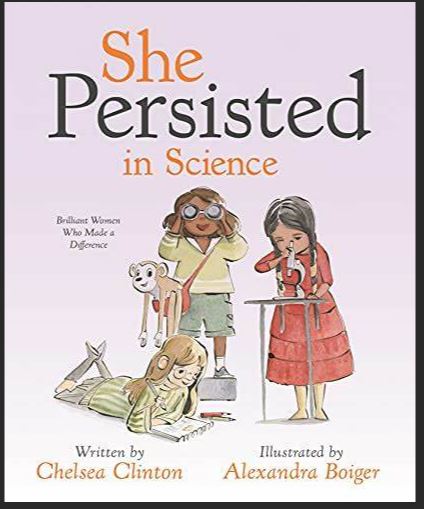
She Persisted in Science: Brilliant Women Who Made a Difference

Throughout history, women have been told that science isn’t for them. They’ve been told they are not smart enough, or that their brains just aren’t able to handle it. In this book, Chelsea Clinton introduces readers to women scientists who didn’t listen to those who told them “no” and who used their smarts, skills, and persistence to discover, invent, and create.

She Persisted in Science is for everyone who’s ever had questions about the world around them or the way things work—the kind of people who won’t give up until they find their answers.

She Persisted in Science shows how many women from different backgrounds made groundbreaking contributions to science. This book features Florence Nightingale, Rebecca Lee Crumpler, Ynes Enriquetta Julietta Mexia, Grace Hopper, Rosalind Franklin, Gladys West, Jane Goodall, Flossie Wong-Staal, Temple Grandin, Zaha Hadid, Ellen Ochoa, Dr. Mona Hanna-Attisha, Mari Copeny, Autumn Peltier, Greta Thunberg, and Wanjiru Wathuti.

Each person is introduced in a two-page spread. One page includes a short introduction of the woman. Both pages have a beautiful picture that highlights each woman’s passion. While most of the women are adults, the book also includes teenager Mari Copeny, who helped bring Flint, Michigan’s water situation into the public’s light. Her story shows that “You’re never too young or too small to change the world.” 

Because of the advanced vocabulary, She Persisted in Science will need to be read aloud to a child, rather than for the child to read it independently. However, the book is an excellent way to introduce a wide variety of women who overcame obstacles and made their dreams come true. Many of the biographies explain how these women from the past are still impacting today’s world. For example, Rosalind Franklin studied DNA and her work “is still being used today by scientists investigating many viruses, including the virus that caused COVID-19.”  

She Persisted in Science will encourage readers to reach for their dreams and explore the world around them. While many of the women featured in the book needed higher education to pursue their careers, other women impacted the world through activism. In the end, these diverse women and their amazing accomplishments highlight that “the world. . . should be full of people raising their voices, using their power and presence, standing up for what is right.”

Sexual Content 

  • None

Violence 

  • None

Drugs and Alcohol 

  • None

Language   

  • None

Supernatural

  • None

Spiritual Content 

  • None

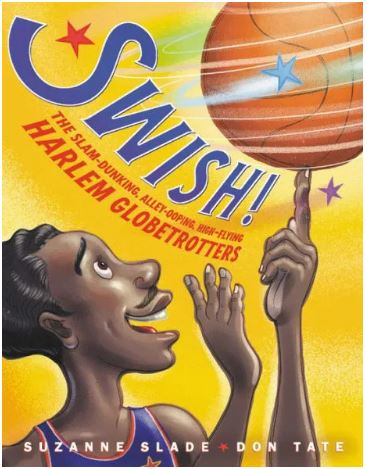
Swish!: The Slam-Dunking, Alley-Ooping, High-Flying Harlem Globetrotters

In this book you will find one-finger ball-spinning, rapid-fire mini-dribbling, and a ricochet head shot! You will find skilled athletes, expert players, and electrifying performers — all rolled into one! You will find nonstop, give-it-all-you’ve-got, out-to-win-it, sky’s-the-limit BASKETBALL!

You will find The Harlem Globetrotters, who played the most groundbreaking, breathtaking ball the world had ever seen. With rhythmic writing and dynamic illustrations, Swish! is a celebration of the greatness, goodness, and grit of this remarkable team.

Swish! uses a fun format to show how The Harlem Globetrotters’ accomplishments shaped basketball history. Each full-page illustration has bright colors and many of them contain humorous elements. The book also includes the racial segregation of the time and explains how it affected the players. Even though the Globetrotters’ games often sold out, “as soon as the game ended, the cheers stopped. The tired, hungry players weren’t always welcome in hotels or restaurants. They couldn’t use most gas station restrooms or phones.” 

Even though the Globetrotters were amazing athletes, people thought they should not be allowed to play in the MBA because only white players were allowed. That started to change when the Globetrotters challenged the Minnesota Lakers to a game—and won! Many thought the Globetrotters’ win was a fluke until they played the Lakers again—and won! NBA team owners finally realized that “their ‘whites only’ rule seemed ridiculous.” 

Not only did the Globetrotters open the door to the MBA for black players, but they also traveled the world with amazing crowds, and “they also made thousands of new friends, met popes, princesses, and presidents, and even sipped tea with the queen of England!” 

Slam! is a fun and educational book that shows the power of persistence. The text not only brings the Globetrotters’ story to life, but it’s also fun to read aloud. The text uses alliteration, oversized color font, and other elements that give the story added pizzazz. Slam! is sure to please basketball fans as well as readers who aren’t into sports. Plus, the book will encourage readers to dream big as well as to use their skills to make the world a better place. Basketball fans who want to bounce into the realm of fiction should check out the series STAT: Standing Tall and Talented by Amar’e Stoudemire.

Sexual Content 

  • None

Violence 

  • None

Drugs and Alcohol 

  • None

Language   

  • None

Supernatural

  • None

Spiritual Content 

  • None

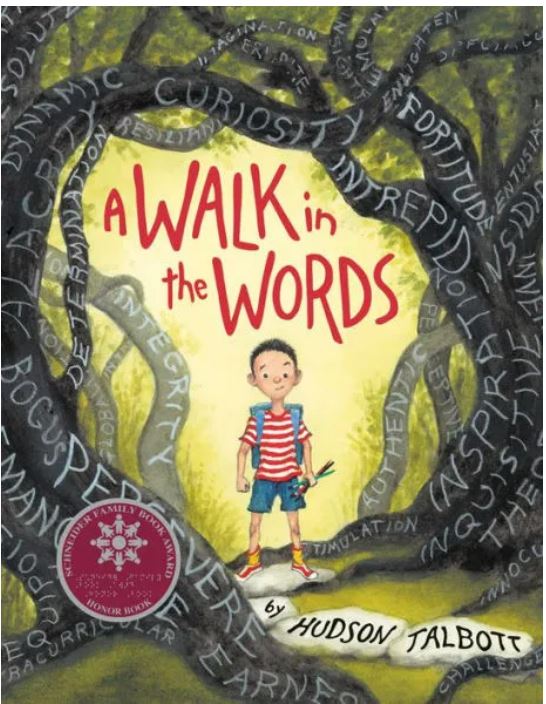
A Walk in the Words

When Hudson Talbott was a little boy, he loved drawing, and it came naturally to him. But reading? No way! One at a time, words weren’t a problem, but long sentences were a struggle. As his friends moved on to thicker books, he kept his slow reading a secret. But that got harder every year. He felt alone, lost, and afraid in a world of too many words.

Fortunately, his love of stories wouldn’t let him give up. He started giving himself permission to read at his own pace, using the words he knew as stepping-stones to help draw him into a story. And he found he wasn’t so alone—in fact, lots of brilliant people were slow readers, too. Learning to accept the fact that everyone does things in their own unique way and that is okay, freed him up and ultimately helped Hudson thrive and become the fabulous storyteller he is today.

A Walk in the Words is a must read for any child who struggles with understanding words. Hudson shows how learning new words can be a little scary. When he first started reading books with more text, “It was a reign of terror. My drawing pad was my safe place.” The accompanying illustrations show Hudson hiding underneath a notebook while words rain from the sky. Hudson worried that others would realize he couldn’t read as quickly as them, which caused him to feel shame. However, Hudson learns that he’s not the only person who struggles with words. To reinforce this, he includes a list of famous people—William Shakespeare, Albert Einstein, and Babe Ruth—who were all slow readers. 

Even though reading was difficult for Hudson, he didn’t give up. Hudson gives advice on how to make reading easier such as, “I took time to look for words that I knew. There they were! Like stepping-stones leading me onward.” Hudson also explains how he used drawing to cope with his difficulties. Throughout the story, Hudson uses his own experiences to encourage others to keep reading—at their own pace.

Besides the message, the book beautifully uses illustrations to help bring the story and words alive. For example, one picture shows Hudson in a dark, foreboding forest; white words are written on the tree trunks and limbs. The words include equipoise, aspiration, and trepidation. In another scene, a group of books greets Hudson and one book says, “We come in peace.” Each page has two to five sentences, but because of the story’s difficult vocabulary, the story will need to be read aloud to a child, rather than the child reading it themselves independently.

A Walk in the Words encourages struggling readers to keep trying. The story shows that many people are slow readers and that if you keep trying, you will become a better reader. Young readers will love the inspiring message as well as the amazing illustrations that have many fun elements. To introduce more ways that words can be fun, check out The Word Collector by Peter H. Reynolds and Stacey’s Extraordinary Words by Stacey Abrams.

Sexual Content 

  • None

Violence 

  • None

Drugs and Alcohol 

  • None

Language   

  • None

Supernatural

  • None

Spiritual Content 

  • None

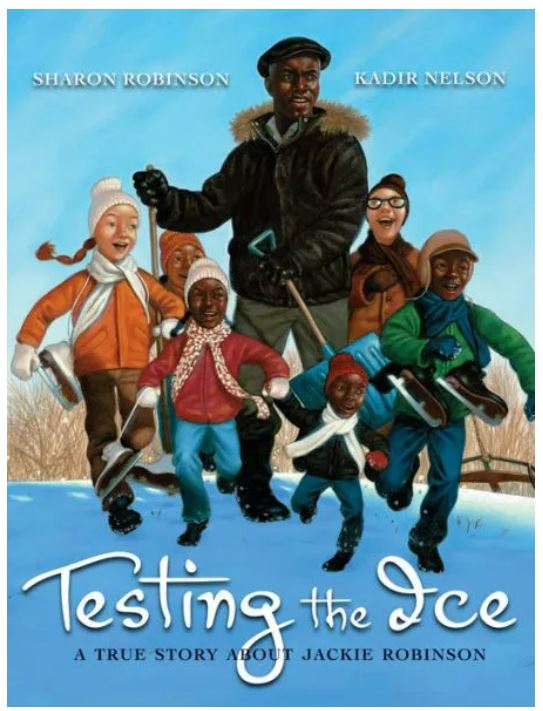
Testing the Ice: A True Story About Jackie Robinson

Sharon Robinson, the daughter of baseball legend Jackie Robinson, has crafted a heartwarming, true story about growing up with her father.

When Jackie Robinson retires from baseball and moves his family to Connecticut, the beautiful lake on their property is the center of everyone’s fun. The neighborhood children join the Robinson kids for swimming and boating. But oddly, Jackie never goes near the water. In a dramatic episode that first winter, the children beg to go ice skating on the lake. Jackie says they can go—but only after he tests the ice to make sure it’s safe. The children prod and push to get Jackie outside, until hesitantly, he finally goes. Like a blind man with a stick, Jackie makes sure the ice is safe to play on. 

Testing the Ice is a metaphor for Jackie Robinson’s legendary breaking of the color barrier in Major League Baseball. While the book introduces Jackie by discussing his role in Major League Baseball, the story focuses on his family’s move to Connecticut and Jackie’s refusal to go into the water. While the two events show Jackie’s bravery, younger readers will need help connecting the two events and understanding the story’s deeper meaning. 

Even though Testing the Ice is a picture book, the story is intended to be read aloud to a child, rather than for the child to read it for the first time independently. Unlike most picture books, Testing the Ice uses some difficult vocabulary and complex sentences that make it more appropriate for older readers. Many of the pages are text heavy and have up to 16 sentences on the page. The realistic illustrations often feature Jackie’s family as well as the neighbor’s children, which makes Jackie more relatable. 

Sharon Robinson’s childhood experience will allow readers to see Jackie Robinson’s bravery through new eyes. Sharon’s love and pride in her father is evident, and readers will come to understand why Sharon believed that, “My dad is the bravest man alive.” Readers who are interested in learning more about Jackie Robinson and sports history should also read Miss Mary Reporting by Sue Macy.

Sexual Content 

  • None

Violence 

  • None

Drugs and Alcohol 

  • None

Language   

  • None

Supernatural

  • None

Spiritual Content 

  • None

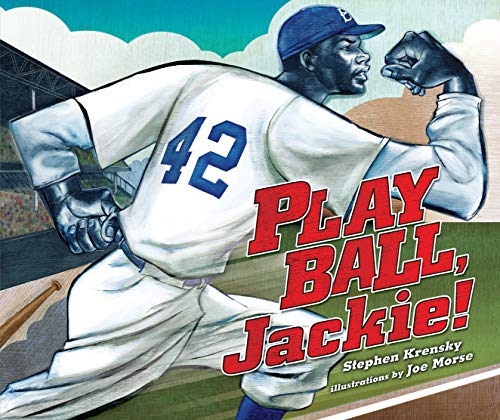
Play Ball, Jackie!

Batter up! April 15, 1947 is a big day for ten-year-old Matty Romano. His dad is taking him to see his favorite team—the Brooklyn Dodgers—on opening day!

It’s also a big day for the Dodgers’ new first baseman, Jackie Robinson. Today is Jackie Robinson’s very first game in the major leagues. Many white fans don’t like the fact that an African American is playing in the major leagues. By putting Jackie on the team, the Dodgers are breaking the color barrier. How will Jackie respond to the pressure? Is he the player who can finally help the Dodgers make it back to the World Series?   

Play Ball, Jackie! is told from the unique perspective of two Dodgers fans, Matty Romano and his father, who attended Jackie Robinson’s first game. The father and son discuss some of the discrimination Jackie faced because “he was a black man.” While at the game, Matty explains some of the discrimination that African Americans faced during the 1940s. Even though the story is set at Dodger’s Stadium, the story focuses on Matty’s experience at the game instead of Jackie Robinson’s achievements. However, baseball fans will still enjoy some of the play-by-play action as well as learn more about Jackie Robinson.  

Even though Play Ball, Jackie! is a picture book, the story will need to be read aloud to a child, rather than for the child to read it independently. Many of the pages are text-heavy with five to nine complex sentences. The illustrations have an old-fashioned feel with blue tinting. All of the characters are shaded in black and some of them have oversized facial expressions that emphasize the person’s emotions. However, some of the facial expressions are a little odd, especially the ones of angry fans. 

Play Ball, Jackie! is packed full of information about discrimination during Jackie Robinson’s time. Instead of having a typical story plot, Play Ball, Jackie! is mostly expository as it explains segregation by using several different examples. The educational book ends with a list of books and websites readers can check out to learn more about Jackie Robinson.  

Play Ball, Jackie! is an excellent book to introduce young readers to big ideas such as segregation, discrimination, and the civil rights movement. Plus, the book shows how Matty is brave enough to speak up in defense of Jackie Robinson; this part of the book is an excellent conversation starter about how to kindly stand up for others. For more history-related baseball stories, you’ll hit a home run by reading the picture books Baseball Saved Us by Ken Mochizuki and Catching the Moon by Crystal Hubbard. 

Sexual Content 

  • None 

Violence 

  • None

Drugs and Alcohol 

  • None 

Language   

  • When Jackie strikes out, someone yells, “You stink, Robinson! Go back to where you belong.”  
  • While in line at the hotdog stand, Matty sees a boy with an “I’m for Jackie” button. Another boy says, “Negros should stick to their own kind. They’ll never make it in the big leagues.” Matty defends Jackie by saying, “If some of the best players are black, they’re the ones who can help us get to the World Series. That’s what we all want, isn’t it?”

Supernatural 

  • None

Spiritual Content 

  • None 

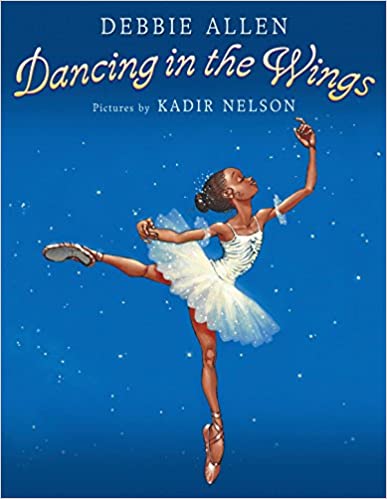
Dancing in the Wings

Sassy is a long-legged girl who always has something to say. She wants to be a ballerina more than anything, but she worries that her too-large feet, too-long legs, and even her big mouth will keep her from her dream. When a famous director comes to visit her class, Sassy does her best to get his attention with her high jumps and bright leotard. Her first attempts are definitely not appreciated, but with Sassy’s persistence, she just might be able to win him over. Dancing in the Wings is loosely based on actress/choreographer Debbie Allen’s own experiences as a young dancer. 

Sassy and her classmates are in that awkward preteen stage where girls often begin to sprout up. At dance class, Sassy stands out for all the wrong reasons. Since Sassy is so tall, she is “too big for the boys to pick up, and too tall to be in line with the other girls.” Instead of being on stage, Sassy stays backstage watching others perform. Despite this, Sassy continues to practice, and eventually, she becomes the star of the show.  

Dancing in the Wings is a motivational story that shows the importance of dedication and hard work. While the story focuses on Sassy’s love of dance, her family is showcased in a positive manner. Both Sassy’s mother and uncle encouraged her to keep dancing. Despite his teasing, Sassy’s brother and his football team make an appearance to support Sassy. One negative aspect of the story is the mean words exchanged between Sassy and the other dancers. Even though the other girls tease Sassy, she never gives up.  

Even though Dancing in the Wings is a picture book, the story will need to be read aloud to a child rather than for the child to read it independently. Each page has five to fifteen complex sentences and some difficult vocabulary that younger readers may not understand. Both Sassy and the other dancers are African American. Large pictures showcase Sassy’s family as well as Sassy’s dancing. In order to give readers a visual of how tall Sassy is compared to the other dancers, the illustrations show Sassy towering over her classmates. Readers will cheer when Sassy is chosen for a select spot at a summer dance festival and her height is no longer a disadvantage. 

Parents looking for an inspirational story to share with their child should read Dancing in the Wings to their children. If your little one is too squirmy to sit through a longer book, Parker Shines On by Parker & Jessica Curry may be a better choice. Both books are well-suited for children who love dance and have participated in a dance class. To introduce your child to more inspiring women, She Persisted in Sports by Chelsea Clinton showcases many athletes who overcame obstacles in order to achieve their goals. 

Sexual Content 

  • None 

Violence 

  • None

Drugs and Alcohol 

  • When Sassy’s uncle picks her up from dance class, he smells of cigars. 

Language   

  • Sassy signs up for dance auditions. Afterward, she overhears two girls talking about her. Mona says, “Oh please, she’ll never make it. They said talent, not a tyrannosaurus.”  
  • While auditioning, Sassy tells Mona, “Your little skinny short legs are gonna look like chicken wings next to mine.” Mona replies, “I’d rather look like a chicken than a turkey like you with that long neck.”  
  • While auditioning, Mona says Sassy has a big butt. 
  • Sassy teases her brother about having a “big forehead lookin’ like a street lamp” and her brother teases her about being tall and having big feet. 

Supernatural 

  • None 

Spiritual Content 

  • None 

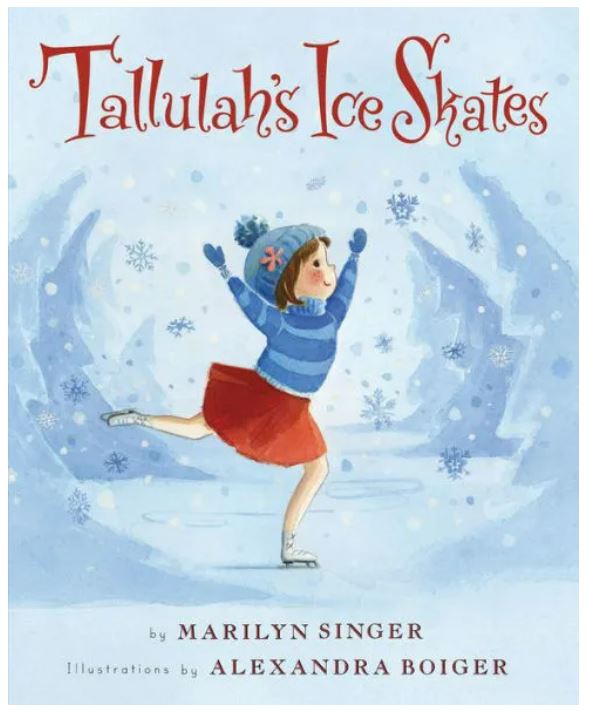
Tallulah’s Ice Skates

Tallulah is an accomplished ballerina, but she also loves to skate. After all, skating’s a lot like ballet—challenging, graceful, and glamorous.

Tallulah is positive that with some hard work, she and her friend Kacie will be just as good on the ice as they are at dance. They’ll be Super Skaters! But Kacie doesn’t want to rehearse fancy moves; she just wants to have fun. So Tallulah practices by herself. That is, until an encounter with a talented boy ends with an embarrassing mishap. Then, Tallulah begins to realize that sometimes having fun is more important than being the best.

Grab a cup of hot chocolate and a blanket, and snuggle up with your young reader to enjoy Tallulah’s ice skating adventure. Readers will relate to Tallulah, who wants to spend time with her friend, even though they don’t agree on what they should do. 

The story’s winter wonderland is illustrated in soft blues, while the kids’ clothing has pops of red and orange. The beautiful pictures show the snowy landscape and include individual snowflakes on almost every page. The ice skaters are shown making graceful twirls as well as falling sometimes. Even the black birds sitting in the tree branches become part of the story when Tallulah thinks that they “were laughing at her.” While there are not many characters, the characters included are diverse.

Tallulah’s Ice Skates will appeal to readers interested in dance and skating. In order to help readers distinguish the narration from Tallulah’s thoughts, her thoughts are written in large, bold letters. Since each page has two to seven sentences, parents will need to read the story to their child.   

Tallulah’s Ice Skates is an engaging story with beautiful pictures that readers will enjoy. Tallulah’s experiences will encourage readers to try new activities. Even though Tallulah realizes she’s “not a Super Skater,” she still has fun doing bunny hops with her friend, hearing the “swooshy sound” her skates make, and the cool air tingle on her face. Other books that feature the fun of winter include A Loud Winter’s Nap by Katy Hudson and Snowmen At Night by Caralyn Buehner.

Sexual Content 

  • None

Violence 

  • None

Drugs and Alcohol 

  • None

Language   

  • None

Supernatural

  • None

Spiritual Content 

  • None

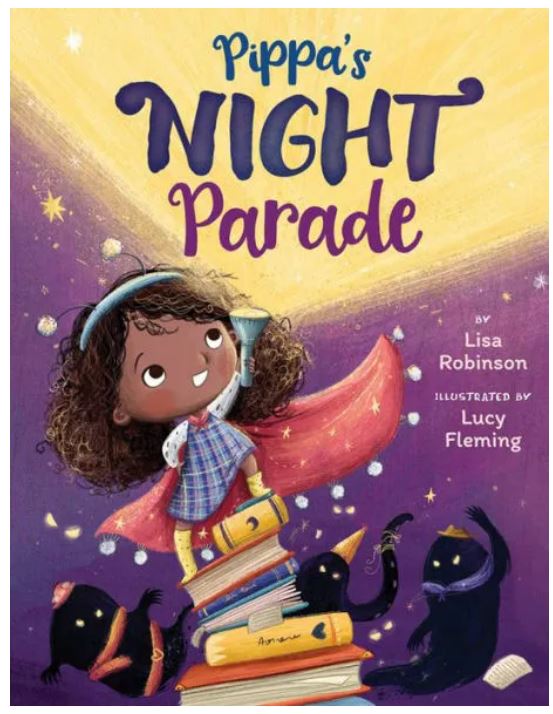
Pippa’s Night Parade

Pippa is a young girl with an incredible imagination and an eye for creativity. To Pippa, a mundane day can become a thrilling adventure. Each morning she tosses every item from her dresser and equips herself with masks, boots, and scarves. They may only be pieces of clothing, but to Pippa they are armor, and they will prepare her for whatever adventure comes her way.

However, Pippa’s imagination doesn’t seem to have an off-switch, and when night comes, it creates leering monsters that lurk from every shadow in her room and sinister characters that crawl out from her storybooks. Pippa has tried everything to stop these villains. She has tried to scare the dragons away with night lights, and to confuse the pirates by hiding under her covers. Yet none of these methods have worked, and every night Pippa is forced to flee to her parents, who only take her back to her room. This cycle repeats night after sleepless night. In Pippa’s Night Parade, readers will witness Pippa come to realize her imagination is a wonderful gift that she alone can control. 

Pippa’s Night Parade is a sweet and charming picture book and a particularly excellent story for those readers who are not fans of the dark. Readers will find an immediately likable and relatable hero in the character of Pippa, and her final plan against the monsters (which is equally hilarious and heartfelt) is nearly guaranteed to put younger readers’ own fears of the dark to rest. With a straightforward story and only one to three sentences per page, the book makes for a quick and easy read.

The book’s illustrator, Lucy Fleming, invigorates the story with vibrant drawings that bring Pippa’s strange, obscure imagination to life. Each page is carefully lit and colored, from sunny, multicolored double-page spreads of Pippa’s room during the days when she delights in her imaginary adventures to darker drawings of Pippa’s room at night, where that very same imagination turns unpleasant; these illustrations are lit only by her dull night light and the creatures’ glowing eyes. It is important to note that although the story involves monsters, witches, and beasts, Fleming does not draw these characters in a way that will scare young readers, and by the end of the story these villains appear just as friendly and approachable as the story’s lead character.

By reading Pippa’s Night Parade, readers who are worried about monsters in the dark will find a story that teaches that imagination is a gift that can be used to defeat or befriend monsters just as easily as it created them. If you are looking for a quick and easy picture book that is matched with a good story, a good heart, and a likable protagonist, Pippa’s Night Parade is guaranteed to satisfy. Plus, the message is especially relevant and helpful. Other picture books that help readers overcome their fear of the dark include The Pout-Pout Fish in the Big-Big Dark by Deborah Diesen and Otis and the Puppy by Loren Long.   

Sexual Content

  • None

 Violence

  • None

Drugs and Alcohol

  • None

Language

  • None

Supernatural

  • The monsters that threaten Pippa’s sleep include a dragon, a witch, a cyclops, and the Loch Ness Monster, among other supernatural creatures. The story clearly shows that these creatures exist only in Pippa’s imagination.

Spiritual Content

  • None

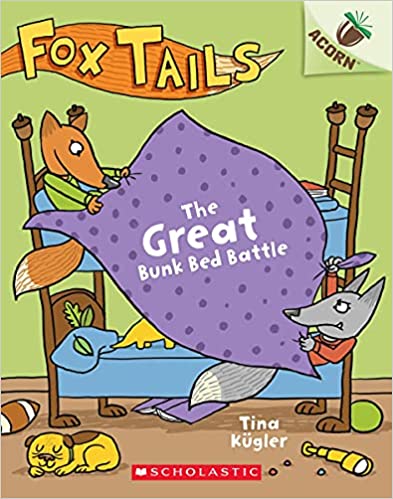
The Great Bunk Bed Battle

Fox siblings Fritz and Franny – and their adorable dog, Fred — get up to different bedtime shenanigans across three short stories in this full-color early reader. An imaginative bedtime routine leads the trio through a castle, a volcano, and even the center of the Earth as they debate whose bunk is best. But at the end of it all, these foxes find a way to meet in the middle.  

Part of Scholastic’s early reader line, The Great Bunk Bed Battle will help children who are learning to read. Each page has one to two simple sentences that are easy to read. The large font appears in speech bubbles which makes it easy to tell who is speaking. Each page has brightly colored, full-page illustrations with cute details. For example, when Fritz pretends his bed is a submarine, his dog has a helmet and air tank so he can follow the submarine.   

The Great Bunk Bed Battle uses humor and a fun storyline to help young readers build reading confidence and fluency. Anyone who has ever had to share will relate to Fritz’s and Franny’s competitive nature. The two foxes show the importance of using your imagination and the surprise ending is adorably cute. Whether you’re looking for a quick bedtime story or a fun book that will engage young readers, The Great Bunk Bed Battle is sure to please. For more fun books that teach the importance of working through conflicts, check out the Unicorn and Yeti Series by Heather Ayris Burnell and Hello, Crabby! by Jonathan Fenske. 

Sexual Content 

  • None 

Violence 

  • None 

Drugs and Alcohol 

  • None 

Language   

  • None 

Supernatural 

  • None 

Spiritual Content 

  • None 

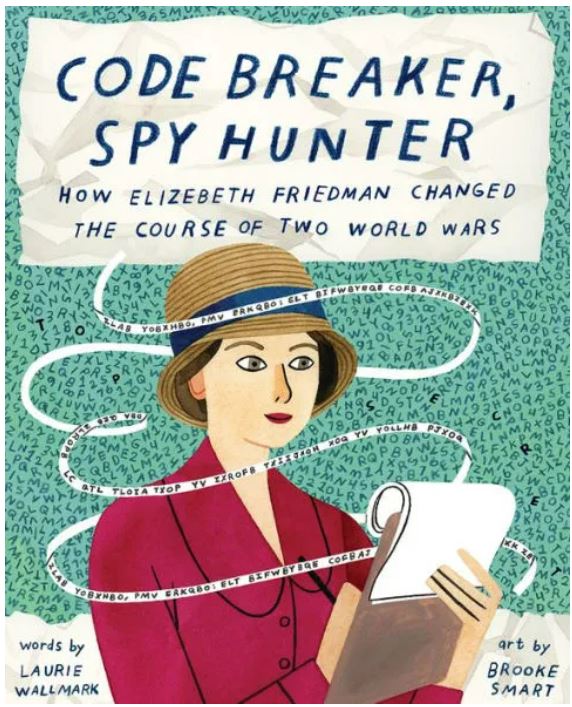
Code Breaker, Spy Hunter:  How Elizebeth Friedman Changed the Course of Two World Wars

In 1943, the CIA intercepted messages from Mexico and South America that were believed to be disguised war information. A team of ciphers was able to decode these messages and they discovered that a secret Nazi spy ring was sending the messages. These decoded messages were the evidence needed to arrest thirty-three German spies in what is now known as “the greatest spy roundup in history.” This team of ciphers was led by Elizebeth Smith Friedman, a renowned cryptanalyst. Elizebeth’s work as a spy and her incredible accomplishments were kept secret, until recently. 

Adapted from Friedman’s personal memoirs, Code Breaker, Spy Hunter utilizes watercolor illustrations and simple vocabulary to recount the amazing story of a previously unacknowledged figure. The story is told in a linear narrative detailing the most significant moments of Friedman’s career as well as some lesser-known fun facts from her personal life. For example, during dinner parties she hosted with her husband, a fellow cipher, they challenged their guests with the coded address of the restaurant.  

The book retells Friedman’s story in a way that is easy for younger readers to navigate while not compromising or minimizing important details to Friedman’s story. Although the book features small font and some particularly text-heavy pages, its colorful, minimalist illustrations help readers maintain a consistent understanding of the story. It is important to note that the book assumes that readers already have a basic understanding of both World Wars. If there are young readers who are not yet familiar with these historical periods, parental guidance will be needed. 

In Code Breaker, Spy Hunter, readers will receive an insightful and important education on an overlooked historical figure. Elizebeth’s story of small beginnings teaches that hard work and positive relationships are the keys to success.  

Sexual Content 

  • None 

Violence 

  • None 

Drugs and Alcohol 

  • None 

Language 

  • None 

Supernatural 

  • None 

Spiritual Content 

  • None 

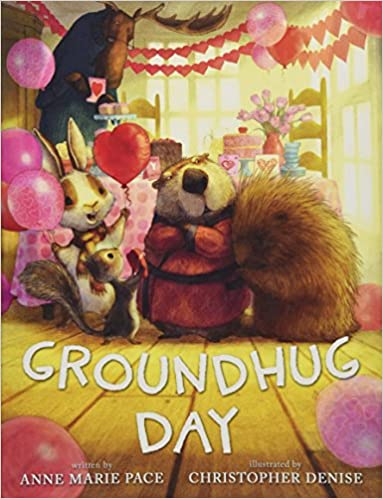
Groundhug Day

Moose is having a Valentine’s Day party, and all his friends are so excited! Everyone except Groundhog, that is. If Groundhog sees his shadow outside, he’ll hide in his hole for six more weeks and miss the party!

Determined to help their friend join them, Moose, Squirrel, Bunny, and Porcupine put their heads together and come up with a plan. But will it be enough to get Groundhog out to play?

When Groundhog comes out of his den and sees his shadow, his animal friends discover that Groundhog is afraid of shadows. In order to get Groundhog to come out, the animals show him all the different ways shadows are “awesome.” The animals show Groundhog how to use shadows to draw silhouettes and create puppet shows. Watching shadows dance is fun too. Despite this, Groundhog goes back into his hole for six more weeks. And when he finally pops out of his den and is ready for a St. Patrick’s Day party, Groundhog discovers that Bunny is “holed up this time of year” because he’s painting Easter eggs.

Young readers will relate to Groundhog’s fear of shadows and love all the ways the animals use shadows for entertainment. The story comes to life with super cute illustrations that are drawn in natural colors. Readers will giggle as each animal plots a way to get Groundhog out of his hole, especially because each scheme is drawn on a chalkboard. Plus, Groundhog is super cute and his clothing resembles an English gentleman. When he finally comes out for spring, he’s dressed for a Saint Patrick’s Day party!

Even though Groundhug Day is a picture book, the story is intended to be read aloud to a child, rather than for the child to read it for the first time independently. Readers may need help reading some of the text-heavy pages that have up to seven sentences per page. However, the adorable illustrations and the conversations between the animals make Groundhug Day entertaining enough for younger readers to enjoy.

Groundhug Day is a sweet story that will warm readers’ hearts and remind them that shadows are not scary. If you’re looking for another fun Valentine’s Day book, check out Splat the Cat: Funny Valentine by Rob Scotton.

Sexual Content

  • None

Violence

  • None

 Drugs and Alcohol

  • None

Language

  • None

Supernatural

  • None

Spiritual Content

  • None

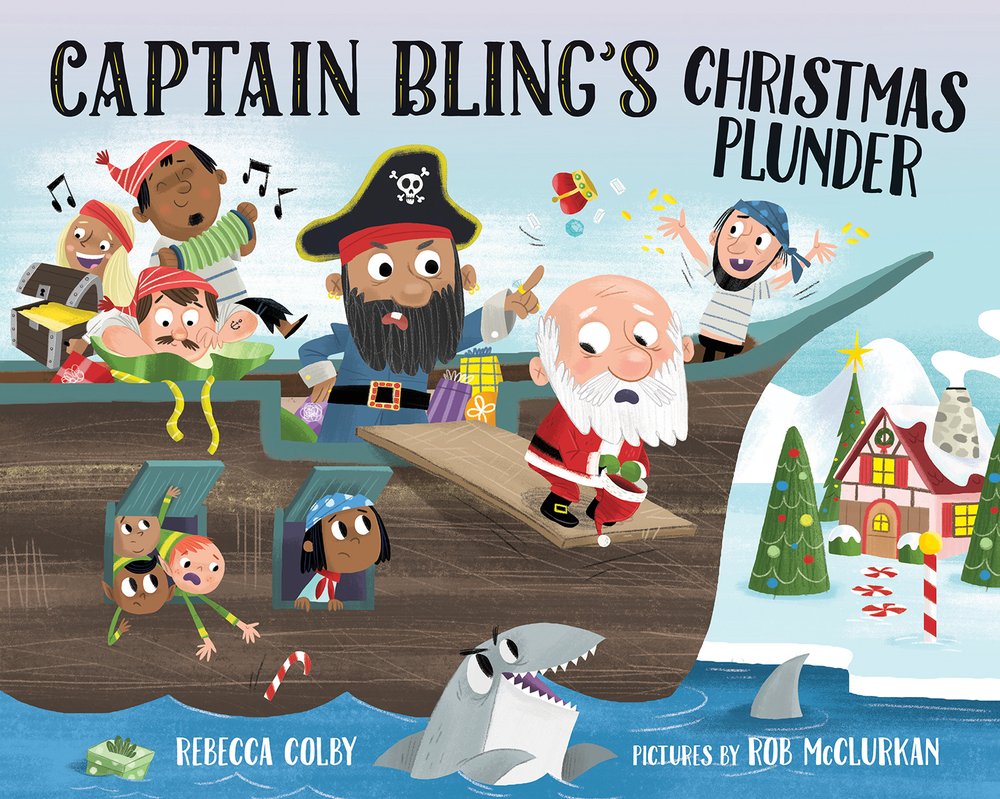
Captain Bling’s Christmas Plunder

Captain Bling and his merry crew set off to find treasure, but they get blown off course and end up at the North Pole. When they spy the elves carefully wrapping presents, the pirates think they have found the ultimate booty! They quickly steal the presents and make their way back to the ship. By the time Santa Claus catches up to them, the pirates are well on their way to escaping. But Santa has a surprise for Captain Bling and his crew!

Captain Bling’s Christmas Plunder will take readers on a swashbuckling adventure to the North Pole. The pirates’ plundering activities are told with humor, in rhyming couplets. The pirates attack Santa’s workshop, forcing Santa and the elves to fight, and “though Santa swung fast, the pirates swung faster, and a sack versus swords was a surefire disaster.” However, the gifts are saved because the pirates change their ways and help Santa on Christmas night.

The brightly colored illustrations show Santa’s magical land where pine trees are decorated, snowmen smile, and toys are stacked waiting for Christmas day. Young readers will love the illustrations’ fun details such as penguins watching the elves and pirates fight, and a shark happily waiting as Santa walks the plank. Each page has 1 to 3 rhyming sentences which include some advanced vocabulary. Even though Captain Bling’s Christmas Plunder is a picture book, the story is intended to be read aloud to a child, rather than for the child to read it for the first time independently.

Captain Bling’s Christmas Plunder is a fun spinoff of The Night Before Christmas. Pirate-loving readers will enjoy seeing Santa and the pirates fight over the toys. Plus, the happy ending shows Santa and the pirates working together to deliver Christmas toys. If you’re looking for another humorous Christmas picture book, The Knights Before Christmas by Joan Holub is sure to make readers smile.

Sexual Content

  • None

Violence

  • The pirates take Santa’s treasure, “so Santa gave chase, with his sack on his back, but the pirates were ready to face his attack.” The pirates capture Santa and “the pirates forced Santa to walk the gangplank.”

 Drugs and Alcohol

  • None

Language

  • None

Supernatural

  • None

Spiritual Content

  • None

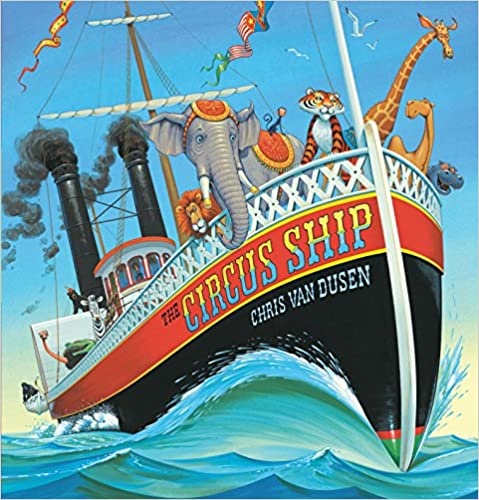
The Circus Ship

When a circus ship runs aground off the coast of Maine, the circus animals stagger to the shore of a small island. At first the townspeople view them with suspicion, but it’s not long before the locals and animals are sharing the island in harmony. Then, when the greedy circus owner returns, the townsfolk and the circus refugees come up with a delightfully original way to outsmart the fiend, exacting hilarious revenge in the process. 

The Circus Ship uses wonderfully expressive caricatures that evoke the early nineteenth century. Young readers will love the humorous illustrations. For instance, when a man sees an alligator sleeping on his wood pile, he jumps into the air and pulls his hair. When the circus master comes looking for the animals, readers will have fun finding all the hidden animals. Many of the animals are disguised in silly ways, such as one woman who is wearing a snake as a scarf and has a monkey in a stroller. 

Even though The Circus Ship is a picture book, the story is intended to be read aloud to a child, rather than for the child to read it for the first time independently. Each page has eight to twelve rhyming lines. The story uses complex sentence structure and some difficult vocabulary words such as menagerie, tuckered out, and bothersome. Despite this, the story’s plot is easy to follow.  

Not only is The Circus Ship highly entertaining, but the illustrations are also wonderful as well. Plus, the story has a positive message about not judging others (in this case, animals) by their appearance. Anyone, young or old, who loves animals will enjoy The Circus Ship. If you’re looking for a silly picture book that young readers will want to read again and again, The Circus Ship is the book for you. For more stories with silly shenanigans with animals, check out the Mercy Watson Series by Kate DiCamillo. 

Sexual Content 

  • None 

Violence 

  • The boat hits a rock. “Then came a CRASH! An awful BASH! Things flew into the air! . . . The splashing, thrashing animals swam round and round and round.” The animals swim to the island.  
  • A little girl gets caught inside a burning building. The tiger “ran past all the people, and he leapt into the blaze.” The girl comes out of the fire unharmed and riding on the tiger’s back.

Drugs and Alcohol 

  • None

Language   

  • None 

Supernatural 

  • None 

Spiritual Content 

  • None 

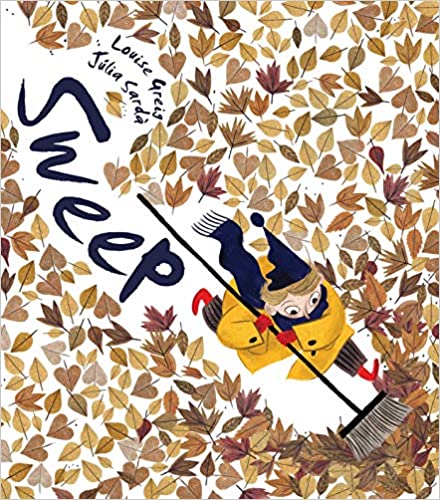
Sweep

On a windy fall night, a young boy named Ed looks over his town. He has a broom in hand and is standing atop a towering mountain of leaves. The day began with him sweeping leaves, but below his mountain are all the other things he seemed to have collected along the way, including dogs, cats, bicycles, cars, buses, people, and buildings.   

The story of Sweep starts when a single leaf in the wind hits Ed’s face, causing him to trip over a broom. This puts Ed in a bad mood, but unlike all the bad moods he’s had before, this one grows and grows until he is ragefully sweeping every leaf around him into one large pile. His bad mood convinces him to go on, not accounting for all the animals, vehicles, or people in his way. Ed knows he is taking things too far. He even knows that if he looked up from the ground, he would see all the beautiful balloons, birds, and kites above it. But his bad mood is not satisfied until he has swept up his whole town. 

By the end of the day, there are no flowers left and the birds have stopped singing. Ed is tired, hungry, and questioning if he can really stop sweeping after going through all this trouble. As he ponders this, his bad mood begins to lift and a strong gust of wind picks up every person and thing in his pile. Not only does the wind put everything back to normal, but Ed believes the town looks even better than it did before.  

The wind gently lands a kite in front of Ed, who, finally looking up from the ground, flies it high in the air. He notices the beauty of all the other kites around him. The next time Ed finds himself in a bad mood, he makes sure to think twice and ask himself if there is a way to process it in a more constructive way. 

Sweep is a smart and funny story that teaches a valuable lesson about learning to process your feelings. The book has one to five sentences per page, making it a fast read. Readers of all ages will also enjoy the book’s art style, which makes use of bleaker autumn shades such as beige, gray, brown, and crimson during Ed’s rampage through his town and uses a wide spectrum of bright, vivid colors when his spirit lifts. The items and characters that amass in Ed’s constantly growing pile guarantee a laugh on every page, and the pile’s mountainous final form is full of clever gags and details for eagle-eyed readers to spot upon repeated readings. 

Younger readers will relate to Ed’s impulse to lash out when he’s in a bad mood. Plus, his journey will help them to understand the harmful nature of being negative. By reading Sweep, readers will also learn how to evaluate and express their feelings in a way that is beneficial to themselves and others. Readers who enjoy Sweep should also read Swashby and the Sea by Beth Ferry, a sweet book that shows how one man’s grumpy mood changes when he meets an unexpected friend.  

Sexual Content 

  • None 

Violence 

  • None 

Drugs and Alcohol 

  • None 

Language 

  • None 

Supernatural 

  • None 

Spiritual Content 

  • None 

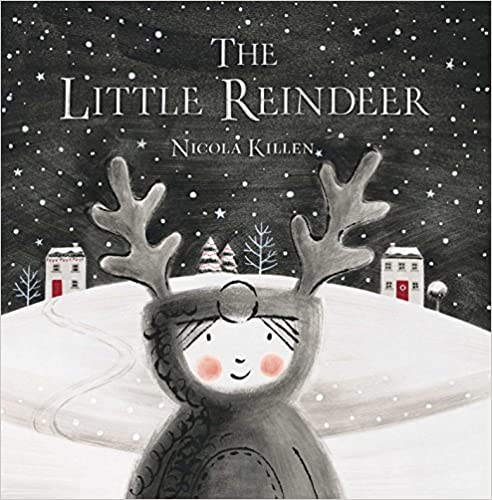
The Little Reindeer

On the night of Christmas Eve, a young girl named Ollie is awoken by a jingling outside her house. She hurries to her window but sees nothing out of the ordinary. With her reindeer pajamas and red sled, Ollie adventures into the snowy night to find the source of the sound.  

Stepping outside, she hears the sound again. She leaps onto her sled. Speeding down the hill outside her house, the sound becomes clearer. Eventually, Ollie traces the sound to the barren, dark woods outside of her neighborhood. Feeling brave, she runs into the darkness. There, she finds the source of the sound hanging from a tree branch. It is a red collar with silver bells. Ollie smiles and takes the collar but wonders who it belongs to.  

Just then, she hears a new sound –the sound of footsteps crunching through the snow. A real reindeer is approaching. He eyes the collar in Ollie’s hands, and Ollie understands that the collar belongs to him. Ollie kindly returns the collar to the reindeer, who gestures his new friend to climb onto his back. 

Suddenly, the two are soaring above the woods, over Ollie’s town, through the night sky. The reindeer softly lands in front of Ollie’s house. Ollie thanks her friend, but admits that she doesn’t want to say goodbye. However, she understands that this reindeer has a very special job to do tonight. Ollie goes back to her room, lies in bed, and pleasantly dreams of her adventure. Her reindeer friend jingles past her window once more, only this time, he is leading Santa’s sleigh. The next morning, Ollie is gifted a snow globe with a figurine of the reindeer inside. She smiles, knowing that she will always have something to remind her of that magical night and that she’ll see her friend next year. 

The Little Reindeer is a fast and fun read for the Christmas holiday, with one to four short sentences per page. Its illustrations are mostly drawn in black, white, and gray, with red being the only color to stand out. The backgrounds are typically entirely blank or black, with chalk-like dots of snow to enliven the winter spirit. Detail-driven readers can have fun searching for Ollie’s stuffed reindeer hiding in every page. 

Young readers who celebrate Christmas will relate to Ollie’s holiday spirit. However, all young readers will admire Ollie’s sense of adventure, her bravery, and her sparkling curiosity. Through Ollie’s journey, readers can learn that by following their bravery and curiosity, they can form their closest friendships and greatest memories.  

Sexual Content 

  • None 

Violence 

  • None 

Drugs and Alcohol 

  • None 

Language 

  • None 

Supernatural 

  • None 

Spiritual Content 

  • None 

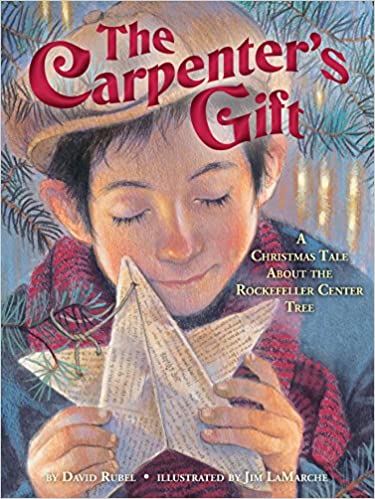
The Carpenter’s Gift

One Christmas night, Henry sits in his house and thinks blissfully back to a special day in 1931. He was a child then, growing up during the Great Depression. The historical downturn left a significant impact on his family. His family lived in a small house, and both of his parents were out of work. They struggled to afford coal for the stove or blankets for the beds. Henry kept an optimistic mind, and occupied himself with thoughts of warm, magical places.  

On Christmas Eve of that year, Henry was surprised to see his father arrive at the house in a big rental truck. He calls for Henry to come along, and the two happily drive to a nearby forest to cut down its evergreen trees and stack them onto the back of the truck. When Henry asks why, his father joyfully replies that they’re going to New York City to sell Christmas trees. 

The thought of being in a big city like New York excites Henry, and he is immediately fascinated by Midtown Manhattan. Henry’s father parks the truck beside a construction site and asks a worker if they can set up shop there. Acknowledging the pair’s situation, the worker agrees. What follows is a heartfelt story of generosity and hope in the hardest of times. 

The Carpenter’s Gift is a sweet holiday tale that spans several generations before arriving at the message that there is no better present than kindness. Henry searches time and again for the warm, magical moments he dreams of, and finds that these moments are produced not by magic but by simple acts of giving. 

The warm atmosphere of the book is strengthened by its lavish, impressionistic illustrations that are passionately drawn in the beautiful colors of each season. The illustrator makes several uses of double-page illustrations to portray the sheer scale and beauty of the evergreen trees. The story is told with simple, easy vocabulary, and readers can expect four to ten sentences on each page.  

The Carpenter’s Gift is guaranteed to satisfy all readers who celebrate Christmas and is a comforting read for those looking for a warm story this winter season. 

Sexual Content 

  • None 

Violence 

  • None 

Drugs and Alcohol 

  • None 

Language 

  • None

Supernatural 

  • None 

Spiritual Content 

  • None 

by Luke McClain 

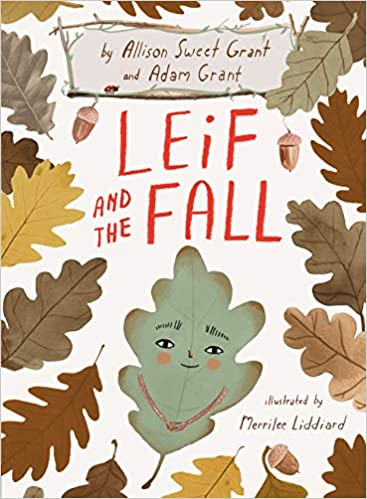
Leif and the Fall

Leif is a small green leaf who lives in a tall oak tree. Being a leaf means being attached to a tree, but Leif doesn’t mind. He loves the view from his branch and getting to spend time with his best friend, Laurel. As the breeze gets harsher and the days get shorter, Leif realizes that it’s nearly fall. Leif has never seen fall, but its arrival worries him, as he knows that fall is the time when all leaves fall from their trees. Leif doesn’t want to be like all leaves. With the help of Laurel, he hatches a plan to catch himself. 

Leif and the Fall is a fun and pleasant read for the young reader who doesn’t let others tell them who they are and what they are capable of. It is also a testament to the power of thinking outside the box and surrounding yourself with the right people. While the other leaves mock and discourage Leif’s plan, Leif persists in his goal and chooses to surround himself with supportive friends like Laurel. While none of Leif’s plans work in the way he intended, the story tells a thoughtful message that all your hard work and skills will inevitably help you in some way, as all of Leif’s discarded contraptions form a pile big enough to soften his and Laurel’s fall. 

The book’s short and sweet story is well-matched with simple, charming illustrations.  The leaves are softly colored in shades of green, yellow, brown, and gray. Faces are drawn to personify them, while their stems are drawn as their arms and legs. The pages have blank backgrounds that are either white or colored with muted autumn shades. Readers can enjoy a second read-through to spot all the insects hiding on the tree’s branches. Each page has one to seven short sentences and easy vocabulary that makes it easy to understand for beginning readers.  

Leif and the Fall is an excellent book for young nature lovers and fans of autumn. Apart from being an enjoyable story, it is sure to help younger readers as they learn the importance of creativity, self-expression, and positive friendships. Readers ready to snuggle up with another fall-themed picture book with a positive message should add Sophie’s Squash by Pat Zietlow Miller to their must-read list. 

Sexual Content:

  • None 

Violence: 

  • None 

Drugs and Alcohol: 

  • None 

Language: 

  • None 

Supernatural: 

  • None 

Spiritual Content: 

  • None

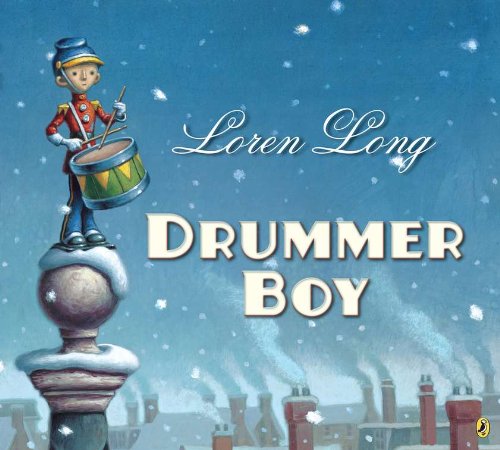
Drummer Boy

In a wintery little town, a toy drummer boy appears mysteriously on a child’s doorstep. The child loves the little drummer boy, and the drummer boy loves the child. The drummer boy gives the child the only gift he can– He plays his drum– boom pum pum boom pum.

 But when he accidentally falls into the trash, the drummer boy is sent on a scary and snowy journey! Even so, as he is carried and flown, and almost buried in snow, the little drummer boy still gives the gift he can to a rat and a snowman and the nighttime stars.

Right from the start, young readers will be captivated by the drummer boy. When he falls into the trash, and is taken to the dump, the drummer boy begins a journey where he ends up in surprising places. Even when his circumstances seem dire, the drummer boy gives to others by playing his song. The ending is surprising and sweet and reminds readers that the reason for Christmas is because a little baby was born.

The snowy illustrations are in muted colors with beautiful details. The illustrations show the scale of the little drummer boy and how small he is compared to his surroundings. Even though Drummer Boy is a picture book, the story is intended to be read aloud to a child rather than for the child to read it for the first time independently. Each page has 2 to 9 sentences; however, some of the sentences are complex.

The story is surprisingly suspenseful, and readers will be curious to see where the drummer boy ends up next. If you’re looking for a holiday book to share with your family, Drummer Boy is an enchanting story that shows the importance of giving to others despite your circumstances.

Sexual Content

  • None

Violence

  • None

 Drugs and Alcohol

  • None

Language

  • None

Supernatural

  • None

Spiritual Content

  • None

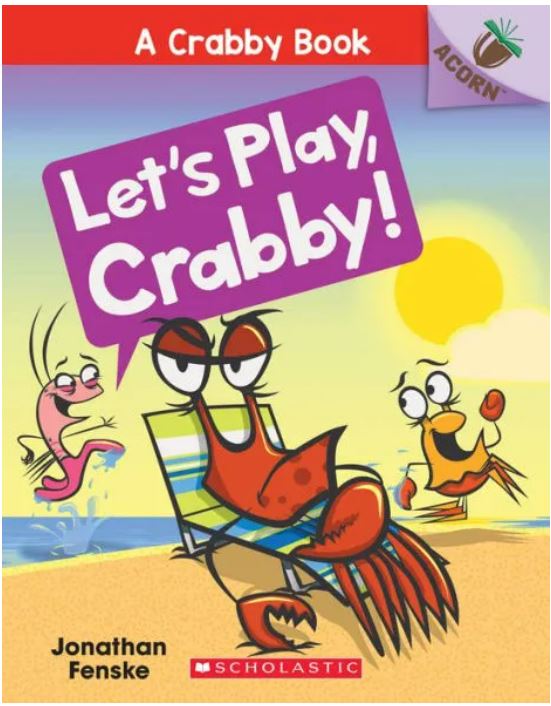
Let’s Play, Crabby!

Plankton wants Crabby to play a game. Plankton tries to get Crabby to play Simon Says, Tag, and Hide-and-Seek. But Crabby does NOT want to play with Plankton. Will Plankton give up? Or will Crabby finally play along?   

Beginning readers will fall in love with Plankton’s enthusiasm and Crabby’s grumpiness. This easy-to-follow, silly plot comes to life in the brightly-colored artwork that appears on every page. The pages are broken into colorful panels, which makes it easy for readers to follow along. Plus, the colorful speech bubbles make it easy to understand who is speaking.  

Let’s Play Crabby is perfect for children who are learning to read. The text uses simple sentences and easy vocabulary, and the speech bubbles are color-coded to distinguish each speaker. Each page contains five or fewer sentences, which makes the story accessible to new readers. 

Let’s Play Crabby is full of humor and has a silly, surprise ending. With easy-to-read text, a comic-story format, and full-color artwork on every page, the book will boost reading confidence and fluency. Readers will laugh their way through the book and will be eager to read another Crabby story. Beginning readers who love Plankton and Crabby can learn more about friendship by reading The Unicorn and Yeti Series by Heather Ayris Burnell.  

Sexual Content 

  • None 

Violence 

  • None 

Drugs and Alcohol 

  • None 

Language   

  • None 

Supernatural 

  • None 

Spiritual Content 

  • None 

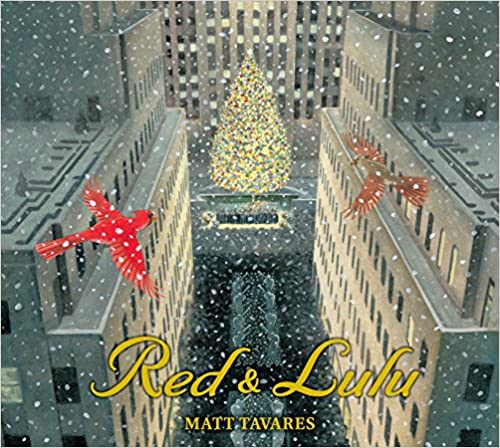
Red and Lulu

Two cardinals, Red and Lulu, have made a nest in a particularly beautiful evergreen tree overlooking a family’s house. The shade from the tree’s branches keeps the birds cool during the hot months, while its needles keep them warm during the cold months. Red and Lulu’s favorite time of year is winter when the family decorates their tree and sings O Christmas Tree. One morning, as that special season is arriving, Red flies out to find breakfast while Lulu stays behind. When Red returns, he finds that their tree has been cut down, and is being driven away on a large truck. Red can hear Lulu singing from somewhere inside the tree. He calls out to tell her to stay where she is. 

Red flies towards the tree, but he can’t keep up with the truck, which leads Red into a chase through highways, across the George Washington Bridge, and through crowded city streets. Before long, Red realizes he has lost sight of the truck, and finds himself in a strange new place unlike anywhere he’s ever been before – New York City. Red spends days searching the city for Lulu. He searches outside of the New York Public Library, through Times Square, and over the Empire State Building. During Red’s search, he and Lulu’s special season finally arrives. As snow falls, Red hears the faint sound of O Christmas Tree being sung from a distance. He hurries towards the sound, finally tracing it to a crowd of people surrounding a familiar tree standing at Rockefeller Center. The tree is covered from top to bottom in colorful Christmas lights, but Red immediately recognizes it as his and Lulu’s tree. 

He flies over the happy carolers and into the tree’s branches, where he is joyously greeted by Lulu. The two reside happily in their tree and smile at the large crowds of people who seem to love it just as much as they do. One day, the same truck arrives and takes their tree once again. This time, Red and Lulu find a new tree in Central Park, where they make their new home. Every winter since, Red and Lulu take a trip to Rockefeller Center to visit their first tree and listen to the crowd of people sing their favorite song. 

Red and Lulu is a sweet and touching story and a visually engaging read from start to finish. The book is rich with beautiful illustrations that are carefully and passionately drawn to convey the beauty of winter, as well as that of every season in the book’s opening pages. The background of each illustration tends to have more muted colors, from beige and yellow autumns to gray and blue winters, which allows the bright red cardinals and glowing holiday decorations to stand out. The font of the narration is notably smaller on some pages, but the straightforward narration allows for an altogether easy read. However, beginning readers may need help understanding some of the difficult vocabulary such as “frantically” and “marveled.” There are one to eight sentences per page, but some pages rely on the illustrations to tell the story.  

Red and Lulu’s narrative does an excellent job of getting the reader to care about the relationship between its two title characters, making their eventual reunion feel just as special. Readers who celebrate Christmas are likely to enjoy the book’s Christmas setting, but the book can also be enjoyed by readers who live in New York City or who are familiar with the area. Readers who have moved homes or are preparing to move can also find this story particularly endearing, as they may relate to the overwhelming change felt by Red and Lulu, as well as the story’s message of the home being defined by the presence of loved ones rather than a specific place.  

Sexual Content 

  • None 

Violence 

  • None 

Drugs and Alcohol 

  • None 

Language 

  • None 

Supernatural 

  • None 

Spiritual Content 

  • None 

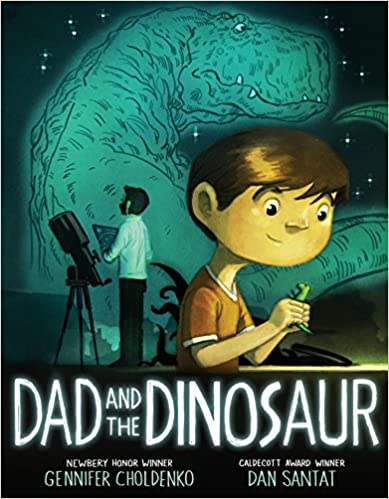
Dad and the Dinosaur

Nicholas was afraid of the dark outside his door, the bushes where the giant bugs live, and the underside of manhole covers.

His dad was not afraid of anything.

Nicholas wants to be as brave as his dad, but he needs help. That’s why he needs a dinosaur. After all, dinosaurs “like the dark, bugs are nothing to them, and they eat manhole covers for lunch and everything under them for dinner.”

With his toy dinosaur, Nicholas can scale tall walls, swim in deep water, and even score a goal against the huge goalie everyone calls Gorilla. But when his dinosaur goes missing, everything is scary again.

Luckily, his dad knows that even the bravest people get scared, and it’s okay to ask for help facing your fears.  

Anyone who has ever been afraid will relate to Nicholas, who carries his dinosaur with him everywhere. Having his dinosaur helps Nicholas feel brave. But when the dinosaur is lost, Nicholas begins to be afraid. Suddenly, Nicholas notices that “the night was as black as octopus ink, giant bugs were everywhere, and their little car was nearly sucked under the street.” Illustrations help bring Nicholas’s fears to life by showing large bugs skittering across the road, and a large octopus crawling out of a manhole. When Nicholas goes to bed, a large octopus tentacle reaches out to touch him. But with his dad’s help, Nicholas finds his dinosaur and is brave again. 

The illustrations show the contrast between Nicholas’s toy dinosaur and his imagined dinosaur. Nicholas’s imaginary dinosaur is shown as a huge outline while the smaller toy dinosaur is often peeking out of a sock or sleeping under Nicholas’s pillow. Plus, Nicholas’s imaginary fears pop off the page because the illustrations of them are so large. Most pages have one to three simple sentences. However, even though Dad and the Dinosaur is a picture book, the story is intended to be read aloud to a child, rather than for the child to read it for the first time independently. 

The imaginative illustrations and the simple text allow readers to explore the things that cause fear—both real and imagined. Because of this, Dad and the Dinosaur is a relatable picture book that kids will enjoy. However, at the end of the book, Nicholas doesn’t tell his mom about how his dinosaur helps him be brave. Instead, it’s a secret between Nicholas and his dad. Some parents might not like that a secret is kept between Nicholas and his Dad.  

Overall, Dad and the Dinosaur’s wonderful illustrations will capture readers’ imaginations and show them how Nicholas overcomes his fear. 

 Sexual Content 

  • None 

Violence 

  • None 

 Drugs and Alcohol 

  • None 

 Language   

  • None 

 Supernatural 

  • None 

 Spiritual Content 

  • None 

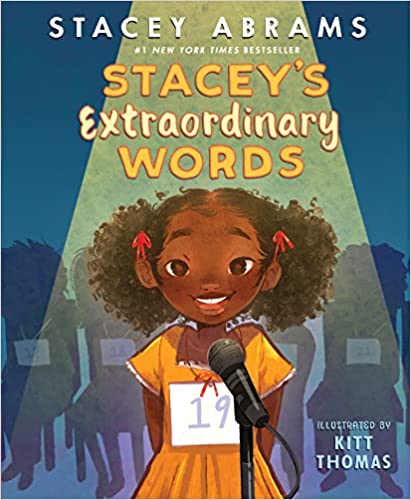
Stacey’s Extraordinary Words

Stacey is a little girl who loves words more than anything. She loves reading them, sounding them out, and finding comfort in them when things are hard.   

But when her teacher chooses her to compete in the local spelling bee, she isn’t as excited as she thought she’d be. What if she messes up? Or worse, if she can’t bring herself to speak up, like sometimes happens when facing bullies at school?  

Stacey will learn that win or lose . . . her words are powerful, and sometimes perseverance is the most important word of all.  

Stacey’s Extraordinary Words is a fabulous story that introduces readers to new words by showing a protagonist who loves words. Stacey “adored fun words, long words, unusual words. Words with histories and weird combinations.” When Stacey encounters a new word, the definition of the word is included. However, because of the many words that Stacey loves, young readers will need an adult’s help pronouncing difficult words such as ptarmigan, onomatopoeia, persnickety, and perseverance.  

Unlike most books, Stacey’s Extraordinary Words doesn’t end with Stacey winning the spelling bee. Instead, the mean boy wins, and he makes fun of Stacey for misspelling a word. Despite the boy’s mean behavior, Stacey “stayed onstage like a good sport as Jake got his trophy and she received her second-place ribbon. Everyone congratulated Jake and so did she.” Through Stacey’s experiences, the reader learns the importance of being a good sport and the importance of perseverance.  

While Stacey’s story doesn’t have a happily ever after ending, Stacey learns that “words shouldn’t be used to hurt people.” But the most important part of all is that Stacey learns “new ways to speak up and help others.” The author’s note at the back of the book explains how the story was based on the author’s life experiences.  

Stacey’s Extraordinary Words tells an engaging story which is enhanced by the colorful full-page illustrations. When Stacey reads, many of her thoughts appear in the background, allowing readers to understand Staceey’s thought process. Many of the words that Stacy loves appear in large text and use fun fonts. Plus, when Stacey is at school, her classmates are a diverse group of students. In addition, her mother appears in several pages and is always encouraging and loving. Even though the story is a picture book, the pages are text heavy and the pages have as many as seven complex sentences.   

The educational and entertainment value of Stacey’s Extraordinary Words makes it a must-read book. Not only will readers learn important life lessons, but they will also enjoy the story and illustrations. The Word Collector by Peter H. Reynolds is another must-read picture book that features a protagonist who loves words.  

Sexual Content 

  • None 

Violence 

  • None 

Drugs and Alcohol 

  • None 

Language   

  • None 

Supernatural 

  • None 

Spiritual Content 

  • None 

Latest Reviews