
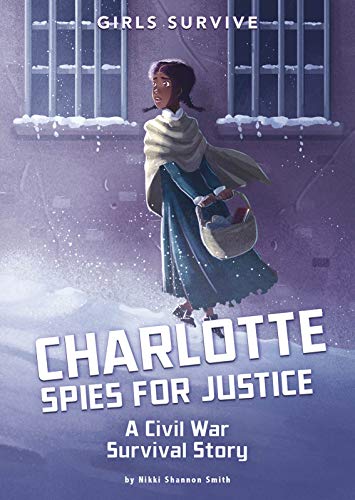
Charlotte Spies For Justice: A Civil War Survival Story

Twelve-year-old Charlotte lives on a plantation in Richmond, Virginia, where the American Civil War is raging. All around her, citizens and the Confederate army are fighting to protect slavery — the very thing Charlotte wishes would end. When she overhears the plantation owner conspiring against the Confederates, Charlotte knows she must help. Maybe together they can help the Union win the war and end slavery. Helping a spy is dangerous work, but Charlotte is willing to risk everything to fight for what is right — justice for all people.  

Charlotte Spies For Freedom is full of action and suspense that focuses on the heroic deeds of many historical events. While Charlotte is fictional, she is a relatable character who shows bravery despite her fear. Several times, Charlotte visits Libby prison. Even though the story shows the harsh conditions of Libby prison and includes the death of several Union soldiers, no gruesome details are given. However, the story highlights Charlotte’s fear of being caught and harmed. Despite her fear, Charlotte is willing to risk her life to help the Union cause. She says, “I’m willing to give my life away if it helps free my people.”  

Even though Charlotte is a fictional character, many of the book’s characters are based on real people. This includes Elizabeth Van Lew, who gathered important information to pass along to the Union Army. Readers will be fascinated with the different ways Elizabeth Van Lew used to send messages, including using invisible ink and ciphers. She also hides messages in hollowed-out eggs, the heels of boots, and loaves of bread. Several times, Charlotte comments on Elizabeth Van Lew’s “odd” behavior; the author’s note explains that Elizabeth Van Lew’s strange behavior was another way she disguised her activities.  

Another historical spy is Mister McNiven. Despite being surrounded by war, Mister McNiven greets Charlotte each morning by saying, “It’s a good day to be alive.” At first, Charlotte doesn’t understand his optimism. However, she soon realizes Mister McNiven believes this because “he knew he was doing something important. He hoped for a better tomorrow and he was doing his part.” 

To make the story easy to follow, each chapter begins with Charlotte’s location and the date. Every ten to seventeen pages there is a black-and-white illustration that focuses on Charlotte’s activities. One illustration shows a Confederate soldier hitting Charlotte. The back of the book contains an author’s note that goes into more detail about the historical facts of Elizabeth Van Lew, a glossary, and three response questions to help readers connect to the reading material. 

Charlotte Spies For Freedom is an engaging story that shows how ordinary people were willing to lay down their lives to fight for the freedom of all people. The story, which uses kid-friendly descriptions, is both educational and entertaining. Since the story is full of danger and action, it will appeal to a wide audience. Readers interested in historical fiction can also learn about the Underground Railroad by reading Long Road to Freedom by Kate Messner. 

Sexual Content 

  • None

Violence 

  • Charlotte goes to a prison holding Union prisoners. While there, she sees “a dead Union soldier. . . I caught a glimpse of his face. I could tell he had been beaten.” 
  • While delivering food to the prisoners, a Confederate soldier named Robert points a gun at Charlotte. Robert “walked toward me, put the barrel of his gun in my face, and cocked it.”  Another soldier, Erasmus Ross appears and grabs Charlotte’s face. “He squeezed even harder, and a sharp pain shot through my jaw.” Ross drags Charlotte outside. 
  • In order to protect Charlotte, Ross takes her outside and tells her, “I’m going to get you out of here, but I have to hit you.” He proceeds to backhand her. “It hurt, but not nearly as much as it should have. . . Mister Ross gave me a shove so hard it sent me to my knees.” As she was leaving, “a shot rang out behind me. I could only hope that Mister Ross had fired into the air.” 
  • After a prison break, Confederate soldiers “recaptured forty-eight Union soldiers. . . Two of them drowned.” 

Drugs and Alcohol 

  • None 

Language   

  • Some people called Elizabeth Van Lew “Crazy Bet.” 

Supernatural 

  • None 

Spiritual Content 

  • None 

Race to the South Pole

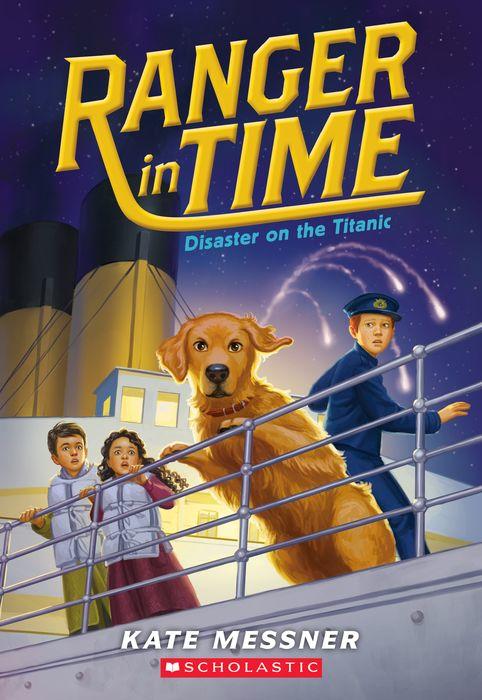
Ranger, the time-traveling golden retriever with search-and-rescue training, is back! This time, he joins a dangerous expedition to the South Pole!

Ranger joins an early twentieth-century expedition journeying from New Zealand to Antarctica. He befriends Jack Nin, the stowaway turned cabin boy of Captain Robert Falcon Scott’s ship. They’re racing against a rival explorer to reach the South Pole, but with unstable ice, killer whales, and raging blizzards, the journey turns into a race against time. . . and a struggle to stay alive.

Told in third-person, Race to the South Pole includes the inner thoughts of both Ranger and Jack. Even though Antarctica is dangerous, most of the danger comes from the harsh weather conditions. During the trip, both Ranger and Jack miss their families and wonder when they’ll be able to return home. Although Jack faces deadly freezing weather, he works hard and never complains. However, Jack sneaks onto the ship without telling his family his plans. And while in the Arctic, he doesn’t follow orders and instead sneaks out of the camp and almost dies alone.

Race to the South Pole is an entertaining and educational story that has a unique perspective because it focuses on a golden retriever. Readers interested in the men who attempted to reach the South Pole will enjoy Race to the South Pole, which has full-page, black-and-white illustrations approximately every six pages. Even though Ranger’s story is fictional, facts are woven into the story. The end of the book has more information about the historic expedition as well as a list of further resources. Plus, the author’s note includes information about Jack’s Maori Chinese cultural background. The book references Ernest Shackleton who climbed Mount Erebus but did not reach the South Pole. Readers interested in learning more about Ernest’s explorations can read Survival Tails: Endurance in Antarctica by Katrina Charman.

While Race to the South Pole lacks suspense, the story contains enough intrigue to keep the reader interested. Jack’s desire to help his family is relatable and his determination is admirable. The author’s note explains how the characters are based on real people, but the original expedition ended with the death of five members of the team, which will help readers understand how dangerous the expedition really was. Readers who want to learn more about how dogs help humans in frozen conditions should also read Dogs in the Dead of Night by Mary Pope Osborne.

Sexual Content

  • None

Violence

  • Horses and dogs were taken on the expedition, but there was not enough food to adequately feed them. “The sled dogs were getting lean, too. They were so hungry that one team attacked a pony that was stuck in a snowdrift. The horse fought off the dogs, but the pony was hurt, too weak to travel even another mile before the men made camp.”
  • A sled dog team fell into a crevasse. “Ranger and Osman strained under the weight of the rest of the team. The other dogs dangled in midair, howling as the lines cut into their fur. . . Jack could hear them yelping and whimpering below.” The dogs are saved.
  • Jack ventures out alone and falls in a crevasse. “The ice walls rushed past as he fell. . . Jack’s leg twisted, and his knee gave a sickening pop. . . Just when it felt like he might plunge into the darkness forever, Jack thumped on his back onto a snow shelf. He landed so hard he couldn’t breathe.”

 Drugs and Alcohol

  • None

Language

  • When Jack falls overboard, one of the men yells, “Good Lord!”

Supernatural

  • None

Spiritual Content

  • None


Powwow Summer

Part Ojibwe and part French, eighteen-year-old River lives on a farm with her mother and stepfather. After graduating high school, she looks forward to spending her last summer before university with her friends, but she struggles with her identity after years of racist bullying. On top of this, she must deal with doubts about her relationship with her boyfriend, as well as her stepfather’s violent tantrums.  

When River’s mother reveals that she’s been seeing someone else, River supports her. But when River’s mother tells her that she wants them to leave in the dead of night and move in with her new boyfriend, River feels conflicted and angry. After a conversation with her mother turns heated, River buys a bus ticket to Calgary to stay with a friend. On the way, she is intercepted by a call from her dad, who invites her to stay with him instead. River agrees, and so begins a summer in the city with her father and grandmother, both of whom are Ojibwe. While staying with them, River learns about the lives of people in her community and grows especially close to her grandmother (or nokomis), Grace. 

Over the summer, River encounters new situations. She joins a healing circle. She goes to her first bar with her dad and, later that night, her first North Side party. She learns about the intergenerational effects of residential schools and other issues facing the Ojibwe community. Eventually, River attends a powwow. At the afterparty, River gets drunk and witnesses a knife fight between two gang members. Not thinking straight, River takes pictures of the fight, including a selfie in front of it that prominently displays her red bandana. When she posts the pictures online, they go viral and the comments are filled with threats from people who interpreted her bandana as gang affiliation. River panics, takes down the photos, and asks her family for advice.  

But the damage has already been done. While coming out of a convenience store, she is attacked by two girls who want to be initiated into a gang. Although she is terrified by this incident, River chooses not to press charges after hearing their experiences during another healing circle. Later on, she shares an especially profound moment with her grandmother while they gather birch bark. At the end of the summer, River returns home with a new sense of self and a plan to major in Indigenous Studies.  

Powwow Summer is ultimately an uplifting story that centers around River’s experience of learning about and growing close to her culture. But the novel doesn’t shy away from the struggles that can come with being indigenous. A prologue at the beginning of the book details the racist bullying that River endured in grade school. While the story doesn’t linger on this, River alludes to the bullying in a conversation with her mother, where River recalls being singled out by a racist elementary school teacher.  

Another issue that frequently pops up in the background of the story is the issue of missing and murdered indigenous women. River feels her heart sink when she observes a team of volunteers dragging the Red River in search of a missing woman. This comes up again when River attends a healing circle and hears one of the members talk about his cousin’s recent suspicious death. The family believes it may have been an overdose, but the police do not seem to care. It is even revealed that the two girls who jumped River only did so because they believe a gang will offer them protection from “perverts and Indian killers.” 

Also looming over the narrative is the memory of residential schools, where River’s grandmother and others endured years of abuse. River grows especially close to her grandmother and wonders how she is able to remain so strong despite such hardships. These three issues are far from the only issues that Powwow Summer tries to tackle. The novel includes a wide range of issues in less than 200 pages, and at times the scope may be a little too broad. Readers may find the plot complicated, but the various threads are woven together skillfully.  

Powwow Summer is told through both conventional chapters and River’s journal entries, which are usually one to two pages long. River is a likable character with believable struggles, but she also witnesses many other peoples’ struggles, and some readers may be disturbed by these intense scenes. Ultimately, Powwow Summer is a powerful story about identity headed up by a likable and well-developed main character. Powwow Summer is best suited for readers interested in historical fiction or who want to learn more about Ojibwe culture.  

Sexual Content 

  • When River tries to alert the teachers about the harsh bullying she receives from boys at school, the teachers say that boys teasing her means that they “like” her. 
  • While at the beach, River notices some younger teen boys gawking at her as she applies sunscreen to her friend’s back and observes that the towels in their laps seem “a little too strategic.” 
  • When River jokes about riding a horse in the Canada Day parade, her boyfriend tells her that it would add “sex appeal.” 
  • One of River’s friends denounces a potential love interest as not a “real lesbian.” Her friend says, “If you don’t like tacos, then go back to the hot dog cart already. I can’t be someone’s experiment.” 
  • River kisses her boyfriend several times. 
  • River brings a blanket to a day trip with her boyfriend. She intends to use it for a picnic, but adds “and then if you’re good, we’ll see what else we can do with, or under, it.” Nothing ends up happening at the day trip because River is a virgin and reluctant to have sex until she is sure that she is ready. 

Violence 

  • When River leaves some of her equipment on the front porch, her stepfather Randy reacts violently by “smash[ing]” fine china “against the brick chimney beside the dinner table.” Blood “splatter[s]” on River and “drip[s] from his hand.” 
  • A grade school teacher singled out River. When River would talk in class, the teacher began “pok[ing]” her and “slapp[ing]” her.  
  • River witnesses a gang fight between two men. One “[holds] a knife to” the other’s throat. He does not actually cut the other man. 
  • After her post goes viral, two girls approach River in a store parking lot and attack her. One girl “[swings] her fist” and punches River. When River falls to the ground, the girls “[stomp] on River’s foot and calf.” 
  • River receives several online threats including one that warns her, “You are gonna wish you killed yourself, after you find out what they are going to do to you.” 

Drugs and Alcohol 

  • In a flashback, River overhears two bullies say, “Indians are mostly drunk people on welfare.” The bullies speculate that River is “drunk at school” and that she “drinks Listerine and sniffs gasoline from a paper bag.”  
  • River’s friend relays that a party is going to have “lotsa babes and booze.” 
  • River’s stepfather drinks heavily. 
  • River’s father orders her a rum and coke from a bar.  
  • At a party, two girls do cocaine near where River is trying to sleep. They offer her some, but she declines. 
  • River gets drunk at a powwow afterparty. 

Language  

  • Bullies at school refer to River’s eyes as “dogshit brown.” 
  • In a flashback, River gets called a racial slur by her peers. 
  • The word “shit” is used frequently throughout the narrative. 
  • “Bitch,” “slut,” “damn,” and “hell” are also used at times. 

Supernatural 

  • None 

Spiritual Content 

  • At a youth night, River smudges herself with sage and wafts tobacco smoke from a bowl. The youth leader explains that the smoke carries prayers up to the Creator.  
  • River “ask[s] the Creator for a sign” or “something that would show her the path she was supposed to be on.” 

Tara and the Towering Wave: An Indian Ocean Tsunami Survival Story

When her mother announces a holiday vacation to Thailand, Tara isn’t thrilled. She’d rather stay home with her friends, but Mom is determined they use the girls’ trip to explore their Thai heritage. Tara is reluctant to travel so far from home, especially to a country she doesn’t feel connected to. But then disaster strikes. The day after Christmas, a massive tsunami sweeps through Phuket, Thailand. Tara’s resort vacation suddenly becomes a fight to survive – and find her mother in the wreckage. 

Tara and the Towering Wave explores themes of identity and heritage by focusing on Tara, who is Thai but has never been to Thailand. All of Tara’s information about her heritage comes from her mother, who also grew up in the United States. When people ask Tara about her identity, she is slightly confused about what to tell them because she knows very little about Thailand. The themes are not explored in detail because the focus is on surviving the tsunami. 

When the tsunami hits, Tara and her mother are separated but Tara eventually makes it to safety. Afterward, a man helps Tara out of the raging ocean, but her only focus is to find her mother. Often, she is so caught up in her own fears that she doesn’t take other people’s situations into consideration. While her behavior is understandable, it isn’t until she is safely reunited with her mother that she begins to think about others.  

The story’s events highlight how people helped each other through this difficult time. Fisherman went out to sea looking for survivors, businesses opened their doors as makeshift evacuations centers, and Tara and her mother helped at the hospital by passing out food and water. As Tara begins to realize the devastation that the tsunami caused, she wonders, “Why were we spared when so many others were not?” She never answers the question, however, she realizes that her and her mother were lucky to survive. 

In order to make the story easy to follow, each chapter begins with Tara’s location and the time. Every 10 to 17 pages there is a black-and-white illustration. The illustrations mostly focus on Tara and the events surrounding her. Some of the illustrations show the towering waves but no one’s injuries are included in them. The back of the book contains an author’s note that goes into more detail about the historical facts of the tsunami, a glossary, and three response questions to help readers connect to the reading material. 

The Girls Survive Series is similar to the I Survived Series by Lauren Tarshis because both books focus on young protagonists who survive a disaster. Anyone who is interested in survival stories will enjoy Tara and the Towering Wave. After Tara is saved, the action wanes but there is still enough suspense to keep readers engaged. However, the book doesn’t tie up all the loose ends, and readers are left wondering what happened to some of the characters—did they live, or did they die? Despite this, Tara and the Towering Wave will introduce readers to the devastating effects of a tsunami while using kid-friendly details of the destruction. Readers who want to learn about another historic tsunami should also read I Survived the Japanese Tsunami, 2011 by Lauren Tarshis. Readers who want a more in-depth look at historical survival stories should check out the Survival Tails Series by Katrina Charman; this series uses the unique premise of having animals tell the story. 

Sexual Content 

  • None 

Violence 

  • Tara and her mother were strolling through an open-air market when the tsunami hit. “Everyone and everything in the market was washed away. The powerful currents knocked my feet out from under me. . . In seconds, the street I had been standing on was gone, turned into a churning river.” 
  • The water tore Tara and her mother apart. Tara “quickly clamped my eyes closed, but salty water filled my nose and mouth. I was tossed and tumbled around in the water like a pile of clothes in a washing machine.” Tara finds a tree trunk to hold on to. 
  • While holding on to a telephone pole, a wave crashes into Tara. “It felt almost stronger than the first. Like the ocean was angry it hadn’t washed me away on its first attempt. . .The water gushed over and around me. . . This was a thick curtain, determined to suffocate and bury me.” Tara eventually makes it to safety.  
  • Tara’s mom broke her foot when the ocean pulled her under. She says, “I slammed into something—I don’t know what. But it was like running into a brick wall.” 
  • Later, Tara learns that “the death toll was unimaginable. In Thailand alone, the number of dead and missing was in the thousands. . . The waters had receded, revealing more bodies.” The death toll appears at the end of the book. 

Drugs and Alcohol 

  • None 

Language   

  • None 

Supernatural 

  • None 

Spiritual Content 

  • When Tara is in the ocean, she sees another wave heading in her direction. She grabs onto a telephone pole. She prays that “this pole will stand up against this next wave.” 
  • After Tara and her mother are reunited, they say a prayer. They “prayed for Malee, Yuk, and Noo, for Nolan and his missing family, for everyone else who had been working and staying at the resort.”  

The Ring of Honor

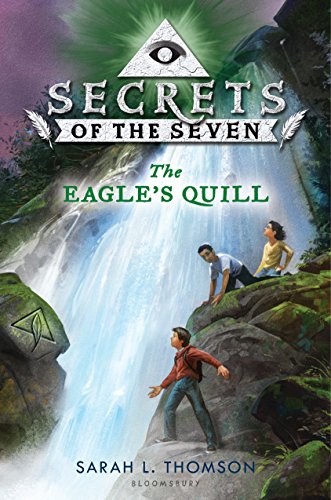
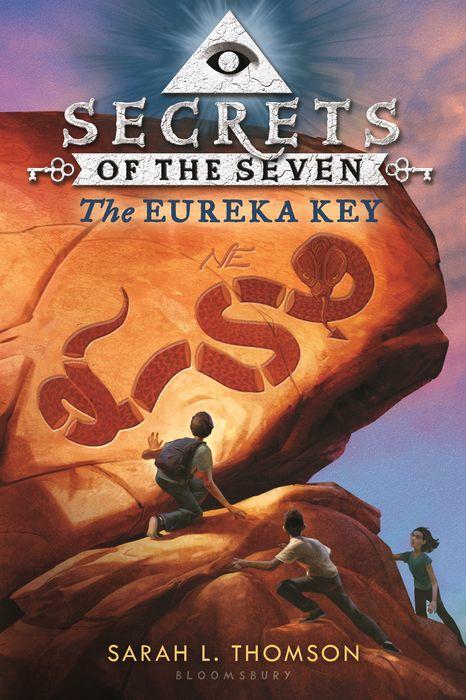
Middle school geniuses Sam, Martina, and Theo arrive in New York City on a mission. They need to find the third artifact left behind by the Founding Fathers before it falls into the wrong hands. After all, together, these objects unlock a secret weapon designed by Benjamin Franklin. The trio has escaped the forest of Glacier National Park at great cost—Evangeline, their chaperone and friend, was captured by the nefarious and dangerous Gideon Arnold.

Now the three friends must navigate New York City, following clues related to Alexander Hamilton to solve and survive the puzzles and traps they encounter along the way, and uncover the third artifact before Gideon Arnold does. The stakes have never been higher, and Sam, Martina, and Theo might not all make it out alive.

The Ring of Honor takes the reader on another fast-paced and fascinating story that educates readers on Alexander Hamilton, the founder of the United States’ financial system. When the kids meet Hamilton’s descendant, Jack, they are surprised to find an aspiring actor who has no interest in Hamilton’s history. While Jack plays a minor role, his appearance adds humor. While many of the characters reappear—Gideon Arnold, Abby Arnold, and Evangeline—Jack’s appearance gives the story an interesting twist.

While trying to solve Hamilton’s clues, the kids discuss the idea of sacrificing your own well-being for the good of a cause, and they learn facts about how Hamilton died in a duel, and the belief that he developed (shot into the air during the duel). As the kids follow Hamilton’s clues, they must use all their brainpower to analyze historical events and ciphers. Readers will enjoy trying to decipher the clues before they are revealed in the story.

The Ring of Honor is the third and final installment of the Secrets of the Seven Series. While the story of Sam and his friends searching for clues is fast-paced, suspenseful, and entertaining, the conclusion is frustratingly poor because of all the unanswered questions. First, Theo’s mother, who was presumed dead, miraculously reappears under odd circumstances. Evangeline, who is being held captive by Gideon Arnold, fades into the background and is forgotten. Even though Sam and Martina were instrumental in finding three of the founders’ artifacts, Theo’s mother thanks them and sends them home. Plus, Gideon Arnold is still a danger to the kids and to the country. The book’s conclusion negates all of Sam and Martina’s hard work. Instead of leaving the story open-ended, the conclusion leaves the reader wondering why Sam and Martina were dragged into the founder’s problems in the first place.

Secrets of the Seven Series will appeal to readers who love history, puzzles, and ciphers. While readers will thoroughly enjoy the Secrets of the Seven Series, the conclusion is cringe-worthy. Readers who are ready for more advanced and exciting clue-solving mysteries should add the Charlie Thorne Series by Stuart Gibbs and the City Spies Series by James Ponti to their reading list.

Sexual Content

  • None

Violence

  • While trying to escape from Gideon Arnold, the kids find a woman “sitting hunched in a corner. One of her wrists was handcuffed to a pipe beside her. . .” The kids try to help the woman, but she tells them to flee before Gideon Arnold finds them.
  • The kids go to see Jack, one of the founders. When they walk into his apartment, “Gideon Arnold, who’d been standing behind the open door, smiled at them like a snake might smile at its dinner. . .. Another man in a dark suit stepped out. . . a gun in his hand, and pointed the weapon straight at Theo.”
  • To escape the villains, Theo “who’d just grabbed his own backpack, swung the arm holding it so his elbow smashed into Dane’s [a thug] already-broken nose. The man doubled over with a roar of pain. . .”
  • As the kids are running, Sam falls. Gideon Arnold’s daughter, Abby, threatens to shoot Sam. “Abby now had the pistol in one hand, and was pointing it up at the sky . . .” Abby shoots and then tells Sam to run.

 Drugs and Alcohol

  • None

Language

  • Marty calls Sam a doofus and an idiot.
  • Sam thinks someone is a slimeball and scum.
  • OMG is used as an exclamation once.

Supernatural

  • None

Spiritual Content

  • Theo repeats Alexander Hamilton’s last words, “I am a sinner. I look to Him for mercy; pray for me.”

George Washington’s Spy

Ten-year-old Matt Carlton and six friends are accidentally swept back in time—to Boston in 1776! The British now occupy the city, and Redcoat guards are everywhere! While the boys are being held captive by a den of Patriot spies, the girls have been taken in by a wealthy Tory family.

The pox is rampant; danger lies around every corner—and there’s no hope for returning home to their own time. How will these seven children survive?

Even though Matt and his friends agree with the Patriot’s efforts to rid America of the British soldiers, the story is not one-sided. The girls who traveled back in time are cared for by a Tory family, who show them kindness. The girls wonder how someone who is loyal to the king can be a good person. Master Hewson, who supports the king, explains his motivation, “In the end, I find I can only be true to my beliefs. I have to provide for my family—and my love for them is what guides me.”

The theme is explored in more detail when Matt wonders how Master Hewson, who is a Loyalist and the enemy, can have a good heart. When an angry mob grabs one of the girls, Master Hewson gives himself up to save the girl. While talking about the family, a girl says, “The Hewsons were born in America. They just chose to stay loyal to their king. Isn’t loyalty supposed to be a good thing?” This encourages readers to think about how the revolution affected both the Loyalists and the Patriots.

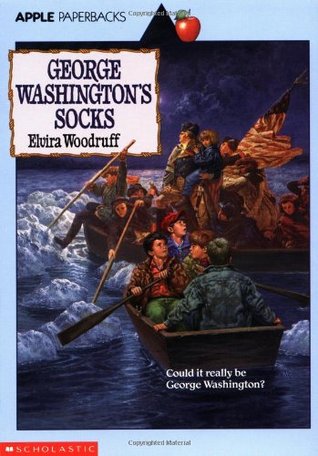
George Washington’s Spies is a fast-paced, suspenseful story that brings history to life. However, the story takes a grimmer look at the war than the first book in the series, George Washington’s Socks. The brutal deaths are described in more detail and may upset sensitive readers. Even though the Battle of Dorchester was a milestone in American’s freedom, the book does not glorify the war. A Patriot spy, Moses, tells Matt, “There is nothing nice about war. It feeds on lies and treachery. It is about killing or being killed.”

Along their journey, Matt and his friends meet a variety of people on both sides of the war. Plus, they meet Benjamin Franklin. While Dr. Franklin’s appearance is brief, he adds some much-needed humor. History loving readers will learn interesting facts about the Battle of Dorchester, the medical practices of the time, and how the war affected both the Loyalists and the Patriots. The entertaining story will keep readers at the edge of their seats, and while the humor is minimal, there are several parts of the story that will leave the reader grinning. Plus, the author’s note includes five pages of additional historical information including information about the Loyalists, women who played a role in the revolution, and the use of leeches in medicine. More advanced readers who want to learn more about the Revolutionary War should also read Susanna’s Midnight Ride by Libby Carty McNamee.

Sexual Content

  • None

Violence

  • While looking for a doctor, Matt is told that “the nearest physician was hung as a rebel spy last month.”
  • While looking into an old mill, “Matt spun around just in time to see a rough-faced man grab hold of Q and bring a knife up to his neck! Seconds later, three other men stepped out of the shadows. There were muskets in their hands and tomahawks in their belts!” The men discuss killing the kids.
  • One of the men, “grabbed hold of Matt by his collar and roughly lifted him off the ground. . . The man slammed Matt up against the building. Matt gasped at the pain that shot through him.”
  • While in town, an officer stops a group of men. “One of the men fitted his musket with a bayonet and drove it into the head of the pig that hung before the butcher’s shop. He lifted the horrible-looking thing into the air and swung it around. The animal’s dulled, glassy eyes stared straight ahead, and its mouth hung dumbly open.”
  • The girls witness four thieves being lashed. The thieves were “caught stealing wood for their fires, and one for stealing a goose.” One of the “criminals” was a “young girl of twelve or thirteen.” The girl’s “thin shoulders” stiffened and then “the whip cracked, and a piercing scream ripped through the chilled afternoon air. . . There was another loud Crack of the whip, followed by another bloodcurdling scream.” The scene is described over two pages.
  • While in town, Matt sees a wagon that “was rigged with a wooden frame. Hanging from the bar atop the frame were three large butcher’s hooks that held the dead bodies of three young men! From each of their necks hung a sign painted in bold red letters that said TRAITOR!”
  • Matt and Moses are on a mission when a soldier stops and questions them. Matt says something wrong causing the soldier to reach for his musket. “But as he did, Moses lunged forward, and the soldier jabbed him hard in the side with his bayonet. The two wrestled to the ground . . . Moses slammed the soldier against the wall. . . the young soldier slumped to the ground and went limp . . .”
  • When Moses realizes the soldier is dead, “his face was white as ash and his hands were trembling. ‘He was hardly old enough to grow a beard.’”
  • When Patience becomes ill, the doctor treats her. “A bloodied rag hung over [the doctor’s] arm, and in her wrinkled hands she held a large glass full of squirming, fat black leaches. She had placed a rope in Patience’s mouth to bite down on to keep her from screaming. . . Even more terrifying was the sight of little Patience lying on the bed—with her bare arms outstretched and five shiny black wormlike leeches sucking blood from the open vein in her arm!”
  • An angry mob attacks Master Hewson’s house. The cook says, “Someone threw a rock through the kitchen window. It nearly hit me in the head!”
  • The angry mob was “in the street wielding torches, clubs, and iron pokers. Their eyes were wild and angry. And like a pack of mad dogs about to attack, they had formed a circle around their prey.” They circle around Katie, and “a large, fierce looking man grabbed her by her wrists.”
  • In order to save Katie, Master Hewson trades places with her. A man “bound him with rope. . . the men rip off Master Hewson’s shirt, take a pot of steaming tar, and pour it over Master Hewson’s head and torso. As he writhed in pain, they emptied a sack of feathers over him. Then, with ropes, they hoisted him up on a cart and drove down the street. . .” The scene is described over three pages.

 Drugs and Alcohol

  • The kids meet a man that “stank of sweat, and rum, and something gone sour.”
  • A man tells Matt, “I may have emptied my neighbor’s jug of ale, but I can still remember the year.”
  • A man uses gun powder to brush his teeth, then “he took a swig of rum from a pewter flask.”
  • The girls are offered Portuguese wine with their dinner. They turn it down and ask for water instead.
  • When a coach stops at a tavern, the driver says, “the house ale is hearty.”

Language

  • The Redcoats are referred to as lobsterbacks, blasted bloodybacks, and British dogs.
  • Good God, dear God, My God, and Good Lord are rarely used as exclamations.
  • When the Redcoats stop a coach, a passenger grumbles, “What the devil do these Redcoats want with us?”
  • A mob attacks a house. One of the men yells, “A Tory is someone with his head in England, his body in America, and his neck in need of a noose!”
  • Master Hewson and his family are called “Tory trash.”
  • A servant is called an impudent rascal and a clumsy oaf.

Supernatural

  • A time traveling rowboat puts the kids under a spell. When the kids get close to the boat, “the boat silently glided beside them, beckoning them to come in. The group fell suddenly quiet under its spell. . . A blue mist rose up around them. . . seconds later there were neither boy, or girls, nor a boat to be seen.”
  • When the boat time traveled it “spun and spun as it was thrust into darkness and space. It kept on spinning until it landed with a thud and a splash.” The kids are transported to the Revolutionary War.

Spiritual Content

  • The kids pray three times. For example, at one point Emma “kept her eyes on the river, praying that the boat would return.”
  • Four times, a character says “God willing” something will occur.
  • A man says, “God grant that be so.”
  • Someone says, “Loyalty and obedience are God’s way. Rebelliousness is the way of the devil. We must remain true to our king—and be thankful for all God has blessed us with.”
  • One of the Patriots, who is using Moses as a fake name, tells Matt, “God’s not seen fit to come down from his heaven with tablets to guide me through this miserable world of ours.”
  • When Moses’s sister sees his wounds, she says, “God help him.”
  • While preparing for a battle, a man says, “The Redcoats will start firing back on our men soon. Say a prayer they miss their mark.”

Night of Soldiers and Spies

Ranger, the time-traveling golden retriever with search-and-rescue training, travels to Colonial America to help the patriot cause!

Ranger’s next mission finds him in the middle of the Revolutionary War. There, he meets Isaac Pope, a fisherman turned soldier for the Continental Army. When General George Washington needs a spy to cross into enemy territory, Isaac is chosen for the dangerous task. Ranger must help Isaac remain safe and undetected, or the battle—and their lives—will be lost.

Even though the main protagonist, Isaac, is young, he shows determination and bravery. He willingly goes into enemy territory even though he knows it will be dangerous and difficult. Isaac is part of the Continental Army, and his regiment is assigned to ferry soldiers across the river. Even though Ranger is afraid, he accompanies Isaac on his spying mission. Ranger saves the boy’s life when he alerts others that Isaac is in danger, but more often, Ranger comforts Isaac by just being with him.

Even though General Washington was a pivotal person in the Revolutionary War, Night of Soldiers and Spies doesn’t portray him as a perfect hero. Instead, the story includes Washington’s flaws, creating a realistic, well-rounded individual. “General Washington himself had argued that black men shouldn’t be recruited as soldiers,” but the Army was in desperate need of men, so slaves were allowed to fight. Under Washington, “the enslaved men who fought for the Continental Army. . . were still considered property. They were sent back into slavery by the country they’d helped to found, and never tasted the freedom for which they’d fought.”

Night of Soldiers and Spies is an entertaining and educational story that has a unique perspective because it focuses on a golden retriever. The third-person narration adds interest while reducing some of the story’s scariness. Full-page, black-and-white illustrations appear approximately every six pages. Even though Ranger’s story is fictional, facts are woven into the story. The end of the book has additional information about the Fourteenth Continental Regiment and a list of more resources. Readers interested in history and war may also enjoy the Boys of Wartime Series by Laurie Calkhoven.

 Sexual Content

  • None

Violence

  • When Isaac is crossing a half-frozen river, the ice begins breaking. “Isaac plunged into the icy river. It was so cold he couldn’t breathe. He couldn’t even think. But he caught another slab of ice floating by and held on.” Ranger gets Isaac help.
  • On a bitterly cold night, the Continental Army marches towards the enemy. “Ranger sniffed the air as they walked. It smelled of ice and river water and tired men. . .Some had worn out their shoes and left bloody footprints in the snow.”
  • A Hessian regiment fired on the Continental Army and Isaac is shot. “A burning pain seared through Isaac’s leg. He dove behind a fence and pressed his hand to his thigh. It was wet and warm with blood. . .” A doctor operates on Isaac’s leg, and he recovers.

 Drugs and Alcohol

  • None

Language

  • Colonel Rall calls the Continental Army’s men “country clowns.”

Supernatural

  • Ranger travels through time with the help of a first aid kit. When the first aid kit hums, Ranger puts the strap over his head. “The box grew warm at his throat. It grew brighter and brighter. . . He felt as if he were being squeezed through a hole in the sky. . .” When Ranger opens his eyes, he is in the past.
  • Isaac has a good-luck charm. “It was just a short length of knotted rope, but its’ rough, scratchy feel always reminded him of home.”

Spiritual Content

  • None

When the World Was Ours

Leo Grunberg spends his ninth birthday riding Vienna’s Ferris wheel with his two very best friends, Elsa and Max. While at the top, they swear they can see the whole world. They promise each other that they “will never forget the day [that they] were kings and queen of all Vienna.” To ensure that that promise will be kept, Leo’s father takes a picture and makes a copy for each of them.   

But Europe is descending into war, and Max’s father is rapidly growing intolerant of his son’s two Jewish friends. As danger descends around Leo and Elsa’s families, their world falls apart. Soon, the lives of all three children take fateful turns when they move to separate countries.  With their lives taking them across Europe—to Germany, England, Prague, and Poland—will they ever find their way back to one another?   

The war dramatically changes the three friends’ lives. After Leo’s father is arrested for being Jewish, Leo and his mother escape to England. On the other hand, Elsa finds a short-lived sanctuary in Prague before being forced into a ghetto and eventually to a concentration camp. All the while, her hope that better days will return gradually dissipates. Meanwhile, starved for a sense of belonging he has only ever felt with Leo and Elsa, Max throws himself into the Hitler Youth. He convinces himself that his old friends could not have been Jewish, and when his father insists that they were, he convinces himself that they were never really his friends. All the while, one vivid childhood memory continues to link the three together. 

When the World Was Ours alternates among the narratives of the three children. Interestingly, each perspective takes on a different style. Max’s is presented in the third person while Elsa’s and Leo’s are in the first person. Additionally, Elsa’s is in the present tense while both boys’ are in the past tense. Though a little jarring at first, this technique ultimately allows the narratives to stand apart from one another in such a way that the reader will never lose track of which perspective they are currently reading. The characters’ heartbreaking journeys are extremely well told and will leave a lasting impact on readers. 

The book’s powerful climax occurs when Max’s father secures him a position as a guard at Auschwitz, and he is tasked to kill his first Jew, assuring himself that this is “the defining moment. Everything came to this.” He is ready to prove himself as a true Nazi but is taken aback when the emaciated girl beyond his pistol utters his name in an all too familiar voice. When she smiles at him, he knows for sure she is Elsa. In these pages, it becomes terrifyingly clear how easy it can be for ordinary people to be swept up in such a horrific regime. 

When The World Was Ours is a powerful must-read but it is not for the faint of heart. The story, which is based on a true story, is an unflinching look at one of the most horrific events in recent history. Readers will find it difficult to forget the characters’ trauma and will walk away with a determination to never let the atrocities of World War II happen again. Readers who would like to learn more about the Holocaust should also read Elie Wiesel’s autobiography Night.  To learn more about what happened to the Nazi’s after the war ended, grab a copy of The Nazi Hunters by Neal Bascomb. 

Sexual Content 

  • In the months before Elsa moves away, Elsa and Max have grown particularly fond of each other. When she informs her friends she is leaving, Max kisses her. “At first, her mouth was pursed up in shock. Then it softened and for two blissful seconds, their lips stayed together in a promise.” 
  • As a teenager, Leo gets close to a girl. One day, he says, “[during] a sudden attack of bravery on my part. . .I kissed her.” She reciprocates and they begin dating. 

Violence 

  • A group of men forces Leo’s father and two other Jewish men to scrub the pavement. One of the men, who he recognizes as Max’s father, kicks his father in the stomach “so hard that Papa fell forward, his face landing in the puddle.” 
  • Leo’s father was attacked at his local synagogue. “His face was cut and bleeding and he was limping.” 
  • While visiting a concentration camp for the first time, Max witnesses a prisoner “get punched in the stomach so hard he [falls] to the ground.” 
  • Elsa sees a man being pulled into a shed by an SS officer during a line-up. When they return, the man’s “left eye is closed and already swelling. He’s limping. He has blood dripping from his forehead.” 
  • While at a concentration camp, Elsa learns that two men are being punished for sending letters to their wives. The inmates are forced to watch both men being whipped. When one man begs for mercy, the officer “kicks him in the stomach so hard that [he] almost flies through the air and lands on his side.” 
  • Multiple people suffocate while being transported to Auschwitz in a cramped train car. The guards stop three times to “throw out the dead.” 
  • Upon their arrival at Auschwitz, Elsa’s family is sent to the gas chambers. When Elsa asks to go with them, a guard laughs and says, “‘Believe me, you don’t want to go that way.’” 
  • Elsa’s friend Greta plans to escape from the camp, but her plan is discovered by the guards. She is beaten to death. Elsa describes, “I watch one guard take hold of her while another kicks her in the stomach. And then I cannot watch anymore.” 
  • Elsa is sent to be executed and Max is tasked with shooting her. Elsa recognizes him and experiences a surge of hope, telling him he doesn’t need to do this. Overwhelmed, Max nearly walks to her before being coerced back into the act by his two fellow guards. He decides this moment is no different from the other tests of “his true commitment to the regime.” He hesitantly raises his pistol, but one of the other guards fires his weapon, apparently intending to kill Elsa himself. The bullet instead hits Max “in the head.”  
  • After shooting Max, the two guards panic and decide to stage the death to look like a suicide. In despair, Elsa demands they kill her too, saying she is done with her life. She closes her eyes, not letting them “into her soul while they [empty] out their own,” and is shot, but the death is not described in detail. This entire sequence spans 15 pages, alternating between Max’s and Elsa’s perspectives. 

Drugs and Alcohol 

  • Leo and Max’s parents had “drunk wine and sat talking together.” 

Language 

  • None 

Spiritual Content 

  • Leo’s family believes in Judaism. Leo and his family “say Shabbat prayers every Friday night.” 
  • When Leo’s father returns home from synagogue, he states that he and several friends were “praying for an end” to their persecution.  
  • While not as religious as Leo’s family, Elsa says that her family has begun “going to shul (Jewish services) on Saturday mornings when [they] can, and every Friday night [they] light candles . . . and say a brachah – a blessing – over them.” 
  • Elsa hears several fellow passengers on the cart to Auschwitz reciting Kaddish, the Jewish prayer of mourning.  
  • When Leo’s father returns to his family at the end of the war, he informs his son that both Elsa and Max died at Auschwitz. The family lights a candle and recites Kaddish for Leo’s friends.

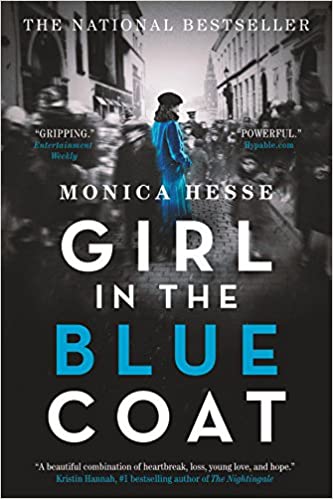
Girl in the Blue Coat

Hanneke Bakker is struggling to find her place during World War II. Without her parent’s knowledge, Hanneke has been obtaining and selling black market goods. However, her life gets turned upside down when Mrs. Janssen, one of her usual customers, asks her to find Mirjam Roodveldt, a young Jewish girl that Janssen had been hiding in Mrs. Jansesen’s home.  

At first, Hanneke refuses to help find Mirjam. However, when she agrees to search for her, Hanneke quickly becomes exposed to the brutal realities of war. When Hanneke meets a group dedicated to hiding and rescuing Jewish citizens who are under threat from the Nazis, it causes Hanneke to question how beneficial her efforts have been. With blonde hair and light eyes, Hanneke identifies herself as the “Nazi’s poster child,” making her feel guilty about her negligence to the war.  Hanneke is eventually drawn further into the mystery of the missing girl and her search leads her to stunning revelations about the war and the people involved. 

Teens will relate to Hanneke because she falls deals with many of the same struggles that normal teens experience, such as young love and conflicts with parents. The story is told from Hanneke’s point of view in a very raw and honest way. Throughout the book, Hanneke must cope with the death of her boyfriend, Bas, as well as the loss of her normal life during wartime. She also deals with losing her best friend, Elsbeth, whose morals become questionable after marrying a Nazi soldier. The story teaches readers that grief is not a one-way street and that there are multiple coping mechanisms that help someone deal with loss.  

Since the story is written from Hanneke’s point of view, other characters are not well developed. While everyone is dealing with their own form of grief, describing the lives of other characters more in-depth would have made the novel more impactful. For example, Ollie copes with the loss of his brother who died in battle. When talking to Hanneke, Ollie reminisces on his brother’s life saying, “. . . I talk about him all the time. Him and his obnoxious jokes, his laugh, what he would have become.” Unfortunately, readers are given limited knowledge on Ollie’s personality and perspective. This leads readers to have a one-sided view of the conflicts in the story. 

Even though Hanneke is the protagonist, she is not always likable. However, she has several positive attributes including courage and determination. Her naivety comes out frequently, which makes her seem self-centered. For example, when Mrs. Janssen asks Hanneke to find Mirjam, Hanneke focuses on whether or not it would benefit herself. At times, she lacks conviction and she frequently questions her actions, which may frustrate readers. She asks people involved in the war resistance dumb questions too, then becomes angry with herself because she had previously shielded herself from the horrors of the war. 

Despite taking place in 1942, teens will be inspired by Hanneke and the positive messages she carries. Hanneke’s life would have been simpler had she not agreed to search for Mirjam; however, she knows it is what must be done for the sake of Mrs. Janssen, who is worrying herself sick over Mirjam’s disappearance. Despite making mistakes, Hanneke continues her journey. Ultimately, Hanneke’s compassion for Mrs. Janssen and for everyone who has lost people to the horrors of war is comes to drive her.  

While the characters are fictional, many of the events are historically accurate and the war within the Netherlands was extremely well-researched by the author. However, at times the plot felt like it went too slow, while other times it went too fast. Plus, the conclusion was rushed and confusing. Nonetheless, those who are interested in the history of WWII would find this an interesting read, especially those who wish to learn more about the German occupation of the Netherlands. For readers interested in learning more about the World War II resistance, Resistance by Jennifer A. Nielsen is a must-read. 

Sexual Content  

  • Hanneke and Ollie, the brother of Hanneke’s dead boyfriend, briefly kiss whilst pretending to be a couple in front of German soldiers. “Ollie cups my face in his hands and kisses me. His mouth is soft and full, his eyelashes brush against my cheek, and only he and I know that our lips are shivering in fear.” 
  • Hanneke occasionally flirts with German soldiers to avoid suspicion. “With the way I’m standing, my dress has risen above my knee, and the soldier notices . . . I shift my weight a little so the hemline rides even higher, now halfway up my goose-bumped thigh.” 
  • Hanneke frequently recalls previous romantic encounters she had with her boyfriend. In one instance, she recalls her first kiss with him. “When he kissed me, he dropped his bicycle and it clattered to the ground, and we both laughed.” 
  • Ollie confesses his love for Willem, saying, “Jews aren’t the only ones who suffer because of the Nazis. I don’t love Judith. I love Willem.” 

Violence  

  • At the beginning of the war in the Netherlands, “two thousand Dutch servicemen were killed when they tried but failed to protect our borders as the country fell” and “German planes bombed Rotterdam, killing nine hundred civilians.” 
  • Hanneke is shocked when Mrs. Janssen says, “I’ve heard of people imprisoned, taken away and never returned. But four people, including a woman and a child, shot dead in cold blood?” 
  • Mrs. Janssen recalls the death of her family at the hands of the Nazis. This took place at the Janssen family shop, where the Janssens were hiding their Jewish neighbors. Someone had tipped off the Nazis that these individuals were being hidden, leading to a massacre. “When the shooting was done, Hendrik was dead, and David, and Rose, and Lea. Only Mirjam managed to escape.” 
  • The Nazis capture and beat a man, causing “bleeding from the nose, his right eye split and swollen.” 
  • Hanneke talks about protests that have “left dead bodies in the streets.” 
  • A fight breaks out between two shop customers. Nazi soldiers come to disperse the fight. “A fight broke out in the shop, which led to the earliest major roundup and hundreds dead.” 
  • Hanneke talks about how resistance workers “could be shot” for their work. 
  • During a round up, a girl tries to escape, but she is shot and killed by a Nazi soldier. “They shoot her. In the middle of the bridge, in the back of the neck so that blood bursts from her throat, slick and shining in the moonlight.”  

Drugs and Alcohol  

  • Hanneke smuggles items through the black market, including “cigarettes and alcohol.” 

Language                                                                                                                                               

  • Profanity is used rarely. Profanity includes damn in both English and italicized Dutch. 
  • Mrs. Janssen goes to show Hanneke the cupboard where she hid Mirjam. When she sees it, Hanneke thinks, “Verdorie. Damn it, she’s crazier than I thought.” 

Supernatural  

  • None 

Spiritual Content  

  • Several of the characters are of Jewish faith, which is a big source of conflict within the story as it takes place during World War II.  
  • The Nazi soldiers sympathize with the Christian characters. A soldier says, “I feel bad punishing a good Christian woman who is too stupid to know where her husband was.” 

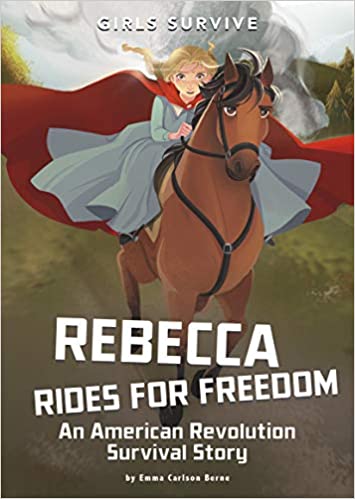
Rebecca Rides for Freedom: An American Revolution Survival Story

The American Revolution is raging in Philadelphia, and Rebecca is determined to do all she can to help. With her father stationed with Washington’s army at nearby Whitemarsh, it’s up to Rebecca to help her mother at home with her younger siblings. That includes selling vegetables to British officers stationed in wealthy houses nearby. When Rebecca intercepts a message about an impending British attack against the Patriots from one such house, she knows she must act. It’s up to her to get the message to the Patriot army – before it’s too late.

 Rebecca Rides for Freedom begins by describing how the American Revolution affected families. Rebecca’s father leaves the family alone so he can fight alongside General Washington. However, because of the families’ loyalties to the Patriots, there is constant fear that the Tories will harm them. Despite the danger, Rebecca is determined to deliver an important message to her father’s garrison. Rebecca’s ride through dangerous territory highlights her bravery and determination. When she is finally close to the Patriot’s camp, a soldier tries to send her away, but Rebecca refuses to give up. She thinks, “I’d ridden miles in the snow, been captured, escaped, and forded the frozen creek. I hadn’t come this far only to be dismissed as a silly girl.”

Rebecca’s experience doesn’t go in-depth about the history behind the American Revolution. However, readers will begin to understand people’s fear of the Redcoats and how the war impacted families. While Rebecca’s fear of the soldiers is obvious, the events are described in kid-friendly terms. However, this doesn’t detract from Rebecca’s harrowing experiences or her bravery.

To make the story easy to follow, each chapter begins with Rebecca’s location, the date, and the time. Every 7 to 10 pages there is a black-and-white illustration. The illustrations focus on Rebecca and the events surrounding her. Some of the illustrations show the Redcoats carrying rifles. The book ends with a note from the author that describes her inspiration for writing the story, a glossary, and three questions about the story.

Rebecca Rides for Freedom is a fast-paced, entertaining book that will spark readers’ interest in history. While Rebecca is a fictional character, the author explains how real women inspired Rebecca’s character. The author writes, “The women behind Rebecca’s story were real wives, mothers, and daughters. They were ordinary women who showed extraordinary courage in order to protect both family members they loved and the ideals they believed in.” This allows girls to see the important and often overlooked, contribution women made during the American Revolution. In addition, Rebecca Rides for Freedom will encourage readers to stand up for their beliefs. Readers who want to learn more about the Revolutionary War should grab a copy of George Washington’s Socks, which is a fast-paced time travel adventure that goes into more detail about the war.

Sexual Content

  • None

Violence

  • When the Redcoats moved into one family’s home, they “turned the families out onto the street in the middle of the night. Lydia Wright’s baby sister had died that way.”
  • A Redcoat officer accidentally “shot himself in the foot.”
  • Rebecca meets Betsy whose “brother was beaten in the street when he wouldn’t get out of the way of the Redcoats. They broke his arm.”
  • For Rebecca to take papers with attack plans, Betsy helps. Betsy “swept her arm across the surface of the desk. All the papers fluttered to the floor.” As Rebecca leaves the house, “there was a smacking sound, and Betsy cried out.”
  • Rebecca is captured by the Redcoats. When she escapes, she jumps on her horse, Brownie, who “ran directly through the soldier’s campfire before any of them could realize what was going on. . . the soldiers dived for safety to either side.”

 Drugs and Alcohol

  • A group of Redcoats apprehends Rebecca. That night at their camp, the men were “Passing their jug from hand to hand, sometimes breaking into song. When the sergeant speaks, there is the “unmistakable slur of drink in his voice.”

Language

  • A Redcoat refers to General Washington’s soldiers as “Patriot devils.”

Supernatural

  • None

Spiritual Content

  • When Rebecca is planning to escape from the Redcoats, she “prayed none of them would sense my movement.”
  • While crossing a swollen river, Rebecca “held the wet reins, clinging to Brownie’s wet mane, and prayed. It must have been heard because the water grew more shallow.”

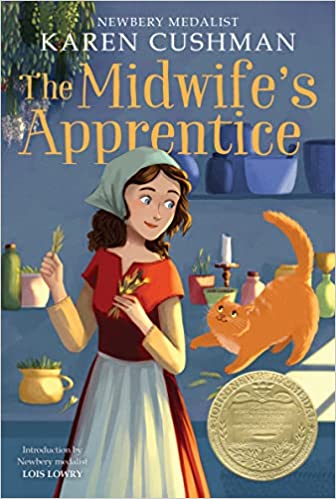
The Midwife’s Apprentice

A girl known only as Beetle has no family, no home, and no future until she meets Jane the Midwife and becomes her apprentice. As she helps short-tempered Jane deliver babies, Beetle—who renames herself Alyce—gains knowledge, confidence, and the courage to want something in life for the first time. 

At first, Alyce thinks she is unimportant and unworthy of kindness. The midwife often reminds Alyce that she is a nimwit, a lackwit, and has no brains. At first, Alyce believes the midwife’s assessment of her and silently takes the midwife’s abuse. Slowly, with the help of fate, Alyce begins to realize that she is worthy and deserves a real name. However, Alyce’s growing confidence is often overcome by fear. And when Alyce faces failure, she runs away from the midwife and leaves the village. While she is gone, she learns to value herself and to ask herself what she really wants.  

As the title implies, the story revolves around a midwife who often delivers babies. While none of the births are described in detail, there are some long descriptions of the herbs and potions that are used during birth. In addition, the story discusses some of the medieval superstitions revolving around birth. Because Alyce is the midwife’s apprentice, she accompanies the midwife and learns many skills through observation. Due to this, there is little action (after all, babies take time and patience to deliver.) 

While Alyce isn’t necessarily a relatable character, readers will still sympathize with her plight and understand her fear of failure. Originally, Alyce allows her fear and uncertainty to paralyze her, but she eventually learns that failure is part of life and she must “try and risk and fail and try again and not give up.” Even though Alyce is frightened, she is brave when a boy almost drowns and she saves him, and when a woman is struggling to birth her child, Alyce uses her knowledge to safely bring the child into the world. These events help Alyce learn that “everyone is somebody” and everyone deserves to be treated with kindness. It is Alyce’s compassion for those in need that make her a truly remarkable character.  

The Midwife’s Apprentice received the Newberry Medalist award. It has universal appeal because Alyce wants what every human wants—to be loved. Through Alyce’s experiences, readers will step back into medieval times and learn about their superstitions, customs, and the importance of midwives. The rich period language, advanced vocabulary, and slow pace make The Midwife’s Apprentice best for strong readers who are interested in the topic. Readers who stick with the story will fall in love with Alyce and her cat, and the story’s conclusion will leave readers with a warm glow and encourage them to never give up.  

Sexual Content 

  • Alyce spies on the midwife and sees her kissing the baker, “and him with a wife and thirteen children in their cottage behind the ovens.”  
  • While looking at a comb, the merchant says, “Comb those long curls till they shine, girl, and sure you’ll have a lover before nightfall.”  
  • Some of the village boys have “too much ale and too few wits.” When they see Alyce, a boy says, “Dung Beetle, give me a kiss.” Alyce runs away. 
  • The priest opens the door to a barn and sees “the smith’s lardy daughter, and the pockmarked pig boy from the manor. The boy gathered his breeches and flung himself out the barn window.” Their behavior was blamed on the Devil. 
  • While looking for a friend, a man looked at Alyce and said, “Forget this Edward, curly top. . . Climb up here on this hay bale and give me a warm, sticky kiss.” Alyce tells the man, “Save your sticky kisses for your wife or your cow.” 

Violence 

  • The boys in the village are mean to Alyce and her cat. “The taunting, pinching village boys bedeviled the cat as they did her, but he, quicker and smarter than they, always escaped. She did not, and suffered their pinching and poking and spitting in silence. . .” 
  • Two of the village boys throw rocks at Alyce, “which made the villagers laugh.” 
  • One day the village boys capture the cat. A boy put the cat in a sack with an eel. “And the sack with eel and cat was tossed into the pond.” Alyce saves the cat. 
  • A boy drags Alyce to a pregnant woman’s house to help deliver a baby. When Alyce doesn’t know what to do, the woman yells, “‘ ‘By the bones of Saint Cuthbert, they have sent me a nimwit! You lackwit! No brains!’ Screeching still, the miller’s wife let go of Beetle’s arm and began to throw at the girl whatever she could reach from her bed—a jug of warm ale, half a loaf of bread, a sausage, the brimming chamber pot.” The midwife shows up and sends Alyce away. 
  • For fun, a mean boy would sit on Alyce, “so Jack and Wat could rub chicken manure in her hair.” The miller was also mean to Alyce. He “pinched her rump when she brought grain to the mill.” 
  • When the village boys begin teasing Alyce’s cat, “she took a handful of nuts, the biggest and hardest and heaviest in her basket, and heaved them at the boys.” Then she yells, “Touch that cat again and I will unstop this bottle of rat’s blood and viper’s flesh and summon the Devil, who will change you into women, and henceforth each of you will giggle like a woman and wear dresses like a woman and give birth like a woman!” The boys leave the cat alone. 
  • A pregnant woman sends someone to get Alyce, instead of the midwife. The midwife is furious and “she began to throw cooking pots.” Alyce quickly leaves the room.  

Drugs and Alcohol 

  • The midwife uses herbs and other plants such as “columbine seeds to speed the birth, cobwebs for stanching blood. . . jasper stone as a charm against misfortune, and mistletoe and elder leaves against witches.” 
  • Throughout the story, both children and adults drink ale. The adults also drink wine. 

Language   

  • After Alyce pulls the cat out of a pond, she says, “Damn you, cat, breathe and live, you flea-bitten sod, or I’ll kill you myself.” 
  • The midwife insults Alyce and calls her derogatory names such as a “clodpole,” “brainless bratt,” “good-for-nothing,” “shallow-brained wiffler,” etc. Other villagers call Alyce names as well. 
  • While delivering a baby, the midwife tells the woman, “Push, you cow. If an animal can do it, you can do it.” 
  • Alyce saves a boy from drowning in the river. When he calls Alyce brave, she says, “I near pissed myself. I did it for else you’d have drowned and gone to Hell, a drunken loudmouth bully like you, and I would have helped send you there. . .” 
  • The saints’ names, such as “corpus bones,” are used as exclamations, but rarely. For example, a pregnant woman says, “Let me die. By the bones of Saint Mildred, let me die.”  

Supernatural 

  • The midwife requested “a murder’s wash water” to help in delivering babies.  
  • People are superstitious and think there are witches and devils in town because a two-headed cow was born and a “magpie landed on the miller’s barn and would not be chased away.” Then they see strange footprints and the villagers are “convinced the Devil had found their village and was looking for souls to lead into sin.” For a while, when people were found sinning, the villagers thought the Devil tempted them. 
  • People believed that “newborn infants are readily seized by fairies unless salt is put in their mouths and their cradles, that a baby born in the morning will never see ghosts, and that a son born after the death of his father will be able to cure fevers.” 
  • The villagers believed that twin cows were “a joy and a boon while twin babies were ill-starred and unlucky.” 

Spiritual Content 

  • When the hay had been cut and was drying, “the village [was] praying for rain to hold off until the grain was safely cut and stored away.” 
  • When the midwife injures herself, “her furious oaths made Beetle truly fear she was a witch, for only someone who had truck with the devil could know such words.” 
  • Alyce helps birth a cow. During the labor, a boy tells her, “Rub her head and belly. If we can but calm her, God will tell her and the calf what to do.” 
  • An innkeeper cheats her customers. She tells Alyce, “Thundering toads. . . I am sure God does not begrudge me my little economies.”  
  • A peasant “cursed God for making him a peasant and not a lord.”
  • While delivering a baby, Alyce “called on all those saints known to watch out over mothers—Saint Margaret and Saint Giles and Saint Felicitas, and even Saint Loy who protects horses, and Saint Antony, who does the same for the pigs, for she believed it would do no harm.” After the baby is safely born, “the man and the servants, still on their knees before her, prayed and thanked her for the cure of their mistress.” 

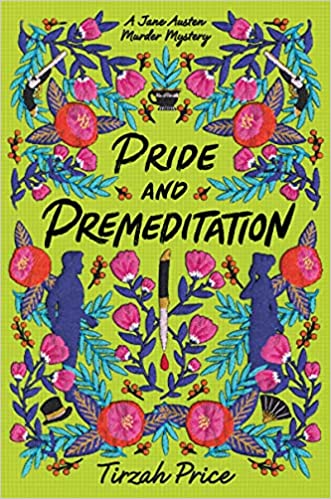
 Pride and Premeditation

Unlike other unmarried women her age, rather than a good husband, seventeen-year-old Lizzie Bennet wants nothing more than to practice law and work in her father’s law office. When there is a murder in high-society London, Lizzie jumps at the opportunity to prove herself worthy of being a litigator.

Although the authorities have charged someone with the crime, Lizzie has her doubts, promising to catch the real killer and clear the name of the man accused of the crime. But many obstacles stand in her way. For example, the man accused of the crime isn’t actually her client and is being represented by Mr. Darcy, a young lawyer and the heir of a prestigious law firm, who has no interest or patience for Lizzie’s antics. In order to uncover the truth and catch the killer, Lizzie pushes the boundaries of social and gender norms in this regency-era murder mystery.

Pride and Premeditation reimagines Jane Austen’s classic characters from Pride and Prejudice with a murder mystery twist. Following in the footsteps of the classic, Price examines gender roles and social standards of 19th century England. Lizzie is often pushing against preconceived sexist notions of what an unmarried, young woman should be doing. Rather than finding a husband of good social standing—as society and her mother tells her to—Lizzie would rather help her father around his office, and study contracts and case law. In conversations with her father or Mr. Darcy, Lizzie questions if she would be treated differently if she “weren’t a young lady.” Headstrong and extremely motivated, Lizzie explains she “will not live [her] life sitting by the side while there are so many men making a mess of things.”

The novel also looks at the classism and the social hierarchy of English society at the time. Lizzie feels as if she is looked down upon by those with higher social standing. The upper class often looks down on Lizzie, judging her based on where she lives or what she wears. But Lizzie, actively aware of this classism, simply sees this as another obstacle she must face in order to prove herself. Furthermore, Lizzie observes how people of her social standing look down on people of a lower class. In one instance, her mother scolds Lizzie for socializing with “street children” (or “urchins” as her mother would say).

Full of witty dialogue, Pride and Premeditation is a fast-paced story centered not only on the murder of a member of high-society London, but also on notions of justice, class, and the role of women in 19th century England. Readers will relate to Lizzie, who struggles with social and familial standards, and the people who are trying to dictate her actions when Lizzie is simply trying to pursue her interests. Readers can learn the importance of unabashedly being oneself and sticking to one’s convictions from Lizzie, no matter the obstacles society attempts to throw at you.

Pride and Premeditation has many familiar characters from Jane Austen, making it a great read for those familiar with Austen’s works (though knowledge of the original characters can make the twists and turns of this mystery slightly more predictable). However, the novel can also be enjoyed as a standalone novel for those unfamiliar with Pride and Prejudice. With a strong female lead, Pride and Premeditation is an inspiring and fun book with just the right mix of mystery, adventure, and a hint of romance, making this book is a must-read.  Readers who enjoy historical fiction and mystery should also read Enola Holmes and the Black Barouche by Nancy Springer.

Sexual Content

  • Lizzie and Darcy share one kiss. When Lizzie sees Darcy a few weeks later she is “reminded of the warmth of their kiss.”

Violence

  • The basis of this novel is the murder of Mr. Hurst, who was “stabbed with a fine penknife.”
  • There is a discussion about the blood spatter on the body, Lizzie notes “when a creature is killed, there is usually a bit more splatter.”
  • As she walks down the street, Lizzie is abruptly grabbed, as “a gloved hand” stops her from screaming and shoves her into a carriage. Lizzie is taken in order to talk to Lady Catherine de Bourgh, someone interested in Lizzie’s investigation, then freed.
  • Lizzie discovers the dead body of Abigail who was left in the river Thames to drown with her hands “bound with rope”.
  • After stumbling upon the ransacked offices of Pemberley and Associates, Darcy and Lizzie are shoved by the assailant “sending them tumbling into the records room.” As the assailant rushes back to the streets, Georgina, Darcy’s younger sister, “opened the door [of the carriage] as he went by and hit him quite hard,” but he gets away.
  • In a heated moment of action, as Lizzie and the others discover what Mr. Wickham has done, he holds Lizzie at gunpoint, digging “the muzzle into her ribs.”
  • Mr. Wickham drags Lizzie out of her house, threatening violence to anyone who interferes. A chase ensues. Lizzie manages to escape the grasps of Wickham, “plung[ing] the sharp end of her brooch into his thigh.” As Lizzie tries to run away Wickham shoots at her, just missing her. The scene lasts over ten pages.
  • Darcy catches up to Wickham and Lizzie and confronts Wickham with a gun. In order to stop them from shooting each other, Lizzie steps in between the two. There is a confrontation between Darcy and Wickham where they talk about Wickham and Darcy’s history. This is interrupted by the mastermind of the murder of Mr. Hurst and Abigail, who shoots Wickham. He “double[s] over …crumpl[ing] to the ground,” falling into the river Thames. This action sequence is described over a chapter.
  • When Lizzie confronts a suspect, he grabs her, but she pulls away, drawing “Darcy’s spare pistol, pointing it at [him] just as he brandished a knife.”

Drugs and Alcohol

  • Multiple times, Mr. Hurst is referred to as a drunk and he is “always drinking.” The night before he is killed, the man suspected of killing him finds him at a “club,” brings him home, and tells “him to sober up.”
  • There is a delay outside Darcy and Lizzie’s carriage, and the driver blames it on “a drunk.”

Language

  • Mrs. Bennet refers to Fred, Lizzie’s informant, as an “urchin.”
  • Words like “lord almighty,” “for heaven’s sake,” and “bollocks” are used once.

Supernatural

  • None

Spiritual Content

  • None

by Mikaela Querido

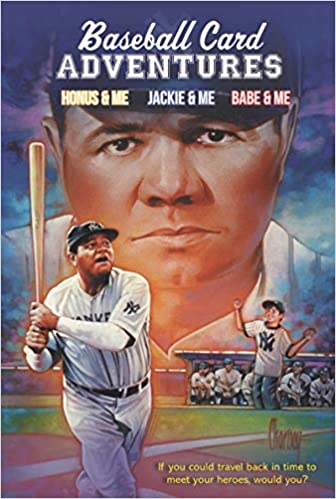
Babe & Me: A Baseball Card Adventure

On October 1, 1932, during Game Three of the Chicago Cubs–New York Yankees World Series, Babe Ruth belted a long home run to straightaway centerfield. According to legend, just before he hit, Babe pointed to the bleachers and boldly predicted he would slam the next pitch there.

Did he call the shot or didn’t he? Witnesses never agreed. Like other baseball fans, twelve-year-old Joe Stoshack wants to know the truth. But unlike other fans, Joe has the astonishing ability to travel through time using baseball cards—and now he’s determined to settle one of baseball’s greatest puzzles.

 Babe & Me explores the father-son relationship through both Babe Ruth’s eyes and Joe’s eyes. Even though Joe’s father has spent little time with him, Babe Ruth points out the good aspects of Joe’s dad. Despite this, Joe struggles with feelings of resentment because his father seems more concerned with coming up with get-rich-quick schemes than spending time with him. His father, who is often angry, blames his troubles on luck. He says, “You can try as hard as you want. Be as good as you can be. But a lot of what happens in the world is plain dumb luck.” Towards the end of the book, Joe’s dad finally realizes that his relationship with Joe is more important than money.

Throughout the story, both Babe Ruth’s public persona and his private, more serious side are shown. Babe Ruth is loud, reckless, and a big spender when around people. However, when he is alone with Joe and his father, Babe Ruth has a tortured soul because of his upbringing as well as his belief that he was not a good father. Historical pictures and partial news articles are scattered throughout the story. Plus, the author explains what events actually happened and which events he made up. In addition, there are four pages of quotes from baseball players that show that even now, people do not agree on whether or not Babe Ruth called his shot.

Joe is a likable main character, who has conflicting emotions about his father. Because Joe and his father were able to spend time with Babe Ruth, they witnessed Babe Ruth’s generosity, his reckless behavior, and his emotional turmoil. However, Joe’s father is not necessarily a likable man and his change of attitude is not believable. Despite this, the fast-paced time travel adventure will appeal to sport-loving readers even though the story has little baseball action. Readers who want to learn more about Babe Ruth should also read Babe Ruth and the Baseball Curse by David A. Kelly. Middle-grade baseball fans can also jump back into time by reading The Brooklyn Nine by Alan Gratz.

Sexual Content

  • Babe Ruth sees a woman crossing the road and says, “Got a load of the sweet patootie! She is one red-hot mama!”

Violence

  • While at a park, men stood on wooden crates making speeches. As one man spoke, “some people booed, and somebody threw a rock at the guy . . .” When two policemen show up, “somebody threw a rock at one of them, and it bounced off his helmet. The cop pulled out a nightstick and hit a guy with it. . . The people in the crowd began to hiss and boo and throw things at the cops. The second cop pulled out his pistol and fired it up in the air.” The scene is described over two pages.
  • Babe Ruth was signing his autograph when one boy dropped his paper. Joe picks it up and refuses to give it back to the boy. The boy’s father “reached into his jacket and pulled out a knife.” After the fathers’ argument, Joe gives the paperback to the boy.
  • As a boy, Babe Ruth stole money from his father. “Dad caught me and beat me with a pool cue.”
  • Babe Ruth’s father “got kicked in the head in a fight outside his saloon and died when he was forty-six.”
  • Babe Ruth tells a story about a baseball player who “didn’t see a pitch coming at him. It busted his skull. He crumpled like a rag doll right in the batter’s box.” The man died.
  • One of the reasons that Joe’s father is often angry is because of his family history. His grandparents and their children were rounded up by the Nazis. Joe’s father says, “Only my father escaped, by hiding under the house. The Nazis sent the rest of the family to Treblinka, a concentration camp. They were all killed. In the gas chambers.”
  • Joe’s father catches Babe Ruth’s home run ball. His father “and a few other guys dove for it, but I got there first. They tried to beat it out of me. That’s how I got the black eye, actually.”

 Drugs and Alcohol

  • Babe Ruth is seen smoking a cigar.
  • Even though it’s prohibition, Babe Ruth orders a pitcher of beer. During his meal, “he washed everything down with another pitcher of beer.”
  • Babe Ruth says that he “was drinking beer before I could read.”

Language

  • Several times cuss words are replaced with @#$%.
  • Someone calls Joe’s father an idiot.
  • Babe says heck once.
  • While at a game, some of the other teams called out insults. Someone calls Babe Ruth an “ugly tub of guts.” He is also called, fatso, a washed-up balloon headed meatball, old potbelly, lummox, and other names.
  • Some boys are playing baseball. A boy calls a player a dope.

Supernatural

  • For Joe, baseball cards function as a time machine. When he touches an old card, “that tingling sensation was the signal that my body was about to leave the present and travel back through time to the year on the card.”
  • In order for Joe and his dad to return from the past, Joe needs “to bring a new card. . . If I didn’t have one with me, we could have been stuck in 1932 forever.”

Spiritual Content

  • While men were giving speeches on the solution to the Great Depression, someone says, “God is the answer.”

The Wig in the Window

Sophie Young and Grace Yang are best friends, seventh graders, and wannabe spies. The town of Luna Vista is quite boring, so they make a game out of spying on their neighbors. They even have a map of who and who not to spy on. But their game quickly becomes serious.  On one of their midnight stakeouts, they stumble across a terrifying scene at the home of their eccentric yet demure middle-school counselor Dr. Agford (also known as Dr. Awkward). The school counselor is hacking away at what appeared to be a piece of human flesh. Even though they are proven wrong about what Dr. Agford was chopping, the girls are still convinced that Dr. Agford is hiding a dangerous secret—and are determined to find out what it is.

Sophie and Grace attempt to uncover more about Dr. Agford, but Dr. Agford effortlessly evades the girls’ efforts to trip her up. Dr. Agford, as a respected adult, easily inserts herself into Sophie’s life. She slowly changes the girls’ neighborhood watch into a serious game of cat-and-mouse. As their investigation heats up, Sophie and Grace crack under the pressure. Their friendship, along with their investigative skills, are put to the test.

The narrative squarely focuses on Sophie’s perspective. This point of view helps the reader understand the workings of Luna Vista Middle School and Sophie’s personal life. Older readers will relate to the book’s portrayal of middle school, as the story is realistic in depicting Sophie’s thoughts about her classes, peers, and teachers. Like any preteen, Sophie also openly talks about her obsession: hers is Chinese culture, more so since Grace is Chinese American. Sophie gets “carried away with the traditional Chinese practice of feng shui . . . the idea that you can arrange your space to bring good luck and positive chi” and she takes the teachings of philosopher Sun Tzu as fact. This is notable when Sophie uses Sun Tzu’s tips about deception (when you are near, you must pretend you are far) to make sure she doesn’t reveal any information to Dr. Agford.

The story also covers cultural appropriation and interracial friendships, which is a point of conflict between Sophie and Grace’s relationship. Sophie dislikes that Grace is seemingly unengaged in Chinese culture, and Grace hates that Sophie practices activities relevant to Chinese culture without knowing their cultural significance. Grace accuses Sophie of “being superficial” because she talks about Sun Tzu, arranges her room with feng shui in mind, and practices kung fu. Sophie is performative in her adoration of Chinese culture. To Grace, Chinese culture is who she is. While Sophie never understands its importance to Grace, the two friends make up, but Sophie doesn’t move past her surface-level understanding of Grace’s culture. Through their exchanges, readers will learn the importance of being considerate of other’s cultures.

The Wig in the Window is a suspenseful yet fun story that focuses on relationships between authority figures and friends. The suspense comes from the girls avoiding Dr. Agford’s wrath, as she has a lot of sway in the community. Sophie’s narration about the school and the town gives the story a humorous and light tone. There is some name-calling that is typical of middle schoolers bad-mouthing each other, such as when Sophie’s classmates purposely mispronounce her French name as “AY-NUS” instead of “AN-YES.”

The consequences for the girls’ crimes—spying on their neighbors and breaking-and-entering—are nonexistent for the sake of the plot. Any adults that could stop the girls from investigating criminal activity are equally absent. Still, this book has lessons about appreciating other cultures and a good portrayal of interracial friendship, alongside the masterful way the girls uncover the mystery surrounding Dr. Agford. If readers enjoy the game of cat-and-mouse between Dr. Agford and the girls, and the girls’ friendship, then they should consider reading the City Spies Series by James Ponti.

Sexual Content

  • Grace is in love with one of the boys in their grade. She says “Score. He’s totally hot”
  • Sophie’s brother, Jake, says Sophie’s probably angry because it’s “probably that time of the month.”
  • Jake got busted for not being home. At first, Sophie thinks her brother, “had his own brush of death at his girlfriend’s.” However, upon closer inspection, she notices that “the red welts all over his neck proved to be hickeys.”
  • Sophie thinks of her crush, Rod. “Who cares if people still called him Rod Pimple? He was cute now.”
  • Sophie thinks about Rod’s appearance. “At Luna Vista the guys weren’t allowed to let their bangs hang over their eyes. It made him seem even cuter that he was so adorable and a rebel.”

Violence

  • Agent Stone tackles Sophie to the ground. Sophie “groaned in agony as he pressed his knee against my back and wrenched my arms behind me.” Sophie feels pain on one side of her body for the rest of the night.
  • Sophie gets out of Agent Stone’s grip so she can stop Dr. Agford from hurting Grace. The adults want to get rid of the girls because the girls were going to tell the authorities about their crimes.  “[Sophie] hoisted [her] knee up and rammed [her] foot down over his.” He loosens his grip. Then, Sophie “delivered a swift donkey kick square into his crotch.” He crumples to the ground, groaning. Finally, Sophie pepper sprays the man’s eyes. He “screamed. His hands flew to his face as he stumbled backward.”
  • Agford is trying to drown Grace, so Sophie sneaks up on Dr. Agford. Then, Sophie hits Dr. Agford so she can get Grace out of Dr. Agford’s grasp. “[Sophie] slammed the heel of Grace’s cowboy boot directly into the back of [Dr. Agford’s skull]. She let out a bloodcurdling yell and crumpled to the sand in front of [Sophie].” Dr. Agford is knocked unconscious.

Drugs and Alcohol

  • None

Language

  • Most kids at Luna Vista Middle School refer to Dr. Agford as “Dr. Awkward.”
  • Grace says “Oh my God” nine times.
  • “Thank God” is used as an exclamation five times.
  • One of Sophie’s friends says “Oh, my lord!”
  • Sophie calls herself a “psycho.”
  • After meeting with Agent Ralston, Sophie comments that the government “sure gives [FBI agents] crappy cars.”
  • When she is trying to figure out why Dr. Agford wasn’t smiling at one of the assemblies, Sophie thinks “for God’s sake.”
  • While watching an episode of Wheel of Fortune, Sophie’s grandfather yells, “Buy a vowel, nitwit!”
  • Grace and Sophie call themselves “crazy” for confronting Dr. Agford.

Supernatural

  • None

Spiritual Content

  • Sophie is obsessed with Chinese philosophy, and she explains the concept behind the teardrop-shaped half of a yin-and-yang pendant. “According to Chinese philosophy, yin and yang are opposite forces that interact with each other. Yin is dark, quiet, colder energy. Yang is active, bright, and warm energy. The two need to be in balance for harmony.”
  • Sophie’s brother likes to topple some of Sophie’s “Buddha figurines” because he thinks it’s funny to mess with her.

by Jemima Cooke

Disaster on the Titanic

Ranger, the time-traveling golden retriever with search-and-rescue training, finds himself in 1912 on the Titanic!

Everyone says the Titanic is unsinkable, and Patrick Murphy believes this most of all. He grew up near the shipyard where the magnificent ship was built and started working there when he turned thirteen. Then he was chosen to be part of the crew during the Titanic’s maiden voyage! Ranger meets Patrick before the ship sets sail, and once on board they befriend Maryam and Hamad. But one night, the ship hits an iceberg and starts to take on water. It’s a race against time, and Ranger and his friends must help get as many passengers as possible—including themselves—off the ship before it’s too late.

Even though Ranger helps people in dangerous situations, he has a playful disposition and likes to chase squirrels. While on the Titanic, Ranger wasn’t sure how to help the passengers of the Titanic, but he nuzzled some of the most frightened passengers. Ranger thought, When you couldn’t fix a problem, you could at least let a person know you were there.”

Even though the sinking of the Titanic is told in kid-friendly language, the story doesn’t skip over the horrible events. For example, some men snuck onto the lifeboats instead of allowing a woman or child to take the spot. In addition, after the Titanic sunk, many of the people in lifeboats were leery about helping passengers who were in the water. They didn’t try to help others even though their boat had room for more passengers. One group refused to help because “there are hundreds of people in the water. What if they swamp the boat?”

Disaster on the Titanic is an entertaining and educational story that has a unique perspective because it focuses on a golden retriever. Ranger’s perspective adds some humor, but it also helps reduce some of the fear of the situation because he interprets fear from his scent. For example, when Ranger follows Patrick below deck, Ranger thinks, “With every flight of stairs they descended, the air smelled more dangerous. Like metal and seawater and ice.”

Readers interested in the Titanic will enjoy Disaster on the Titanic, which has full-page, black-and-white illustrations approximately every six pages. Even though Ranger’s story is fictional, facts are woven into the story. The end of the book has more information about the Titanic as well as a list of further resources. Readers who want to read more about the Titanic should also read I Survived the Sinking of the Titanic, 1912 by Lauren Tarshis. For readers who love jumping back into time, the Time Jumpers Series by Wendy Mass would also be worth the read.

Sexual Content

  • None

Violence

  • Patrick’s father was working on the Titanic when “a section of the staging collapsed in the shipyard. Patrick’s father was killed in a fall.”
  • After the Titanic hit an iceberg, stewards were trying to get women and children out of the third-class floor and onto the lifeboats. “A mob of passengers crowded behind a gate that led up to the boat deck . . . They were arguing and surging forward. . . An officer shot a gun into the air.”
  • Some men tried to push their way onto the lifeboats. Patrick saw, “crew members firing pistols in the air, threatening men who tried to force their way onto boats.”
  • A teenage boy tries to board a lifeboat. When the steward sees him, he pointed a gun at the boy and said, “I’ll give you ten seconds to get back onto that ship!” The boy gets off the lifeboat and “collapsed on the deck” and begins crying.

 Drugs and Alcohol

  • None

Language

  • None

Supernatural

  • Ranger travels through time with the help of a first aid kit. When the first aid kit hums, Ranger puts the strap over his head. “The box grew warm at his throat. It grew brighter and brighter… He felt as if he were being squeezed through a hole in the sky. . .” When Ranger opens his eyes, he is in the past.

Spiritual Content

  • Patrick tells his mother that he will be working on the Titanic’s maiden voyage. His mother replies, “I’ll pray for your safety.”
  • Patrick wanted to keep a young boy and his sister together, so he helps the boy dress as a girl. When he was getting on the boat, “Patrick prayed that she wouldn’t call Hamad’s name.”
  • As the ship sank, some people “huddled in right little circles and prayed.”

The Eagle’s Quill

After barely escaping Death Valley, middle school geniuses Sam, Martina, and Theo head to Glacier National Park to find the second of seven artifacts—keys that unlock a secret weapon—left by the country’s Founding Fathers. The clues lead them to look for Thomas Jefferson’s Eagle’s Quill at a Montana ranch on the outskirts of Glacier National Park.

But the dangerous Gideon Arnold, a descendant of the infamous Benedict Arnold, is hot on their trail—or is he one step ahead? Gideon Arnold takes the kids’ chaperone and the ranch owners hostage until the kids deliver the quill. Can Sam, Martina, and Theo, with the help of rancher girl Abby, find a way to save everyone without handing over Jefferson’s artifact? They enter the wilderness to solve riddles and escape traps that have protected the quill for generations…but if they find it, can they keep it away from Arnold?

Arnold captures the kids’ chaperone and Abby’s parents, leaving the kids to follow Thomas Jefferson’s clues alone. Readers will have fun trying to decipher Jefferson’s words; the first clue is a compass that is engraved with “in matters of style, swim with the current. In matters of principle, stand like a rock.” Throughout their journey, Sam relates the founding of America to chess. For example, he thinks, “The important thing about chess wasn’t how powerful you were. It was all about where you were standing and who you were standing with.”

Throughout the story, readers will learn some facts about Thomas Jefferson, who wrote “all men are created equal.” However, the story doesn’t portray Jefferson as perfect. While he was pivotal in helping form America’s government, he also “owned slaves. He’d kept his own children as slaves. And it had probably never occurred to Jefferson, that women—like Marty and Abby, would grow up to be—would like to be considered equal too.” The text is never judgmental of Jefferson, but instead uses a factual tone that will leave readers thinking about some of the unjust aspects of colonial America.

The Eagle’s Quill introduces Abby, who is an interesting addition to the cast of characters. The story is not as fast-paced as the first book in the series, The Eureka Key, because the kids are not being chased by villains. Instead, they are navigating Glacier National Park and running from wild animals. Plus, some of the founder’s traps are unrealistic. Despite this, The Eagle’s Quill draws the reader into the kids’ conflicts and will have them trying to solve the clues. The ending has a surprise twist that will have readers excited to read the last book in the series, Ring of Honor.

 Sexual Content

  • Thomas Jefferson owned a woman, Sally Hemings, and “he had seven children with her. . . And they were slaves in his own house.”

Violence

  • While sleeping, Sam hears an explosion. When he and Theo go to investigate, they find men in black. “Theo stepped forward, pushing Marty behind him. . . instead of running, Theo turned sideways to the oncoming men and thrust one arm out. . . He pretty much ran into Theo’s fist, and he fell to the ground with a groan, clutching at his nose.”
  • As the men try to grab the kids, “it was Abby who stepped forward this time. One leg bent, the knee drawing up. Her leg snapped forward and her foot connected with Jed’s wrist just as his gun was coming forward to point at Theo’s head.”
  • During the attack, Sam “dove for his knees. They both went down, and the back of the man’s head bounced off the wall with a heavy, solid thud. He hit the ground and lay still.” Then Abby points a musket at the two men, who stood “blinking with shock. . .”
  • When the bad guys surround them, Theo uses “his candlestick to crack the one with the bloody nose across the side of the head, knocking him to the floor.” The kids hide in a safe room. The attack scene is described over eight pages.
  • Sam runs from a bear and climbs up a tree to avoid the giant bear. “Less than three feet below him, the bear snarled. Sam’s heart was pounding. . .” Marty chases the bear off with a bear whistle.
  • An injured mountain lion chases the kids. Theo grabs an animal bone. “Then Theo stepped forward and braced himself like a major league batter facing a pitcher with a wicked fastball. He swung his length of bone. It hit the mountain lion in the face, and the animal yowled, flung off balance. It twisted in the air to land on three feet, keeping its front left leg off the ground.” The injured mountain lion slinks into the shadows.
  • Arnold captures the children and his goons “pushed all three kids to the floor. . . one of his men stood guard with a gun while two more made quick work of tying up two more prisoners.” The kids are tied up in the barn, where they find two adults, who have been tied up for days without food or water.

 Drugs and Alcohol

  • None

Language

  • Marty tells Sam, “Don’t be an idiot.” Later, she uses a secret code to write, “SAM IS A DOOFUS.”
  • Marty calls someone a moron.

Supernatural

  • None

Spiritual Content

  • None

Enola Holmes and the Black Barouche

Enola Holmes is the much younger sister of her more famous brothers, Sherlock and Mycroft. But she has all the wits, skills, and sleuthing inclinations of them both. At fifteen, she’s an independent young woman—after all, her name spelled backwards reads “alone”—and living on her own in London. When a young professional woman, Miss Letitia Glover, shows up on Sherlock’s doorstep desperate to learn more about the fate of her twin sister, it is Enola who steps up. It seems her sister, the former Felicity Glover, married the Earl of Dunhench and, per a curt note from the Earl, has died. But Letitia Glover is convinced this isn’t the truth, that she’d know—she’d feel—if her twin had died.

The Earl’s note is suspiciously vague and the death certificate is even more dubious, signed by a John H. Watson, M.D. (who denies any knowledge of such). The only way forward is for Enola to go undercover—or so Enola decides at the vehement objection of her brother. And she soon finds out that this is not the first of the Earl’s wives to die suddenly and vaguely—and that the secret to the fate of the missing Felicity is tied to a mysterious black barouche that arrived at the Earl’s home in the middle of the night. To uncover the secrets held tightly within the Earl’s hall, Enola is going to require help—from Sherlock, from the twin sister of the missing woman, and from an old friend, the young Viscount Tewkesbury, Marquess of Basilwether!

The interaction between Sherlock and Enola is humorous and although Enola usually doesn’t include Sherlock in her plans, he does acknowledge her ability to come up with a creative scheme to solve the mystery. Like Sherlock, Enola is a capable character who uses her mind to solve problems. To Sherlock’s dismay, Enola’s unconventional upbringing has allowed her to grow into a spunky, self-sufficient teen. Enola explains, “My mother saw to it that I was not taught to knit, crochet, embroider, or play the piano; she wanted to make quite sure that I would never become domestic or decorative.” Enola Holmes and the Black Barouche is an engaging mystery, and also explores women’s roles during the Victorian Era.

Springer excellently narrates the adventure with old fashion language, British colloquial language, as well as difficult vocabulary such as crepuscular, galvanization, and pulchritude. Despite this, most readers will be able to use context clues to understand unfamiliar words. The different types of language are part of the book’s charm and help distinguish different characters. For example, when Dr. Watson is worried about Sherlock’s behavior, he seeks out Enola. Dr. Watson tells her, “I exhorted him to shave and get dressed as a rudimentary step in exerting himself toward recovery, but to no avail.”

Enola Holmes and the Black Barouche takes readers on an action-packed adventure that is pure fun. Readers will fall in love with Enola, who is the story’s narrator. The unconventional character isn’t afraid to take risks, use stealth, or ask for the assistance of others. Even as Enola galivants through England, she takes the time to discuss her fashionable clothing which will delight fashion-conscious readers. Readers who want a delightful mystery should add Enola Holmes and the Black Barouche to their must-read list. More mature readers who enjoy historical mysteries should also read Glow by Megan Bryant.

Sexual Content

  • When Sherlock was investigating a case, he fell into a deep hole. Enola shows up to help and “the Lord of the manor came out with a shotgun and fired upon us!” Both Sherlock and Enola were able to escape.
  • Women could be committed to an insane asylum if they had “adulterous thoughts or tendencies.”
  • When the Earl of Dunhench’s wife is freed from an insane asylum, she says, “I could not cease brooding over Caddie, his infidelities, how he doomed me for not being complaisant. . .”

Violence

  • The Earl of Dunhench and his butler grab Enola and lock her in a bedroom. She is able to escape.
  • Tish dressed up as her sister who was committed to an insane asylum. Mistaking Trish for his wife, the Earl of Dunhench, puts her in a black barouche and sends her back to the asylum. On the way, Tish gets upset with Dawson (a servant). “Tish reacted like a viper striking. Screeching something inarticulate, she coiled, snatched off her sow, and flung it at Dawson’s face.”
  • While Dawson is distracted, Enola comes out from underneath the black barouche’s seat. When Dawson goes to scream, Enola “pounced, clamping my hand over her mouth before she got past her initial squeak. Kneeling on her bosom, with one hand silencing her and the other flourishing my danger, I warned her.”
  • When the driver goes to help Tish out of the carriage, Enola “charged. . . I knocked them both sprawling, Tish back into the carriage on her posterior, and the coachman similarly into a formidable rose bush.”
  • When Sherlock confronts the Earl of Dunhench, Watson “stationed himself at the main entry and stood guard with his pistol in hand.” When the conversation “deteriorated,” Sherlock “pulled out my life preserver—a handy pocket truncheon made of rope and weighted wood—and showed it to him.”

 Drugs and Alcohol

  • When Sherlock injured himself falling into a deep hole, Enola tossed “down brandy and bandages.”
  • In order to help Sherlock, Enola lists drugs that help with depression. “Laudanum, belladonna, antimony, all highly efficient if they do not cause your untimely demise.” Sherlock does not take any of the drugs.
  • Enola falls off a horse. As she lay on the ground, she “saw the clodhopper boots of comment men surrounding me and smelled alcohol on the breath of those leaning over me.” The men take Enola into a tavern and offered her “a nip of brandy.”
  • The Earl of Dunhench offers Enola wine, but she “sipped only water.”
  • Enola goes into an insane asylum and is told, “In order to calm them enough for bathing, we must drug them.”

Language

  • Sherlocks gets angry at Enola and says, “Your mission be damned!”
  • Hell is used twice. When Sherlock enters the Earl of Dunhench’s house unannounced, the earl yells, “Who the hell might you be?”
  • A woman calls the Earl of Dunhench a “great parlous pile of pig dun” and a “cad.”

Supernatural

  • When someone dies, mirrors are covered “supposedly so that the soul of the departed might not blunder into one and get trapped inside the house.”

Spiritual Content

  • Enola finds a woman picking fruit on a Sunday. The woman had been stung by a honeybee. She tells Enola, “Some would say it’s what I deserve for working on the Sabbath. But I can’t believe God will mind, being as these will make such good cider.”

George Washington’s Socks

When five kids take a walk along Lake Levart late one night, a mysterious wooden rowboat beckons them aboard. As if in a trance, they all step inside. But what they don’t realize is that this enchanted boat is headed back in time—to the time of George Washington. And their neighborhood lake has been transformed into the icy Delaware River on the eve of the battle at Trenton. Matthew, Quentin, Hooter, Tony, and Katie experience the American Revolution firsthand and learn the sobering realities of war. But how will they ever find their way home?

The first six chapters of George Washington’s Socks are slow, but readers who stick with the book will be glad they did. Matt and his friends time jump and end up in the middle of George Washington’s rebels crossing the Delaware. The rebels are preparing to attack the enemy, in a surprising way. Matt is soon separated from his sister and his friends and marching to battle. Along the way, Matt befriends Isaac, who didn’t join the Army because he believed in the cause, but rather because he needed to help support his younger siblings. While marching with Isaac and the other soldiers, Matt gets firsthand experience with the difficult situations that the rebels faced. Once Matt jumps into the past, he’s in for an action-packed adventure.

George Washington’s Socks gives readers a close look at war; while none of the descriptions are bloody, Matt sees several people whom he considered friends die. During the war, the rebels faced danger, death, and harsh conditions and yet they carried on. Seeing these experiences changes the way Matt views the rebels and the enemy. For example, Matt sees some of George Washington’s rebels being disrespectful to a Hessian soldier that they killed. “Matt suddenly felt sick to his stomach. He hated to see them acting so badly, for these were his rebels. They were the special brave men that he had always dreamed about and suddenly they seemed neither special nor brave.” Because of his experiences, Matt realizes that the line between good guys and bad guys isn’t always clear. Instead, “there’s no such thing as just good guys fighting bad guys. It seems like there’s good and bad on both sides.”

George Washington’s Socks will appeal to history lovers and readers who want a great time travel adventure. Even though the story focuses on colonial America and the Revolutionary War, the story highlights the kindness of others and has pockets of humor. In addition, Matt is a compassionate and relatable protagonist who learns that history books do not tell the whole story. Readers who enjoy historical fiction and want to learn more about the Revolutionary War should read Daniel at the Siege of Boston 1776 by Laurie Calkhoven.

Sexual Content

  • None

Violence

  • Adam Hibbs was supposed to take the kids to safety, but “Adam Hibbs lay bleeding, with his head resting in Hooter Melrose’s lap. It seemed the young corporal had been standing in a boat looking up the shore when he stumbled and fell onto his bayonet. . . Adam Hibbs was not expected to live the night.”
  • Two Indians find Matt alone in the woods. “One raised a tomahawk while the other held a bow with a long arrow pointed directly at Matt’s heart.”
  • When Katie wanders off, Hessian soldiers find her. When Matt and his friends discover the group, “Matt took a deep breath and reached for a musket. Tony and Hooter did the same. At the sound of their footsteps, the Hessians swung around and drew their swords. . . The soldiers waved their swords and shouted until Matt and the boys put their hands over their heads.”
  • A Hessian soldier, Gustav, was helping the kids when there was “the sound of musket fire.” The kids “looked on in horror as Gustav cried out in pain, for a musket ball had ripped through his back. He took a step, then fell forward, toppling to the ground with his face in the snow.”

 Drugs and Alcohol

  • One of the soldiers has “sour rum breath.”
  • A young soldier is eating snow when he says, “I wish we had a small beer to wash it down with.”
  • A soldier’s father “has a likeness for rum. . . He spends most of his day in the tavern.”

Language

  • One of Matt’s friends asks if Matt’s grandfather is “a little bit batty.”
  • Several times the soldiers refer to the enemy mercenaries as “Hessian pigs.” They are also said to be “blood-thirsty.”
  • While traveling to attack the enemy, Colonel Knox says, “We’re hours behind because of this damn storm.”
  • When Matt decides to stay close to his dying friend, a soldier calls Matt a “little fool.”
  • After killing Hessian solider, a man refers to the dead man as “scum.”

Supernatural

  • Matt’s grandfather tells a story about a friend, Adam Hibbs, who disappeared. Adam “was out on the lake in a rowboat, a rowboat my grandpa had never seen before. . . Grandpa ran to the tent to get a lantern. But when he got back to the lake it was too late. Adam Hibbs was gone, disappeared, boat and all, and no one to this day knows what happened to him.”
  • When Matt and his friends see a mysterious rowboat, “he was the first to come under the boat’s spell. It was the same desire to board the boat that he’d felt when he first saw it. . . Smiling, as if in a trance, Matt reached for an oar.”
  • After their adventure, Katie tells the rowboat to take them home. A soldier is surprised when it looks like the kids “disappeared into thin air. . . They were in a boat on the beach and suddenly they started to spin around and then they vanished!” The general thinks the soldier imagined it because of his “harsh whisky breath.”
  • While the kids were gone, no one missed them because, “a person traveling through time can experience days, weeks, and even years, and then return home to find that he’s only been gone a few hours.”

Spiritual Content

  • A soldier thinks Matt and the kids are enemy spies. The soldier says, “God forgive the cold Tory heart that would send children out to face the dangers of this night.”
  • General Washington says, “God willing, we’ll all live to remember this night.” Later he says, “God granting, the day will be dark.”
  • When Matt’s friend dies, a man says, “He’s no longer here, but in God’s glorious kingdom.”


The Eureka Key

When middle school puzzle master Sam and history wiz Martina win a contest for a summer trip across the U.S., they discover they’ve been drafted into something vastly more extraordinary. Joining another kid on the trip, Theo, a descendant of George Washington himself, they must follow clues to find seven keys left behind by the Founding Fathers.

Together, the keys unlock Benjamin Franklin’s greatest invention – a secret weapon with the intention of defending the country. Each key is hidden in a unique location around the U.S., protected with puzzles, riddles, and traps. This has kept the weapon safe . . . until now! Gideon Arnold, a dangerous descendant of the infamous Benedict Arnold, is on the chase.

Readers of The Eureka Key will enjoy learning about one of America’s founding fathers, Benjamin Franklin, in this fast-paced story. The action begins from the very first page and never stops. To find a weapon hidden by the Founding Fathers, Sam, Martina and Theo must find clues and answer the riddles left by Benjamin Franklin. With the villain’s goons just steps behind them, the kids must focus on deciphering the clues. Similar to Indiana Jones and the Temple of Doom, each new clue can also lead to a potentially deadly trap which makes for some very suspenseful moments. The clues are based on Franklin’s real inventions and readers will attempt to figure out the clues along with the characters.

While the action drives the plot, both Sam and Martina are well-developed but imperfect characters. Girl Scouts has taught the nerdy Martina to always be prepared, and her quirks make her very likable. At first, Sam laughs at everything Martina packs and teases her for her encyclopedic knowledge, but Sam soon realizes that without Martina he wouldn’t have survived the journey. Sam begins as a reckless troublemaker, but after the near-death journey, Sam asks himself, “So which Sam Solomon was he? The one who hacked into school computers to change his friend’s grades, or the one who did his best to save the country from treachery that went back more than two hundred years?” In the end, Sam’s character growth and maturity will please and surprise readers.

The Eureka Key will appeal to a wide range of readers. Those who love mystery, puzzles, history, and action will enjoy The Eureka Key. Even though the story has many historical facts, they are integrated into the story, and they never read like a history textbook. Some of the characters are descendants of historical figures and one character is a descendant of Benedict Arnold. While some believe Arnold was a traitor, his descendant reminds readers, “History sometimes forgets the truth.” Readers interested in learning more about Benedict Arnold should read George Washington’s Spies by Claudia Friddell. The characters, mystery, and history combine to make a highly entertaining story that will have readers reaching for the next book in the series, The Eagle’s Quill.

 Sexual Content

  • None

Violence

  • A man who Sam calls “Aloha” kidnaps Sam, Martina, and Theo. Sam tries to leave clues for others to follow. “A second later, the loudest sound he’d ever heard nearly split his eardrums open. He yelped, and Martina jumped about a foot. . . Aloha was standing behind them with his gun pointed at Sam’s hat, which lay on the ground with a smoking hole through the brim.”
  • Several times someone points a gun at the kids to force them to comply with orders.
  • To find the eureka key, the kids must answer riddles. If they answer incorrectly, a deadly trap awaits them. While trying to figure out a clue, the kids make a mistake and, “The light around them seemed to flare, and Sam stumbled back, blinking madly. . . Then a scream filled the air. It came from Aloha. . .The orange flowers on Aloha’s shirt burst into red flames. He howled in pain, staggering across the plateau, as the fires took hold.”
  • As Aloha is flailing, “Aloha was still holding his gun; it swung toward Theo as the man twisted and wailed. Theo dodged to the side as a bullet cracked in the air, and at the same moment Aloha’s left heel vanished off the edge of the cliff. He toppled and was gone, his screams lengthening.” Aloha dies.
  • The villain, Flintlock, pulls a gun on the kids. When the kids open a secret door, “Theo snapped upright, driving a fistful of rocks into the man’s stomach.” Theo and Martina run, but someone has a hold on Sam. Then, “Something whizzed past Sam’s face, and then Martina’s flashlight cracked his captor right on the bridge of his nose. The hand around Sam’s arm loosened as the man howled.” The kids escape.
  • To escape a trap, Martina connects an electrical circuit to herself. “Martina’s body shook as if she were a puppet with a madman yanking at the strings. . . Martina dropped to the floor as if the puppeteer had tossed her away and lay there—still as death.”
  • The bad guys and the kids are in a room that has a lot of keys hanging from the ceiling. One of the bad guys, Jed, “grabs a key. Sam was sure he could hear electricity leaping from the key to Jed’s hand. The instant his huge fist closed around the key, he was flung across the room, so quickly he didn’t have time to cry out. He crashed to the floor and lay still.”
  • Sam tries to sneak away from the bad guys. Sam “took two steps toward the way out, only to have a bullet blast into the wooden floor in front of him.”
  • A man falls into a mine shaft. “There was a sharp, panicked yell that started loud and got softer and softer. . . until it stopped.” The man dies.
  • During the revolution, Benedict Arnold left one of his contacts to be hanged.
  • One of the villains slaps “Theo across the face. . . Theo stood as solidly as a deeply rooted tree and didn’t make a sound.”
  • To get Sam to comply, one of the thugs grabs Martina. “He grabbed hold of her arm, clamping his other hand over her mouth and nose. He grinned as she made a startled, choking sound.”
  • When Sam makes a smart-aleck remark, “the back of Arnold’s hand smacked into the side of his face.”

Drugs and Alcohol

  • None

Language

  • Oh my God and Oh, Lord are each used as an exclamation once.
  • Sam thinks someone is a jerk.
  • A man calls someone a pinhead.
  • Martina calls Sam a moron.
  • Heck is used once.

Supernatural

  • None

Spiritual Content

  • Martina tells Sam about Benjamin Franklin. “Franklin said people should try to ‘be like Jesus and Socrates . . . Sacrificing themselves for the common good.’”

Mary and the Trail of Tears: A Cherokee Removal Survival Story

Twelve-year-old Mary and her Cherokee family are forced out of their home in Georgia by U.S. soldiers in May of 1838. From the beginning of the forced move, Mary and her family are separated from her father. Facing horrors such as internment, violence, disease, and harsh weather, Mary perseveres and helps keep her family and friends together until they can reach the new Cherokee nation in Indian Territory. Will Mary and her family survive the terrible move forced upon them?

Mary and the Trail of Tears is told from Mary’s point of view, which allows the story to be told with kid-friendly descriptions. While the descriptions are not graphic, some readers will be upset by the brutality that the Cherokees faced. For example, Mary’s grandfather is killed by a man who says, he “wouldn’t be happy until every Cherokee in Georgia was dead.” The Cherokees faced the constant threat of being shot or dying from disease. However, the story ends on a positive note when Mary and most of her family are reunited in Oklahoma.

The story highlights the difference between the Cherokees and the soldiers. The Cherokees loved nature and respected all people. In contrast, the soldiers were motivated by greed and hate. “Since gold had been discovered on Cherokee land a decade earlier, many Georgians were convinced we had gold hidden away. They didn’t understand that to us the most valuable things were other Cherokees.” Throughout the story, the soldiers show cruelty or indifference to the Cherokees’ suffering.

Each chapter begins with the date and location, which makes it easy for readers to follow the events that take place between May of 1838 and March of 1839. To help readers visualize the story’s events, black and white illustrations appear every 7 to 10 pages. The book ends with nonfiction support material including a glossary, and three questions about the Indian Removal Act of 1830. These accounts will help readers learn more about the removal of the Cherokees from Georgia, Tennessee, Alabama, North Carolina, and the ten prison camps that were set up in Tennessee.

Mary and the Trail of Tears focuses on one girl’s story and the suffering that the Cherokee people faced during the Trail of Tears. Because readers will sympathize with Mary, the death of her family members will be upsetting. Despite this, Mary and the Trail of Tears should be read because of its educational value. By writing this informative story, the author—who is a member of the Cherokee tribe—sheds light on “one of this country’s darker chapters.”

Sexual Content

  • None

Violence

  • Mary’s family and neighbors are forced out of their homes and the whites fight over the Cherokee’s belongings. “Georgians marched Raven out of his house with his hands tied in front of him. His hair was messy, and his cheek was swollen. . .They had hit Raven and bound his hands.”
  • When Mary’s grandpa runs back into his house, she “was afraid they were going to beat my grandpa or whip him when we got to the fort. Grandpa was only in the house a moment when a single rifle shot exploded.” Grandpa is killed.
  • The man who shot grandpa said that “he wouldn’t be happy until every Cherokee in Georgia was dead.” The man is not punished for his crime.
  • When Mary’s family is in the prison camp, they meet a man who had run away from the prison camp and then returned. He says, “The soldiers who were escorting us were cruel. I came back here because there is no place else for a Cherokee to go. . . There is no food or water, and many drowned falling from the overcrowded boats.” Through the man’s story, they learn many had died, including enslaved Africans.
  • While traveling, the children were slowing them down, so “the soldiers took babies from their mothers and put them in wagons with the sick and the dead.”

 Drugs and Alcohol

  • None

Language

  • None

Supernatural

  • None

Spiritual Content

  • Mary thinks about her grandma, who looked for medicinal plants found in the woods. Mary thinks, “The creator provided food and medicine we couldn’t grow in the garden.”
  • Grandpa sings a song after dinner. He explains that “It’s about us. It means the creator wants us to take care of each other. If a child is alone and crying, we need to take care of them.” Later a group sings the song.

Long Road to Freedom  

Ranger is a time-traveling golden retriever with search-and-rescue training. In this adventure, he goes to a Maryland plantation during the days of American slavery, where he meets a young girl named Sarah. When Sarah learns that the owner has plans to sell her little brother, Jesse, to a plantation in the Deep South, it means they could be separated forever. Sarah takes their future into her own hands and decides there’s only one way to escape – to run north.

Told in third-person, Long Road to Freedom includes the inner thoughts of both Ranger and Sarah. Sarah’s thoughts add suspense by focusing on her fear of being caught and sent back to her master’s plantation. Ranger perceives other characters’ emotions through smell, which conveys people’s feelings to the reader in a non-scary way. For example, when Jesse runs into the forest alone, Ranger goes to look for him. “Jesse’s scent was still there, with a mix of new smells that make the hair on Ranger’s neck stand up. Deer. Blood. And wolves.” Unfortunately, Jesse is snotty and stubborn. His behavior almost attracts the attention of slave hunters. Jesse’s attitude is annoying, and readers may wonder why he isn’t willing to save himself.

Long Road to Freedom explores the Underground Railroad in kid-friendly terms. As they run north, Sarah and Jesse find safe passage with people who are willing to hide them. When a group of men tries to bully their way into a barn where the two children are hiding, Ranger alerts the neighbors. When the bad men are surrounded, they back down. Ranger thinks, “They didn’t have tails to lower, but Ranger understood that they were submitting. The challenge was over.”

The Ranger in Time Series format will appeal to young readers. The book has large text and full-page, black-and-white illustrations that appear approximately every six pages. The author’s note includes information about the historical people and places in the book, as well as a list of resources for readers who want to learn more about the Underground Railroad.

Even though readers will learn many facts about the time period, the facts are integrated into the plot, so the book never feels like a history lesson. Readers will fall in love with Ranger, who loves squirrels, his family, and helping people in need. Long Road to Freedom uses a lovable dog and a unique premise to teach readers about history.

 Sexual Content

  • None

Violence

  • Sarah and Jesse are hiding in a barn when a group of men appears, demanding to see what’s behind the stacked hay. The farmer tries to stop the men but is unable to. Ranger knows the kids are in trouble so he “leaped out at him. The man started and fell. Ranger stood over him, barking his toughest bark. He turned and saw another big man holding Mr. Smith with his arms pinned behind him.” Ranger jumps on the man holding Mr. Smith, who manages to free himself from the man’s grasp.
  • Ranger wakes up the neighbors, who come to Mr. Smith’s aid. “Men and women streamed into the barn, carrying farm tools—axes and hoes and pitchforks.”

 Drugs and Alcohol

  • None

Language

  • None

Supernatural

  • Ranger travels through time with the help of a first aid kit. When the first aid kit hums, Ranger puts the strap over his head. “The box grew warm at his throat. It grew brighter and brighter… He felt as if he were being squeezed through a hole in the sky. . .” When Ranger opens his eyes, he is in the past.

Spiritual Content

  • Sarah heard stories about the Quakers helping runaway slaves. “But when Master Bradley brought Reverend Hayworth to give a sermon on the plantation, he preached how slaves ought to obey their masters. He said those who didn’t would see the wrath of God along with the overseer’s whip.”

Mac Saves the World

The Queen of England calls on her trusty spy, Mac B., once again. This time, Mac must navigate secret tunnels beneath the Berlin Wall to retrieve cheat codes from a Soviet scientist. Floppy disk in hand, our hero finds himself trapped in East Germany, stuck between the wall and the Stasi. How will he escape? Well, it is 1989, and walls do fall down.

Before he leaves for his mission, the Queen of England gives Mac a short lesson on the Cold War and the Iron Curtain. However, the information is surface level and doesn’t show how the Berlin Wall affected the people of Germany. Even though Mac sneaks into East Germany, the story has little suspense, and the plot is not well developed.

The sixth installment of the Mac B. Series lacks the puns and wordplay that make the other books so much fun. Some of the story’s humor comes from jokes about floppy disks; unfortunately, younger readers who have never seen a floppy disk may not find the floppy disk scenes funny.

Despite the lack of humor, readers will enjoy the large pink, gold, and black illustration that appear on every page. The short chapters—many are just one page—use simple vocabulary and lots of dialogue. Any words that may be confusing are defined within the text, making the story easy to read. Mac Saves the World will appeal to reluctant readers as it helps readers build confidence. Although Mac Saves the World can be read as a stand-alone book, for maximum enjoyment the books should be read in order.

The Queen of England, her corgi, and the KGB man all make an appearance in all the Mac B. books; these characters add plenty of silly moments that will leave readers giggling. While Mac B isn’t successful in his mission, he doesn’t lack courage. Throughout the story, Mac gives historical facts that sound outlandish, but he reminds readers, “But it’s true. You can look it up.” And if you look it up, you will find it is true. Readers who love humorous mysteries should also read the Investigators Series by John Patrick Green.

Sexual Content

  • None

Violence

  • East Germany and the Soviets wanted to keep people from leaving the country. “They rolled out barbed wire, right in the middle of the streets. People panicked! They crawled under the wire and tore their clothes and cut their skin! West Berliners held out blankets for East Berliners who jumped out of windows into West Berlin.”

 Drugs and Alcohol

  • None

Language

  • None

Supernatural

  • None

Spiritual Content

  • None


The True Confessions of Charlotte Doyle


Thirteen-year-old Charlotte Doyle leaves her boarding school in England to reunite with her family in America. She leaves England a prim and proper lady with a notebook from her father to detail her travels. However, Charlotte quickly discovers that her voyage home is not going to be smooth sailing.

On board The Seahawk, Charlotte fears the majority of the ship’s male crew, including the lone black man Zachariah, who gives her a knife the first time they meet. He warns Charlotte to keep the knife for protection, as “she might need it.” This is the first hint that things aboard The Seahawk aren’t all they seem, but Charlotte’s determined to keep her ladylike composure, especially in front of Captain Jaggery. Jaggery is a refined and educated man, unlike his crew, which prompts a friendship between him and Charlotte. Yet, Charlotte wonders if something more is awry when Jaggery asks that Charlotte become his “informant” and report any talk of rebellion to him.

After her promise, Charlotte discovers that the crew intends to mutiny. When Charlotte reports the threat, Jaggery responds with violence, killing some of the sailors including Zachariah. Suddenly, Charlotte’s journey turns into one of atonement. To fill the gap left by the now dead sailors, Charlotte joins the crew. Then, during a hurricane, the first mate is found with Charlotte’s knife in his chest. After a trial by Jaggery (who now scorns Charlotte because she has sided with the crew), Charlotte is proclaimed guilty, even though she didn’t commit the crime.

In the end, it’s discovered that Zachariah lived through his beating. He helps Charlotte create a plan to rid the ship of Jaggery and prove her innocence. They discover that it was Jaggery who murdered the first mate as a ploy to get rid of Charlotte, whom he hates for being an “unnatural” girl. Charlotte is able to dispatch Jaggery and sail home as a young captain with Zachariah by her side. However, her greatest conflict is the one she faces back on American soil, when her father burns her journal and forces her to be a “lady” again. Charlotte runs away from home when she remembers the words Zachariah once told her: “A sailor chooses the wind that takes the ship from a safe port. . . but winds have a mind of their own.”

The True Confessions of Charlotte Doyle is a thrilling and detailed story for young adults. The book is told from Charlotte’s perspective, and she is a compelling narrator. At first, she’s somewhat difficult to like because she’s stuck in her ways, but the reader will sympathize with her desire to do what is right despite the criticism she faces as a woman. While it is unlikely something like Charlotte’s story ever happened at the time, the story is realistic in the context of the era – such as the behavior of the characters, the dialogue, and the use of religion. The end of the book also includes a glossary of ship terms which the author uses for the reader to feel as if they’re on board a ship just like Charlotte is. The overarching message of this story is to follow one’s own path, even in the face of adversity, and Charlotte is a character that embodies that until the end.

Sexual Content

  • Ewing, one of the crew, kisses Charlotte on the cheeks to say goodbye.

Violence

  • Zachariah gives Charlotte a knife for protection.
  • Charlotte uses the knife to scare an animal. “I heard a sound. I looked across the cabin. A rat was sitting on my journal, nibbling at its spine. Horrified, I flung the dirk at it.” The rat runs off.
  • Zachariah describes a past incident where Captain Jaggery punished one of the crew for not tying a knot properly. “Captain Jaggery said Mr. Cranick’s laboring arm was his by rights. Miss Doyle, Mr. Cranick has but one arm now. He was that much beaten by Captain Jaggery, who, as he said himself, took the arm.”
  • Captain Jaggery shows Charlotte that he keeps guns in his cabin.
  • Charlotte describes Jaggery’s violent behavior. “If provoked sufficiently, the captain might resort to a push or a slap with his own open hand. . . I saw him strike Morgan with a belaying pin, one of the heavy wood dowels used to secure a rigging rope to the pin rail. In dismay, I averted my eyes. The fellow was tardy about reefing a sail, the captain said and went on to catalog further likely threats. Confinement in the brig. Salary docking. No meals. Lashing. Dunking in the cold sea or even keelhauling, which, as I learned, meant pulling a man from one side of the ship to the other – under water.”
  • Charlotte finds a gun in one of the crew member’s chests. Another man, Morgan, who catches her, threatens her so she won’t tell the captain. “He lifted a hand, extended a stiletto like a forefinger, and drew it across his own neck as if cutting A spasm of horror shot through me. He was – in the crudest way – warning me about what might happen to me if I took my discovery to the captain.”
  • Captain Jaggery kills a crew member, who tries to start a mutiny. “Captain Jaggery fired his musket. The roar was stupendous. The ball struck Cranick square in the chest. With a cry of pain and mortal shock he dropped his sword and stumbled backward into the crowd. They were too stunned to catch him, but instead leaped back so that Cranick fell to the deck with a sickening thud. He began to groan and thrash about in dreadful agony, blood pulsing from his chest and mouth in ghastly gushes.”
  • Captain Jaggery has Zachariah whipped for starting the unsuccessful mutiny. The first mate “turned Zachariah so that he faced into the shrouds, then climbed up into these shrouds and with a piece of rope bound his hands, pulling him so that the old man was all but hanging from his wrists, just supporting himself on the tips of his bare toes. . . I turned to look at Captain Jaggery. Only then did I see that he had a whip in his hands.”
  • Jaggery says that the first mate, Mr. Hollybrass, will give Zachariah 50 lashes. “Hollybrass lifted his arm and cocked it . . .with what appeared to be the merest flick of his wrist, the whip shot forward; its tails hissed through the air and spat against Zachariah’s back. The moment they touched the old man’s skin, four red welts appeared. . .” Hollybrass continues to whip Zachariah.
  • Charlotte begs the Captain to make it stop. When Captain Jaggery refuses, Charlotte whips him. “He took another step toward me. In a gesture of defense, I pulled up my arm, and so doing flicked the whip through the air, inflicting a cut across the captain’s face. For an instant a red welt marked him from his left cheek to his right ear. Blood began to ooze. . . When [Captain Jaggery] saw they were bloody he swore a savage oath, jumped forward and tore the whip from my hand, whirled about and began beating Zachariah with such fury as I had never seen.” Later, Charlotte sees the sailors dump a hammock overboard, which is said to contain Zachariah’s dead body.
  • After Charlotte joins the crew, Captain Jaggery punishes her. “He struck me across the face with the back of his hand, then turned and walked away.”
  • Charlotte finds Mr. Hollybrass’s body after he’s been killed. “A knife was stuck in his back, plunged so deeply only the scrimshaw handle could be seen. I recognized the design. . .This was the dirk Zachariah had given me.”
  • Charlotte is accused of murdering Mr. Hollybrass since the knife belongs to her. Captain Jaggery threatens to hang her if she can’t prove who killed him.
  • After Charlotte realizes that Captain Jaggery has killed Mr. Hollybrass, he chased her with a pistol to kill her. Jaggery chases Charlotte out to the bow, where he falls into the sea and drowns.

Drugs and Alcohol

  • One of the sailors, Morgan, has a tobacco pouch.

Language

  • Charlotte describes the sailors as “men recruited from the doormat of Hell.”
  • Captain Jaggery says that the men on the ship are unable to understand kindness. He says, “they demand a strong hand, a touch of the whip, like dumb beasts who require a little bullying.” He also calls the crew, “the dirtiest, laziest dogs” and “a poor set of curs.”
  • When Charlotte tells Jaggery that she suspects a mutiny, Jaggery says, “why the devil did you not tell me before?”
  • Captain Jaggery shouts, “damn you!” once.

Supernatural

  • Charlotte considers that Zachariah might’ve appeared to her as a ghost or an angel.

Spiritual Content

  • References to God, the Bible, and Heaven occur occasionally throughout the text. Captain Jaggery occasionally has a Bible with him, and a church service is held on the ship on Sundays, where Charlotte reads passages from the Bible to the crew. Captain Jaggery sometimes refers to himself as a Christian. “And was ever a Christian more provoked than I?”
  • Zachariah compares God to a ship’s captain. “When a ship is upon the sea, there’s but one who rules. As God is to his people, as king is to his nation, as father to his family, so is captain to his crew.”
  • After Cranick’s death, Zachariah wishes to give him a funeral, but Captain Jaggery wants him thrown overboard. Zachariah says, “Even a poor sinner such as he should have his Christian service.” Captain Jaggery replies, “I want that dog’s carcass thrown over.”
  • Charlotte feels responsible for what happened to the crew and Zachariah since she revealed their plot. She prays to God for forgiveness.
  • During Charlotte’s trial, each man swears on the Bible to tell the truth.
  • Zachariah tells Charlotte an old saying, “the Devil will tie any knot, save the hangman’s noose. That Jack does for himself.”

by Madison Shooter

Maria and the Plague: A Black Death Survival Story

Years of bad weather and natural disasters have choked Italy’s food supply, and the people of Florence are dying of starvation. Breadlines are battlegrounds, and twelve-year-old Maria must fight for her family’s every loaf. Adding to the misery, the Black Death is rapidly spreading through the country, killing everyone in its path. Maria has already lost her mother and sister. Will she be strong enough to survive the challenges ahead of her?

Maria and the Plague educates readers about the challenges of living during the black plague. Maria mentions the death of her mother and baby sister; however, their deaths took place before the events in the story and are not described. But tragedy follows Maria’s family. When her father is infected, Maria says goodbye to him and then he goes off into the woods to die. With her father gone, Maria is not left alone for long. She soon meets up with a group of survivors and the adults willingly take Maria under their wing.

Even though the story tackles a difficult topic, the engaging tale describes the events in a kid-friendly manner. While Maria makes it clear that some of her loved ones will die, the actual deaths are not described. Although the story doesn’t go in-depth, it does include some interesting facts. For example, the song “Ring Around the Rosie” began during the plague. A “part of the song was about the rash that appeared on people’s skin. It was also about the flowers and herbs we carried near our faces to stop the smell of the sickness.”

Each chapter begins with the date and location, which makes it easy for readers to follow the events which take place between April 13, 1347 and September 10, 1348. Black and white illustrations appear every 7 to 10 pages. The book ends with a note from the author that describes some of her thoughts while writing the story. There is also a glossary, and three questions about the story.

Maria and the Plague will help readers understand the events that revolve around the black plague. Readers will connect to Maria because she is a relatable character who loves her family. Throughout Maria’s ordeal, she shows determination, bravery, and compassion for others. Maria and the Plague is a fast-paced story that will entertain as it educates. Readers who enjoy historical fiction should also check out the Imagination Station Series by Marianne Hering & Paul McCusker.

Sexual Content

  • None

Violence

  • While Maria was in line for bread, “two people behind me started arguing over who got there first. Their raised voices turned into blows.”
  • After leaving the breadline, a man stops Maria and demands her food. “He wrenched my arm and grabbed for my bag. I kicked him, hard, and ran. As I sped away, I heard his heavy steps pounding after me.”
  • An old woman, who was carrying a basket, walks by Maria’s house. “Two men ran up to her. One of them grabbed her and held her tight. The other wrestled the basket from her hands. . . The men shoved her to the ground.”
  • A group of men tries to steal Maria’s bag. Her dog, Speranza, “launched herself at him. Her jaws clamped down hard on his leg. The thin man howled in pain.” A group of adults intervenes, and the men leave.

 Drugs and Alcohol

  • None

Language

  • A man calls Maria’s dog a “stupid mutt.”

Supernatural

  • None

Spiritual Content

  • Maria’s father says that the plague will not kill any of their family because “The saints will protect us.” Maria’s brother disagrees saying, “The saints are in heaven, not on Earth. We mustn’t rely on them.”
  • As Maria and her Papa are leaving the city, they are “forced to step around the bodies in the road. I [Maria] tried to say a prayer for each person I saw, but I soon lost my voice.”


Latest Reviews